The perils of peppers

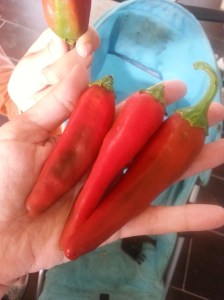
This season we were blessed with a large quantity of hot peppers (all from only four thriving plants), so I’ve been busy making hot sauce inspired by the Yemenite hot pepper spread/dip called Zhug. I don’t really have a recipe; just throw a bunch of de-seeded hot peppers, a head of peeled garlic cloves, a bell pepper, some tomatoes, a generous splash of olive oil and salt to taste into a food processor and whip it all up. It makes a fabulous sauce\paste to add to stews, meat and fish dishes, soups, etc.

Unfortunately, it has been a while since I used fresh hot peppers, so I was careless and didn’t use protective gloves. The deception was in the delay: I didn’t feel any burning in my fingers until I was done cutting up the peppers. Then it hit with a vengeance.

Even more unfortunately, my kids, who like to get into anything that goes on in the kitchen, grabbed some peppers too – and touched their faces without even washing their hands. Ouch. It was a disaster – for the next hour, I was dealing with crying, hurting kids. My eldest sincerely advised me to throw the whole bunch of peppers away (“because nobody wants to eat something like this!”).

I’ve tried some of these remedies for stopping hot pepper burn, but nothing really helped us. The kids felt better pretty quickly. I had to endure several very unpleasant hours of burning sensation in my fingers, hands and any part that was exposed to the capsaicin in the hot peppers.

20160913_165128

Hot peppers: beautiful but deadly (well, almost)

Lesson learned: next time I work with hot peppers, I’m going to wear gloves and warn my children to stay away.

By the way, I wanted to let you know that The Practical Homemaker’s Companion is now available in a new, extended edition of 90 pages, with added content and photos – for the same price. Those of you who have already bought a copy and are sorry to miss the new edition, don’t worry – simply email me using the contact form, and I’ll send you the updated version. Also available in print. Disclaimer: as the printed version is in black and white, I can’t vouch for its photograph quality. Opting for color print would have made the book too  expensive, so I compromised in favor of price.

Incubators or broodies? Pros and cons of each choice for hatching chicks

If you are a backyard chicken owner, it is likely that at some point you will want to add new birds to your flock. You have, then, two main options: either you buy chickens or breed your own. The latter is more labor intensive, but also more self-sustainable and, I believe, very rewarding.

chicks3

If you want to hatch some of your own chicks, you may do so by using an incubator or placing eggs under a broody. But which is preferable? Well, in my opinion, both options have their pros and cons.

Read my latest Mother Earth News post to find out what works for us.

“It was in the second year of our chicken-keeping that we felt the desire to increase our flock by means of adding some new chicks. We wanted to observe the entire process, from egg to softly chirping ball of fluff to productive adult egg-layer. We also felt that a truly sustainable flock maintains itself, by addition of a new generation each year, without us having to buy new pullets to replace aging layers.”

Updated: read Part 2 here.

When little ones are sick

This week we’ve been struggling with a bout of flu that got all of the children in turn. As much as it pains me to see a little one sick, I consider this also an opportunity to slow down – which is especially important if I’m not at my best either – rest, unwind and do some quiet, enjoyable things there often isn’t enough time for:

Reading – listening to an interesting new story, or re-visiting an old friend of a book, is a soothing and relaxing activity that is perfectly suited for a day spent mostly in bed or on the couch. Older children can read quietly to themselves.

Crafts – drawing, stitching, beading and working with play-dough all stimulate the mind and creative senses without requiring too much physical exertion. Dress-up or building forts and hideouts with chairs and blankets are also fun.

Board games – pull out old favorites like Monopoly or Scrabble, or try something new. Forbidden Island is currently all the rage here.

Outdoor time – if the weather is nice, I see no reason to necessarily stay indoors. On the contrary, warm sunshine provides a cheering effect and may even help with nasal congestion. I do discourage sick children from “playing hard” – running, riding bikes, climbing trees, etc.

Outdoors we may also pick herbs to make medicinal tea and talk about their various healing properties, as well as of the importance of staying hydrated in general.

Fresh herbs from the garden make great tea for colds and flu

Movies – I like to restrict screen time, and especially so for sick children, because I find that prolonged staring into a screen is fatiguing, but a short cartoon or an educational video can be nice.

On days when the children don’t feel well, I usually dispense with school, but the girls may still choose to do some fun educational activities such as writing in their story notebooks.

The most important thing is to remember that this, too, shall pass. Slow down, allow everybody the time to rest and heal, and try not to mind the mess too much. There is always tomorrow for catching up with housework, gardening and lessons.

Homeschool science fun

20160907_113818

This neat little experiment comes from Science Bob.

You will need:

A glass or plastic bottle with a relatively narrow neck.

1 tbsp. of dry yeast

1 tbsp. of sugar

A funnel

A balloon

Blow up the balloon and then release the air from it to stretch a bit. Then, using the funnel, pour the dry yeast and sugar into the bottle and shake it all up with some warm water. Put the balloon over the neck of the bottle, making sure it’s firmly in place.

After a few minutes, the yeast will begin making foam and the balloon will start to blow up because of carbon dioxide emission. The foam may actually overrun the top of the bottle and escape into the balloon – that’s OK.

A couple of hours later, the yeast activity will fizz out, but the balloon will retain its size.

It’s a very easy, fun experiment which prompts interesting discussion with kids about micro-organisms, metabolic processes and properties of gas.

Jewish homesteading: an interview

A while ago I was contacted by Tachlis magazine, who were looking for information on the Jewish homesteading movement. My email interview with them is below:

Where do you live exactly?

I’m sorry, but as our privacy is important to us, I cannot state our exact location. I can only say we live somewhere in the Shomron.

What is your homestead like?

I wouldn’t call what we currently have a homestead, precisely; I look at it, figuratively, as the seed of what I would like to have. Right now we have a small flock of chickens, a small garden and a few young fruit trees. I would like to have a large, productive garden and orchard, more chickens, and ideally some sort of a dairy animal. This way, we would provide a significant part of our own food.

In the meantime, we are doing what we can with what we have, and learning relevant useful skills in gardening, improving soil and raising animals. We used to keep dairy goats so I know how to hand-milk and make cheese, and can easily go back to it again.

Is there a community where you live? Is there a minyan?

Yes and yes. We have some wonderful neighbors around here.

How did you decide to homestead?

I don’t think it was a one-time conscious decision. We did know, even when we first married, that we wanted to live on a piece of land, not in an apartment building. We are just taking baby steps in a certain direction, and anything we have accomplished so far has been largely thanks to my husband: sometimes you just need to jump in with both feet, and he can do it much better than I. He was the one who brought home a box with our first chicks, and he was the one who decided on buying goats. He has also accomplished various complicated projects around the household I couldn’t have done myself.

What do you feel your family is gaining from homesteading?

Even though I wouldn’t refer to us a homesteaders just yet, we are learning a whole lot from growing plants, raising animals and working on a plot of land. Our children know the thrill of a newly hatched chick and a newly sprouted seedling. They know how an incubator works and where is the best spot to plant tomatoes. They know all sorts of things I wish I had learned as a child.

Israel+chickens3

Above: Israel, 19 months old, loves to feed the chickens.

I think one of the best things in growing your own food is that the experience does something to every member of the family, regardless of age. You can all share the excitement of newborn baby goats – nobody is too young or too old for that. And when you go foraging for wild-growing goods, you are all equally satisfied when you come home with full containers.

Our lifestyle has brought us together with many wonderful like-minded people, which has been a terrific experience and an education in itself.

And, of course, those who “graduate” to growing and raising a significant part of their own food will reap the benefits of a healthier diet and reduced expenses.

Does homesteading help you connect to the Torah in a deeper or more personal way?

Yes, certainly. Jewish life and working on the land are closely intertwined. Many of the mitzvot specifically refer to agriculture: ma’asrot (tithes), Shmita (the Sabbatical year) and the holy status of the firstborn male, to name a few, and of course anything that has to do with humane treatment of animals. When you grow plants and raise animals, even on a small scale, you get to experience this first-hand, not just learn it in theory. Then there’s everything Shabbat-related, such as the restrictions of tending to the garden (you must do everything before Shabbat) and milking (you can milk so the animals don’t suffer, but not collect the milk). Also, as we’re into poultry especially, we have learned there’s some doubt about the kosher status of certain heirloom chicken breeds (in particular ones with an extra toe). We have found out so many things we would otherwise have had no clue about!

You can read more about homesteading and small-scale farming in Israel in this post.

Supermarket seeds: grow fresh food from store-bought produce

Not long ago, my husband brought home a packet of coriander (cilantro) seeds from the store. They are great in soups, stews and many other dishes. Then, by a stroke of inspiration, he said, “hey, why don’t we try to make them grow?”

I wasn’t sure the seeds were viable, but we had nothing to lose, right? I tried to plant a few and, while only about 30% germinated, it was alright by me as we had so many and bought them so cheaply. A tiny packet of planting seeds would have cost us a lot more (yes, even taking into account the low germination rate).

Below, you can see one of the new coriander plants grown from these seeds. The other plants in the photos – cherry tomatoes, peppers, melons and beans – were likewise grown from supermarket produce.

All these wonderful plants were grown from scraps most people toss into the garbage without a second thought. 

There’s no doubt it’s always better to purchase high-quality seeds from a reputable company. This way you know exactly what you’re getting and the germination rate, with proper handling, is high. Supermarket vegetables are often hybrids, so saving and planting seeds from them can have unpredictable results. But I still think supermarket-produce seeds deserve a chance. They are very cheap, readily available, and most likely you already have some on hand. There’s certainly no loss (except for a little work and some garden space) in trying, and it can be a fun experiment.

I haven’t actually collected a harvest from these supermarket-originated plants yet, but when I do, I plan to write a follow-up post and tell you whether the produce was any good and how much it resembled the mother plant.

Health and homesteading

Check out my latest Mother Earth News post: what happens when physical limitations stand in one’s way to self-reliant life.

“Even in our modernized age when almost everything is done at the click of a keyboard, being able-bodied is still an essential part of building your own house, starting a homestead, and keeping it going. But what do you do if certain health problems interfere with your homesteading goals? Should you accept that some things just aren’t meant to be – like building with your own hands, for example?

It is my belief that there is an alternative way to do pretty much anything, and even to profit from the seemingly untoward circumstances that might seem as a death certificate to your dream.”

IMG_20141127_195847

Illustration: mid-renovations mess in our living room, just before our son Israel was born.