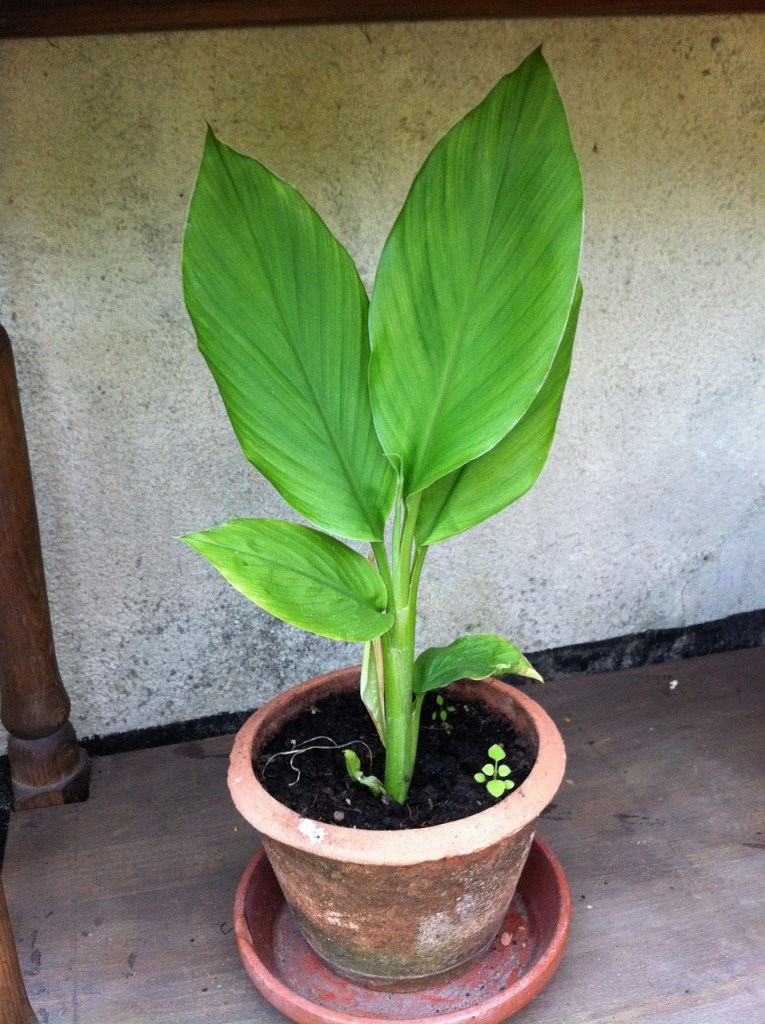
Yesterday, I began harvesting some of the turmeric I had planted last year from rhizomes a friend had given me. I was thrilled to discover lovely, plump, fresh new rhizomes!
Rhizome is actually a thickened underground stem that the plant uses to store nutrients and propagate. To grow turmeric from rhizomes, look for “growth eyes” – little bumps/nodules on the surface of the rhizome. Each piece that includes an “eye” can grow into a whole new plant.
I had grown my turmeric in pots because of space constraints and also to protect the plants from chickens scratching around. Choose plump, firm rhizomes for planting.
Since it never freezes here, I planted when it was still winter. If you live in a colder climate, wait until after the last frost or start your plants indoors. Turmeric likes moist but well-draining soil and plenty of sun.
(Image from Pixabay, since I didn’t take a picture of my turmeric plants while they were fresh).
Turmeric needs a long growing season of 8-10 months. You must wait until the leaves turn yellow and begin to wither – that’s a sign of mature rhizomes. Save some of those for replanting and use the rest in cooking.
Peel and grate or thinly slice the fresh turmeric and add it to soups, stews, stir-fries, or any dish that calls for powdered turmeric. It will be less concentrated than turmeric powder, but I find that it adds a unique flavor.
If you have a bumper crop, you can freeze some sliced/grated turmeric for later use, or even dry and grind it into powder.
Lately, I’ve been following Hillel Fuld, who says “all Jews belong in Israel. Every single one,” and urges every American Jew to make aliyah, like, yesterday.
He says,
“You don’t need to speak Hebrew fluently to live in Israel. Fact.“
Correct. I belong to a generation of repatriants from the former Soviet Union, many of whom never have and never will speak fluent Hebrew.
I admire the people who made a life for themselves here despite the language barrier, but I will never, ever dismiss the challenge of moving from a country where you’re a fluent speaker to a country where you have to struggle to make yourself understood. It’s a loss so profound you won’t really understand it until you’ve lived it.
“You don’t need to lower your quality of life in Israel. Fact.”
Actually, no, not fact. If you lived in a single-family home on a half-acre lot overseas, but can only afford an apartment in Israel (like the vast majority of people here), I’d say that’s a lower quality of life.
Is the sacrifice worth it to be able to live in Israel? For many people, yes. But please don’t pretend the sacrifice doesn’t exist.
“You don’t need to cut your salary in half. Fact.”
Again, not fact, and saying this is simply disingenuous. How much you can earn in Israel depends on your profession, connections, and a whole lot of luck. If, for example, you’ve built a local business in the U.S. and your livelihood depends on serving a certain clientele, you’ll likely have to start from scratch in Israel.
The vast majority of professionally successful people I know who have come here as adults have done some sort of retraining (besides learning Hebrew). Many highly educated people have had to pick up jobs like cleaning or landscaping, often for years, until they can find their footing again.
Moving to Israel, even if you’re Jewish and coming home to your people, is becoming an immigrant. And being an immigrant is never easy.
Apart from all that, in the hypothetical scenario that all the Jews in the world rush to Israel tomorrow, we’ll be facing serious logistical difficulties.
Of course, Israel has a fantastic track record of accommodating large waves of aliyah. In 1990, before the massive influx of Jews from the USSR, Israel’s population was only about 4 million. The new ex-Soviet Israelis inflated the population by 1 million in a very short time – that’s an insane effort when you consider every new arrival needed housing, infrastructure, and integration.
I’d say Israel has done a great job here, but we’re a tiny speck of land with an abnormally high birthrate for a developed country. We’re practically bursting at the seams already. It makes me feel claustrophobic when I see more and more fields, orchards, open spaces make way for roads, buildings, endless concrete.
“But there’s plenty of space in the Galilee and Negev!”
Yes, thankfully, some areas in Israel are less crowded… and we NEED them to remain this way. Those lovely fields and hills aren’t just “wasted spaces” waiting to fill up with more apartment blocks. Our souls need access to nature, and it’s our duty to preserve the biodiversity of this land, which is our legacy.
“Israel should follow Singapore’s example: maximum efficiency, as many people in as little space as possible.”
Would you like to live in Singapore? Maybe some would. I wouldn’t. Just looking at videos from there feels suffocating.
Maybe a few already-crowded neighborhoods could improve if you take Singapore as a model, but this wouldn’t work for historically and culturally significant places like Jerusalem, Tiberias, Tzefat.
Can I offer solutions? For starters, I think Israel needs to address the elephant in the room: land piracy.
No, I’m not talking about settlements. I’m talking about the Arabs, Bedouins, and yes, even the Druze, who build nonstop and then apply for retroactive permits. In 2023, Israel ceded a portion of a nature reserve near Haifa in favor of the Druze town of Daliyat al-Carmel – part of this move to legalize already existing, illegally constructed homes.
It’s a humiliating move that shows how little authority the country actually has over land, even within the borders of what is internationally recognized as sovereign Israel.
I had meant to pop in for a Hanukkah/end-of-year post all last week, but am only getting around to it now, a day after we’ve lit our last candles for this year.
Hanukkah had started with the massacre of Bondi Beach, an act of unspeakable evil that had re-traumatized our already collectively traumatized nation and reminded us that, sadly, Jews aren’t safe in any corner of the globe right now.
Several people have contacted me on social media asking whether I can explain the extent and power of antisemitism. This is a question many people, cleverer and more educated than I, have grappled with; and while it’s a big topic, here’s something I can say right away: antisemitism is NOT a “response” to whatever the Israeli government is or isn’t doing. This wouldn’t explain all the pogroms, blood libels, expulsions, forced conversions, seizures of property, and countless hostile decrees Jews had experienced throughout history while stateless and scattered.
There’s a spiritual dimension to this: “Esau hates Jacob.” But the way I see it, antisemitism is not a unique phenomenon. Many ethnoreligious groups had suffered persecution.
The Sámi, indigenous people of Northern Europe, had lived through language bans, mandatory boarding schools, land theft, and forced assimilation. The Samaritans, once numbering over a million, have shrunk to a group of just around 140 at the beginning of the 20th century (their numbers have grown thanks to the protection Israel gives them). The Roma people lost about 25% of their population to the Nazi genocide, after centuries of being distrusted, marginalized, and accused of sinister practices like black magic.
So why is antisemitism so widely known and discussed? First, because the Jews are so scattered around the world that antisemitism isn’t confined to one region. It’s a global phenomenon.
Second, antisemitism is pervasive because Jews had stubbornly refused to share the fate of the Etruscans, the Minoans, the Jie people of China, many indigenous American tribes, the Manicheans, and numerous other ethnic/religious groups that had vanished from the pages of history. Preservation of the group is such a core principle in Judaism that it overrides almost any other consideration, like individual safety, comfort, or acceptance.
Third, and this is perhaps most important, Jews were hated for their success, which they had achieved despite almost universal persecution and restrictions.
In a largely illiterate world, Jews had emphasized education. Jewish folklore glorified not the knight riding out against the dragon, but the young boy displaying incredible persistence in mastering a difficult Talmudic portion. Jews were forced to move from country to country, becoming multilingual, culturally flexible, inventive, and adaptable. Resilience, resourcefulness, and creativity became an inseparable part of being Jewish.
Furthermore, with restrictions on land ownership, many Jews who would perhaps otherwise become farmers had turned to pursuits like banking and trade. Of course, it was a no-win situation that created the stereotype of the heartless and tight-fisted Jewish lender.
In the Soviet era, every Jewish mama had drilled into her children’s heads that they MUST work ten times as hard as everyone else to get past the infamous “Jewish quotas” in good universities. This kind of work ethic still persists.
When you’re already marginalized, success breeds envy, much like a school bully might hate a talented dorky classmate. So here we are, following thousands of years of oppression, still going strong – and not going anywhere.
I’ve long since accepted that I belong to a family of pack rats who LOVE to accumulate stuff and find it extremely difficult to part with anything, from old T-shirts to frayed sheets or multiple dog-eared copies of the same book.
There are many days when I’m tempted to just pick up a large garbage bag and start chucking stuff into it. I fantasize about how much easier the house would be to clean and maintain in order if it contained 80% fewer things.
Unfortunately, trying something like this around here would start a full-blown war, so I’ve come up with a compromise that preserves my sanity while avoiding conflict: find one item, every day, that you can get rid of without regrets.
It can be anything: an empty perfume bottle, an ancient set of dried-out acrylic paints, a pair of shoes that pinch just a little (and that, if you’re honest with yourself, you know you’ll never wear). This strategy amounts to hundreds of unnecessary items a year, out of your house and of your life. And often, you’ll spot more than one thing you can toss.
On another note, today marks the release of my 20th fiction novel: Lethal Water, book 2 in the Storm of Elements steampunk-y fantasy series. A decade has passed since I self-published my first novel, after snatching away an hour here and there on the family’s clunky desktop while my kids were asleep. Here’s to many more exciting stories to come!
I just finished Bullshit Jobs: A Theory by David Graeber, a highly thought-provoking read. It discusses how “We have become a civilization based on work—not even “productive work” but work as an end and meaning in itself.”
In simple words, the author claims that a big chunk of jobs today is unnecessary, pointless, or at least extremely inefficient.
I’ll be the first to admit there’s a lot of truth in this. But you know what? That’s pretty privileged thinking. Many, perhaps most people I know wouldn’t mind working some silly job as long as it pays well, is fairly non-stressful, and leaves them a reasonable amount of free time.
I’ve worked on quite a few bullshit projects myself. One was writing copy for a major U.S. solar panel installer. This company decided it needed hyper-focused local SEO, with separate service pages not just for each state, but for every major town or city in each state. This translated to hundreds of pages that all followed the same template, except for a location-specific paragraph that usually included a couple of phrases on the city’s climate and topography.
Each page had to be different to avoid duplicate content on the top-level domain, so I had to reword what was essentially the same content in hundreds of variations. There are only so many times you can do this without feeling like you’re stuck in some Groundhog Day remake.
I highly doubt all that micro-localization was necessary. For most people, state-specific information is quite enough to decide whether installing a solar panel is a good idea.
And guess what? I was supremely grateful for that job. It was steady, predictable, fairly easy, and it paid decently. Those hours I spent writing about installing solar panels in Boulder, CO, or Flagstaff, AZ, translated into groceries for my family, paid utility bills, and clothes and shoes for the kids.
If someone offered me a well-paid, secure, flexible job that consisted of copying license plate numbers into Excel sheets or something like that, I’d take it in a heartbeat. For most people, a paid job is a means to an end: feeding their families. A meaningful job is a bonus.
Yes, I do agree that “Young people in Europe and North America in particular, but increasingly throughout the world, are being psychologically prepared for useless jobs, trained in how to pretend to work, and then by various means shepherded into jobs that almost nobody really believes serve any meaningful purpose.” But what’s the solution?
David Graeber doesn’t elaborate on what the alternative to BS jobs would be. He does suggest Universal Basic Income (UBI) as a possibility. For someone like me, it would admittedly be amazing. I’d never lift a finger for any sort of paid work again. I’d continue writing, of course, but would probably pivot into less commercial-minded projects.
However, while UBI sounds good in theory, it comes with a plethora of problems, not the least of which is that it would be 100% government-issued and -controlled. Thus, almost the whole population would be entirely dependent on the government’s goodwill. If those up above decided to withhold UBI for some transgression (like, say, exceeding the allowed travel limits during a pandemic), who’d stop them?
I was curious about what the author thinks of AI. When I looked it up, I was sad to discover David Graeber had passed away in 2020.
As we near Simchat Torah, the Hebrew anniversary of the October 7th massacre approaches. I usually try to anchor myself in positive things – like kitchen hacks, chickens, and yarn – but right now, I can think of little other than the day two years ago, when our world got turned upside down.
I remember it perfectly. I was sitting and schmoozing with some other moms at the playground. It was Saturday, Simchat Torah, and as Shabbat observers, we were blissfully unaware that anything was going on.
Then a panicked-looking lady ran past us, swinging her phone, and snapped at us, “What are you doing sitting here? (Would it help if we started running?) Don’t you know there had been an attack?” (How would we know?)
I would be away from my phone until the evening of that day, but as we walked home, I caught snatches of buzzing conversations: “army taken by surprise… 300 people killed… how is this possible?”
Hours later, the full extent of the horrifying pogrom became known to us. A horde of bloodthirsty barbarians had invaded from Gaza and proceeded to slaughter around 1,200 innocent people (we’d learn this number later, as bodies were gradually uncovered and identified). As if we didn’t have borders, intelligence units, and a tech-whiz army. As if we were back in the shtetl, at the mercy of invading Cossacks.
The IDF rallied within a few hours, but any illusion of personal safety had been snatched away. We were afraid to leave the house. My children were speculating on whether a terrorist would think to search the attic if we lived through a similar invasion in our town.
I would get up in the middle of the night to check the door and windows. I’d experience a moment of relief once I ensured that everything was locked, only to figure that a hand grenade would probably enable a terrorist to break in.
This was nothing new, of course. We were, and are, part of a nation that had long carried generational trauma of countless expulsions, pogroms, persecutions, and, of course, the Holocaust. But October 7th drew a clear line in the sand: life before, life after. Things would never be the same.
In the months following the massacre, my mental health suffered. I continued working and carrying on my daily routine, but it was mostly on autopilot. I would forget simple stuff. I’d open the refrigerator and struggle to remember why. Things I enjoyed seemed to lose their flavor. I’d want to have my children within my sight, always, which of course wasn’t possible.
The recommendation of mental health services seemed disingenuous. No amount of counseling could obliterate a REAL danger. I began feverishly exploring different possibilities of getting our family out – to some remote corner in the world where we could hide and be safe. Until the rising tide of worldwide antisemitism convinced me that there probably is no such a corner anywhere anymore.
Today, two years after the massacre, and with the elimination of Mohammed Deif, Ismail Haniyeh, Yahya Sinwar, Hassan Nasrallah, and the Iranian nuclear facilities, I have achieved some measure of balance. Life will still never be the same, but I strive to be a worthy link in the chain of Jewish resilience through the ages.
May we get to celebrate a joyful Simchat Torah despite the black cloud of trauma that has now settled over this holiday for all of future Jewish history.
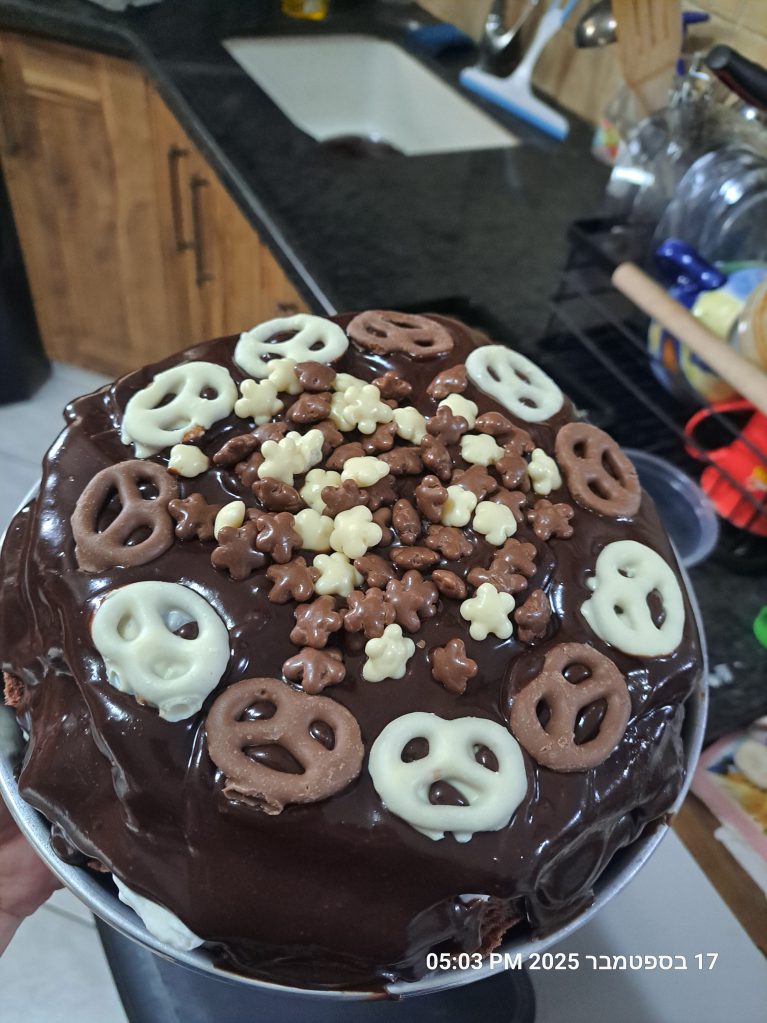
With Rosh HaShana coming up next week, I thought this was the perfect time to make and freeze Tehilla’s birthday cake. However, after popping into three local supermarkets, I discovered, to my dismay, that there’s a shortage of heavy whipping cream, which I needed to make the filling and ganache.
I had several alternative options: commercial plant-based alternatives (yuck!), coconut cream (I prefer it in fruity desserts, not chocolate-based cakes), or, which I was skeptical about at first, sour cream.
Whipped sour cream filling is a Soviet classic that goes great with chocolate cakes. But can you whip sour cream? Yes, if it’s fatty enough. I used sour cream with 27% fat. You can also strain sour cream to make it fattier – just place it in a cheesecloth-lined sieve above a bowl and let it drip for a while.
Whipped sour cream doesn’t turn out as lusciously fluffy as whipping cream, but the results are still delicious. The cream is a bit tangy, so you may potentially need to use more sugar. Powdered sugar is a must here, as granulated sugar won’t dissolve properly. I make my own powdered sugar by running granulated sugar through an electric spice grinder.
Whip well-chilled sour cream until it forms peaks. Gradually add the powdered sugar. Optional: add a tablespoon of instant vanilla pudding mix for more stable cream.
Sour cream also make smooth, silky ganache. Heat chocolate and sour cream at a 1:1 ratio over a very low flame on the stove. Mix constantly until the chocolate has melted. Chill until it’s the right consistency for frosting. Enjoy!








 Domestic Felicity