How do you justify the cost of raising chickens?

While hanging out on Facebook, I came across this comment:
In my humble opinion, asking “Why should you keep chickens when you can just buy eggs in the supermarket?” is like asking “Why bother knitting a garment from hand-dyed merino yarn when you can just buy a cheap acrylic sweater on SHEIN?” or “Why buy a mug at an artisan fair when you can get a whole set of mass-produced crockery for the same price?”

It’s all about priorities. And perspective.

Sure, if you’re just calculating how many eggs you get per dollar, Walmart makes the most sense. But as any backyard chicken keeper will tell you, raising your own flock is so much more.
It’s the satisfaction of pulling a warm, fresh egg from the nesting box, then cracking it into a pan and seeing the firm, perfectly formed golden yolk.

It’s seeing your kids turn up their noses at an omelet from store-bought eggs because they can tell the difference.

It’s walking past empty egg shelves in the supermarket when supply chains get disrupted for some reason, and not being bothered because you have far superior eggs at home.

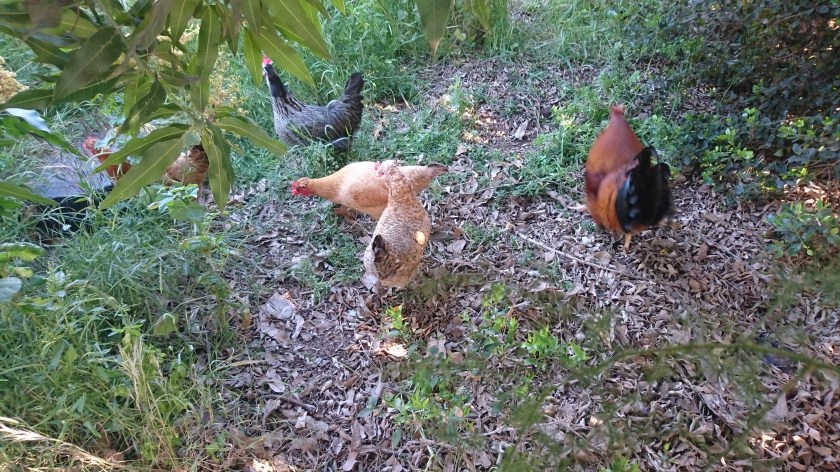
It’s the diversity of the eggs you gather, each one in a different shape, color, and size; and our favorite guessing game, “Who laid this?”

It’s the quiet joy of an afternoon cup of tea while you hang out with your clucking friends. Their antics never fail to entertain!

It’s never having to throw out leftovers again, because chickens eat practically everything.

It’s letting your birds loose and seeing cockroaches, crickets, centipedes, and other creepy-crawlies get demolished.
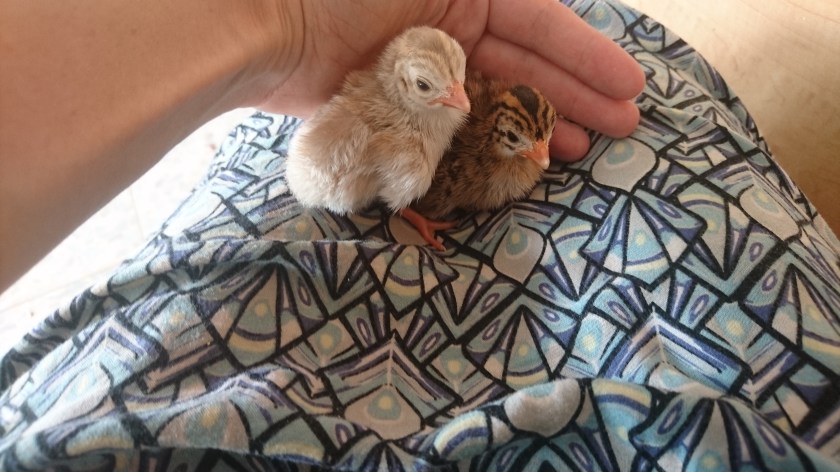
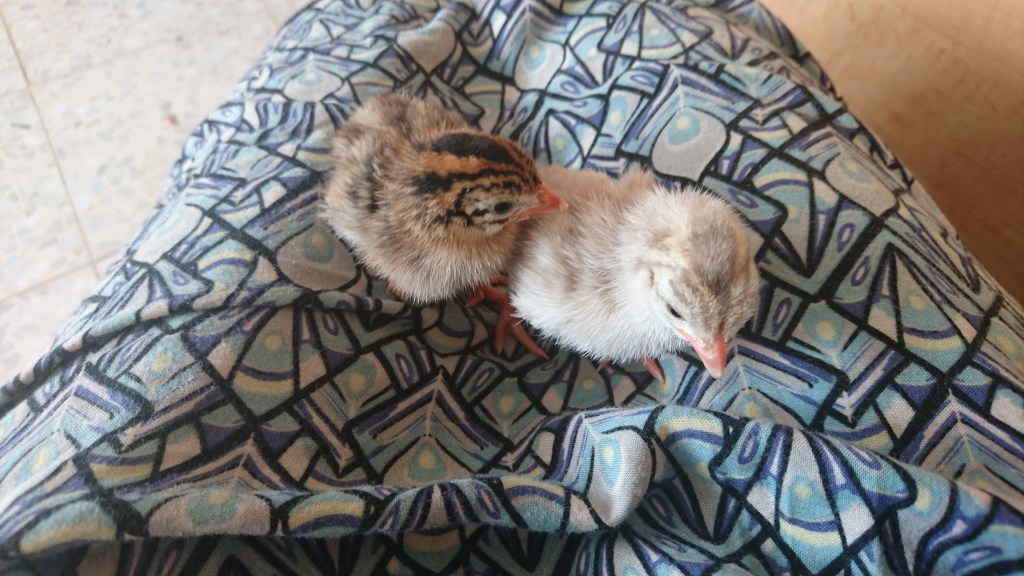
It’s the miracle of watching a tiny chick hatch in an incubator or peek from under its mama’s wing. (The little guys in the photo above are actually guinea keets, but they’re too cute to leave out!)
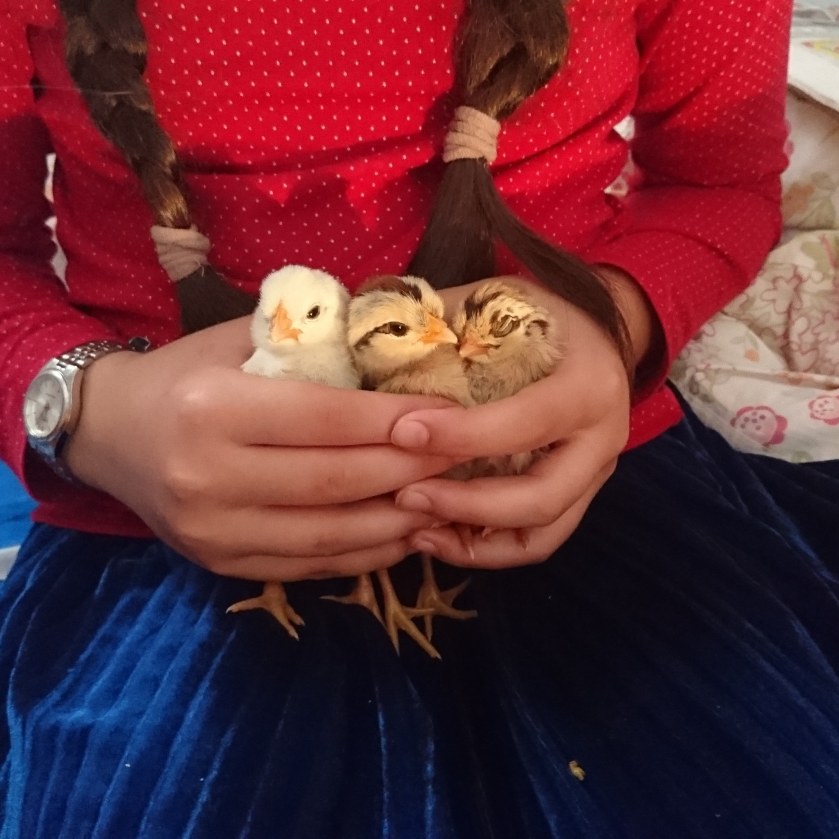
It’s becoming an informal learning hub for the neighbors’ kids, who get to watch a food chain they had previously thought very little about.

It’s a different kind of life. And when you love it, you stop counting eggs per dollar, and just live it and enjoy.

Another round with Coturnix quail

Years ago, we tried raising Japanese (Coturnix) quail. While these are delightful and easy-to-keep birds, our first experiment didn’t go that well, for two reasons: one, I think we subconsciously expected quail to act like mini-chickens (which they aren’t), and two, we underestimated our local predators.

We kept our quail in a bottomless cage placed directly on the ground, mistakenly thinking that its weight will deter anything that wants to snack on these feathery little nuggets. Big mistake. One morning, we walked out to discover that something had dug under the cage and carried off most of the quail.

The remaining birds escaped when transitioning between cages; we were totally clueless as to how well they can actually fly, and once they escape, you’ll likely never see them again. Letting them free-range is NOT an option.

Fast forward to now, when the kids began asking for some quails again. So we decided to give it another go and brought in this trio. The hens are supposed to start laying soon, and we may even try hatching some eggs in time.

Japanese quail are a great option if you’d like some home-grown eggs but live in an area that doesn’t allow chickens, or if you aren’t sure whether raising poultry is really your thing. They’re quiet (the males call, but it’s nothing compared to roosters), robust, and don’t take up a lot of space. You’ll need about 1 square foot per bird.

Japanese quail can pop out up to 300 tiny, delicious eggs per year. 3-4 eggs are roughly equal to one chicken egg in volume. Hens start laying as early as 8 weeks (!). Whenever I get to updating The Basic Guide to Backyard Livestock, I’ll be sure to include our experience with quail.

***

On another note, I’m excited to share that my dystopian trilogy, Wild Children, is now re-released with updated covers! The books follow a group of youngsters surviving and making a life for themselves in the wilderness. Among other things, they discover how essential animals are to food security.

Why do chickens eat Styrofoam?

In a nutshell: I have no idea.

OK, here’s the long version. I’ve raised many chickens over about a dozen years now, and not one of them could resist a bit of Styrofoam packaging or a stray construction panel with Styrofoam insulation.

Chickens will go for Styrofoam even when they have fresh pasture

My chickens consume a diverse diet of layer feed, kitchen leftovers, and pasture. They choose Styrofoam over their feed, vegetable peels, fresh grass, and any food you can imagine. No, they won’t only eat Styrofoam, given the choice, but they’ll eat it before anything else.

It seems this isn’t an anomaly. Chicken owners all over the world report the same thing: their hens and roosters can’t resist Styrofoam. If I ever publish an updated edition of The Basic Guide to Backyard Livestock, I’ll be sure to include this phenomenon.

What do chickens find so appealing about Styrofoam? Its texture, I suppose. It’s easy to peck at, and when it scatters, it looks like crumbs. But surely when they taste it they should be disappointed?

Compared to humans, chickens have very few taste buds, so they don’t respond to taste the same way we do. However, they generally have an innate ability to choose nutritious foods. Styrofoam doesn’t quite fit the profile, though.

Will Styrofoam harm your chickens? I can only speak from experience. For years, I have tried to discourage my birds from eating Styrofoam. I offered distracting treats and shooed them away. I herded them out to patches of succulent fresh grass teeming with bugs. To no avail. If Styrofoam is available, they’ll come back to nibble on it. So far, my flock hasn’t sustained any visible damage.

Naturally, eating Styrofoam can’t be good for chickens. Theoretically, Styrofoam could impact a bird’s crop and cause suffocation. The only practical way to deal with this problem is to avoid leaving any Styrofoam lying around.

Do your chickens go crazy over Styrofoam too? Tell me in the comments.

It’s hatching season again

New arrivals

A little belatedly, hatching season opens here again – and this time, with guinea fowl eggs. I have received some as a gift, and apparently a couple were already in the incubation process, because they surprise hatched after only a week.

So far, we lhave these two adorable keets. One looks like the standard coloring and the paler one could be lavender.

This little one had huge trouble getting out of the egg. I ended up performing an assisted hatch and peeling nearly all the shell. I was really apprehensive, but after a couple of hours it was already running around the brooder! So don’t give up on those chicks who are struggling to get out. They may be perfectly fine and just require a bit of assistance to start out in life.

Best friends

By the way, did you know guinea fowl are kosher? I have only discovered this recently. We don’t eat our birds, but I’d love to try some guinea eggs.

Finally, a predator-proof coop!

Last week, we had a sad incident, in which a fox got two of our chickens. I admit I have grown a little careless, as I wasn’t aware there were any foxes in the area.

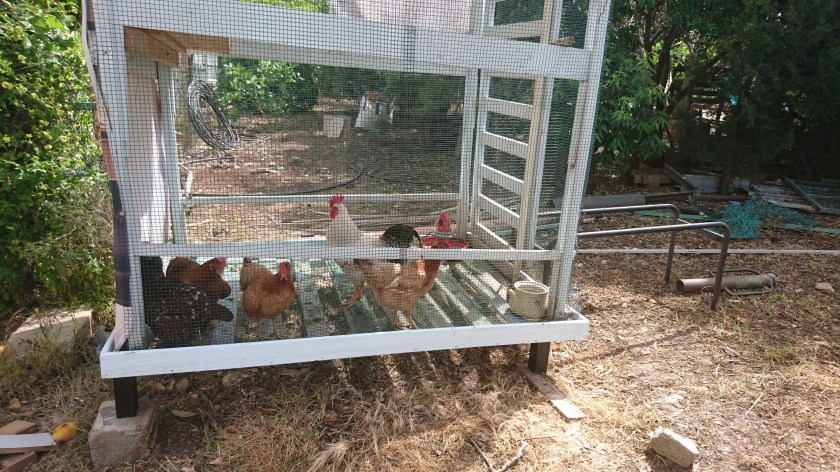
From my previous experience with foxes, I knew they never give up until they’ve eaten all the chickens in a coop OR until they realize it’s impossible. I knew my old coop wasn’t fox-proof. And I knew I didn’t want to race outside with a hammering heart every time a hen started clucking.

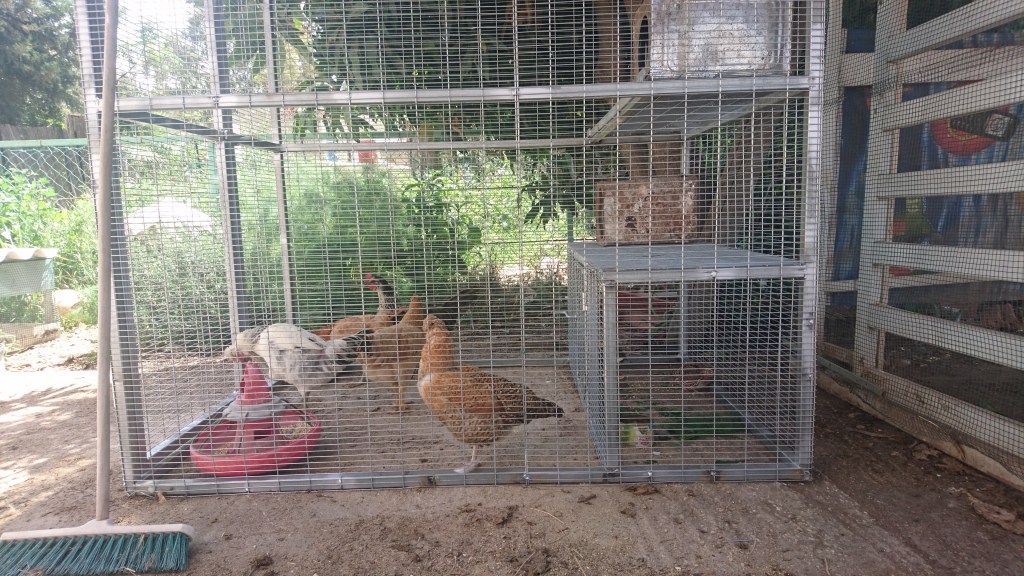
So for a week, I overnighted my chickens in boxes inside the house, and meanwhile, I commissioned a secure and convenient stainless steel coop.

New home for the hens!

Although it isn’t as pretty as some of the rustic style coops I’ve admired on Pinterest, it’s by far the best coop I’ve ever had. I can’t believe how much I paid to have it made, but I’m happy 😊

A housewarming party 🎉

It has two handy shelves for nesting boxes, and a lower section for our quail that can also work as a secure space for a broody hen (of course I would put the quail elsewhere).

Now I’m just waiting for this fox to come again so I can laugh at it 😁

Naughty roosters

Sadly, a couple of days ago we had to re-home one of our two roosters, because the duo was simply making too much noise for our long-suffering neighbors. As hard as it was for us to part with one of our guys, it’s better than having to give up chicken-keeping entirely.

We have an excess of roosters every year, and it’s never possible to keep them all – and always hard to say goodbye.

This coincides with what I wrote recently in my latest Mother Earth News post:

“It’s hard to be totally pragmatic and just weed out as many birds as possible when you have raised them from an egg. Plus, cockerels are fun and often so handsome it’s hard to part with them. It can be tempting to keep a “backup” rooster or two in case something happens to your alpha roo. 

The problem around here – and in many other backyard flocks – is that we always end up with too many roosters. We hatch chicks every year, and around half are male. This year we had about 60% male chicks.”

The good things in life

DSC_0796

This has been a busy summer, but thankfully, not too busy to appreciate the good things in life. Above: a little moth we were lucky enough to be able to watch transform from a chrysalis before releasing it.

DSC_0798

Our mango tree surprised us with pretty big fruit this year. The previous winter had been rainy, so I guess it needed more water.

DSC_0801

Two pullets of this spring’s hatch. All in all, we have 5 young pullets and 8 cockerels (the latter will not be remaining with us – one roo is quite enough!)

IMG_20200820_132406_776

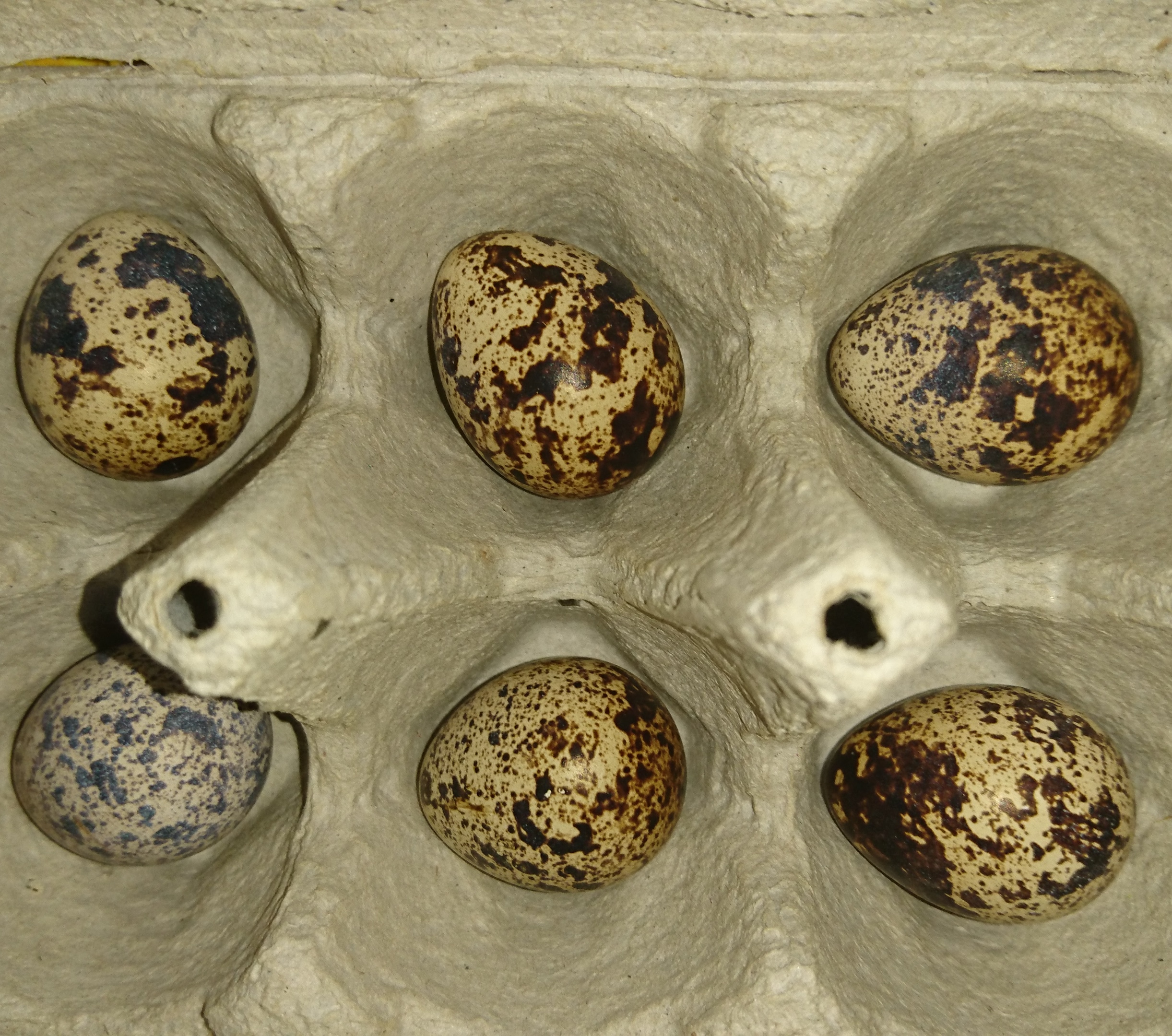
Quail eggs – as pretty as they are delicious.

Hope everyone is having a good August! I love the sunshine, but could do with less heat.