Hatching chicks the natural way

polishbroody

In the past two seasons, we have hatched new chicks exclusively by using broody hens – and, with a few drawbacks, find this age-old, natural way of expanding one’s backyard flock easy and satisfying. Though incubators can be convenient for hatching large numbers of chicks at once, exactly in one’s chosen time (which is kind of hard to do with broody hens), our irregular power supply and frequent outages make the choice pretty obvious. Though we might venture to buy or build a small, well-isolated incubator sometime in the near future, I expect we’re still going to rely almost exclusively on broodies.

Read more in my latest Mother Earth News post:

“We used to let hens accumulate a clutch of eggs in the hopes they would begin sitting, but it only resulted in a lot of mess and many spoiled or broken eggs. Now we collect every egg as soon as it is laid and, to encourage broodiness, provide a clutch of plastic dummy eggs (can be bought cheaply at a toy store or on e-bay). Note: we’ve had some hens begin sitting even without a clutch. Once the broody instinct kicks in, they’ll just do their thing.”

Let them live

DSC_0236

We have had rescue Leghorns several times; though they are a commercially raised breed, they adapt very well to free range life, and soon become much happier. Once they make themselves at home, they usually become the more dominant birds of the flock and occupy a high place in the pecking order. Chickens who were almost completely plucked grow feathers, chickens with extra long toenails scratch away and give themselves a natural manicure, and pretty soon they settle into a regular laying routine, though many will not lay every day anymore.

It is of no consequence to us, however; we are happy with whatever we can get. Our chickens eat a low-cost diet of scraps and whatever they can find in the garden, and only get a modest supplemental portion of commercial feed, so our little backyard operation doesn’t have to be super efficient; we have some chickens and some eggs, and that is enough.

Chickens are not generally the cuddliest of pets, but my kids won’t take no for an answer. Above you can see a photo of a rescue hen getting tamed. She looks pretty annoyed, I think, but knows better than to protest.

Watching our chickens happily dig around in the yard is one of my most satisfying everyday experiences. There are drawbacks, of course – free range chickens are notorious for destroying garden beds, and can be plucked off by predators more easily. For us, however, the tradeoff is worth it.

Green cleaning: simple and effective

Image result for green cleaning

I have a wide array of all kinds of cleaning agents, sprays, powders, liquids, etc, under my kitchen sink – but in general, I prefer to leave them there. My favorite cleaning agents are vinegar, baking soda, and citric acid crystals. Combined with hot water and elbow grease, these will get almost everything clean.

It’s especially important to avoid most commercial cleaning products if you have allergies. Quoting from this article:

“Most household cleaning products are harmful to children. According to research done by the University of Minnesota [1], several chemicals found in the home are linked to allergies. They cause birth defects, cancer, and psychological disorders. The Consumer Protection Safety Commission [2] states that since 1970, asthma cases have increased by 59 percent. Children under 15 years of age have suffered from asthma at a higher rate of 41 percent. The data is alarming to healthcare professionals.”

While it may be difficult to find an unequivocal link between this or that cleaning product and allergies/asthma, one thing is certain: cleaning with stuff that you can actually put in your food has to be safer. It’s better for the environment, too. And as a bonus, it will save you a bundle in the long run!

Read more about green cleaning in this post.

Improving your soil

yourownhands2copy

We don’t have ideal soil – to put it mildly. It is heavy and has a high clay content; it’s muddy and slippery in winter, and sticks to rubber boots until we have clogs so heavy we can hardly lift our feet. Once the rainy season is over and it dries up, it becomes rock hard. Oh, and it’s also full of actual rocks, large and small, which makes clearing up space for a garden bed one challenging job. Using raised beds with imported high-quality soil has been great, but would I like to have friendlier soil all over our property? Sure!

Read more in my latest Mother Earth News post:

“Practically any soil – whether it’s sandy, or has a high clay content, or is somewhere in between – can benefit from generous amounts of organic material being worked into it. Back when we used to keep goats, there was a place in our yard with plenty of brush that needed to be cleared and I often tethered the goats there. Apart from the brush it was pretty arid, but next year, beautiful tall lush grass sprung up there as if by magic. It was goat manure, left over winter to rot and decompose, that did the trick.”

Stay-at-home mothers, social pressure and feelings of inferiority

I’ve been meaning to write this post for a while, and I only hope I have enough eloquence to express myself properly.

In the first neighborhood where my husband and I lived as a young couple with children, it was lonely during the day. Most women worked, except those who stayed home with the really tiny babies. Most children were in daycare by 6 months of age. When people heard that Shira, then less than 3 years old, wasn’t going to attend any type of daycare or preschool that year, they were shocked. No, more than shocked – scandalized. Certain that I’m depriving my child of a very important developmental step. “You’ll have to work very, very hard with her at home to be as good as a daycare,” one Mom told me. I didn’t work hard. I just enjoyed life and we did fine.

I felt very much alone. In all the time we lived there, I didn’t meet one person who shared my views about education and family life. Still, I was convicted that what we’re doing is the right choice for our family. This gave me strength, though at times I reverted to what I now call “the no choice tactic” – telling people “I’m staying home to watch over my children because daycare would be too expensive”; “I’m not getting a job because there aren’t any good jobs available locally, and I don’t drive”. Call me weak, but sometimes it was just easier to do that instead of arguing with people.

Then we moved to our next neighborhood, where I instantly felt at home. Most women were homemakers. Most children were home at least until they were three years old. There was a homeschooling family with girls the same age as mine, and we immediately hit it off. We hosted sleepovers. We hung out in the mornings, watching over the kids. Until I was there I didn’t even realize how good it feels to fit in, to be – if not like everyone else – not a freak either.

Seasons passed, and due to a combination of various circumstances we were forced to move again, to the place where we live now. Socially, I now find myself in the same place as in our first neighborhood, with one further disadvantage: my children are now older, which makes my desire for us to stay together and learn as a family stand out even more. Also, I keenly feel the loss of that environment in our old home which was so supportive of our educational choices.

I see the women all around me. They are all such good women, mothers, friends. They all love their children, take care of them and teach them, just the way I do. They all nurture their homes, cook nutritious meals, and bake delicious treats, just the way I do. Only they do it part-time rather than full-time. They also work hard outside the home – as a personal sacrifice rather than a career achievement, I must add. Many of the men here struggle to provide for their families, and so their wives step in and work extra. Several are nurses working night shift, sacrificing their sleep so they can later be with their children during the day. The families all manage on a very tight budget, even with both parents working.

I am, truly, full of respect for these women. Seeing them sometimes makes me feel spoiled, indulged. Not that I sit twiddling my thumbs at home; I have three children and am a freelance writer and editor. I get no help with household chores or child care. I thrift shop and have become a really economical cook. Still, I sometimes wonder what it is about me that makes it nearly impossible to even let a baby out of my sight, let alone go to work for part of each day. Is something wrong with me?

But I guess that what makes me ache most is the feeling of mental isolation. I would so love to develop close, trusting relationships with at least some of my neighbors. I feel that what we have in common – the love for our G-d, our families, our children, our homes – is far bigger than our differences. Unfortunately our neighbors feel differently. I sense people are wary around us. Like it’s not enough to have a lot in common; like you have to be exactly the same to be friends. And I think that’s a real pity.

I guess the key here is that nobody should feel threatened by the different choices others make. I don’t pass judgment on the Mom whose young children are in daycare from 8 to 4, and then in various afternoon classes from 4 to 6 (though I might think this lifestyle is quite hectic). Similarly she shouldn’t pass judgment on me (though she might privately think our lives are boring). We can disagree on some issues, but we can agree on many others. And we can be friends. At least that’s what I believe.
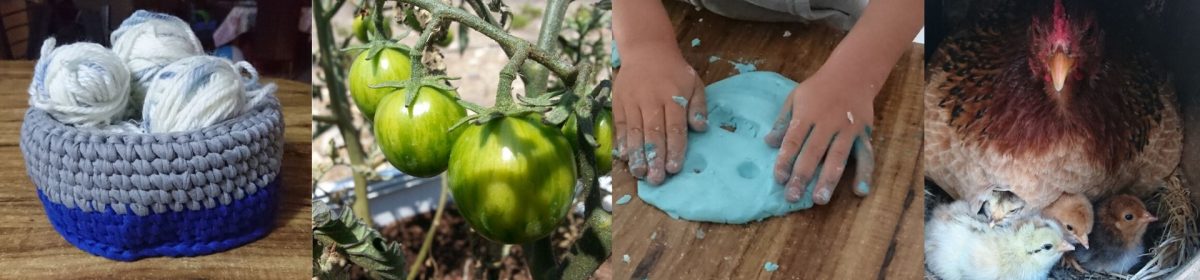

Weeding Made Easy

tomatobed - Copy

Do you have a least favorite garden chore? Mine is probably weeding, but with raised beds, things have been a lot easier for some time now. Read more in my latest Mother Earth News post:

“The best time to pull weeds is after a good rain, when the ground is nice and soft. Once our ground dries, it gets the consistency of hard clay and weeding becomes increasingly difficult. This doesn’t go for the raised beds, of course, which are always kept nice and fluffy. I have taught my kids to always give the beds a quick look-over and pull up every tiny weed they can find – sometimes we even make a contest as to who pulls up most.”

Keeping chickens significantly reduces weed level as well (one of the many benefits of having our feathered friends around!). Also, things do get better with each year that passes one the same plot, if you are diligent and pull up young weeds without letting them go to seed. When I look at our yard today, I actually think to myself, “wow, this looks almost well-kept considering to what it was two years ago!”

A Walk With Grandma

Image result for i like to walk with grandma

I hope it’s normal that, every time I happen to come across this poem, I just sit for a minute and cry. These simple words are so touching. I also remember my own Grandma, who was such a quiet and soothing presence, and who was always ready to play board games and tell stories about her childhood, early life, and numerous relatives whom I had never met.

Grandma is wise. She knows there is really nothing bigger, better and more beautiful than the fluffy clouds in the sky, the flower growing at the roadside, the butterfly fluttering around a rosebush. She has done it all. She has seen it all. She knows there is nothing more important than telling a story, taking a walk, baking cookies on a cold winter afternoon.

We don’t have to live to Grandma’s age to appreciate the little things that really matter. Though our lives are busy, may we not let this prevent us from slowing down and walking with “short steps” alongside the child in our life, or the little child hidden within us.
***
P.S: my latest novel, Wild Children, is currently at a 0.99$ discount on Kindle (until next Thursday), so if any of you are looking for a new dystopian/light SciFi read, you might want to check it out!