One afternoon in the garden

It’s summer… warm, lovely summer with long days, homemade popsicles, water balloons, and everything growing like mad.

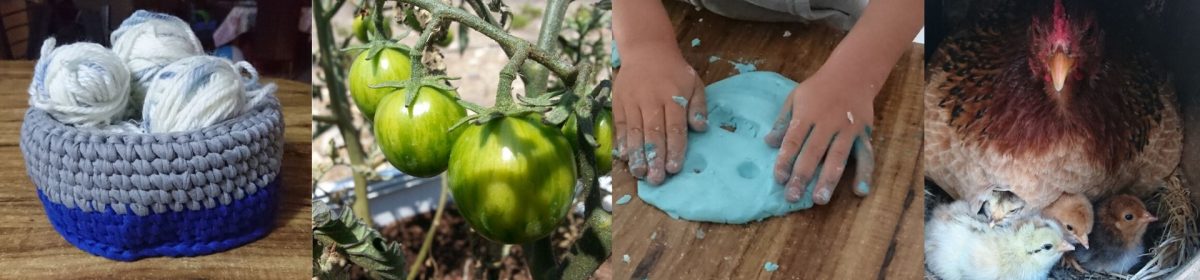
As you can see above, our sage plants, after a long latent stage as poor little sticks, have grown to be mighty bushes. And our tomatoes, though still green, are already very promising. I also put in some new pepper plants.

Here is also one very annoyed mama hen. Doesn’t her whole attitude speak very plainly: “Do not get close to my chicks, or else?” After a heartbreaking result with our previous batch of chicks – some sort of predator dug its way into the coop and just made off with all our chicks, plus two of my favorite chickens, leaving absolutely no trace – I spent hours reinforcing the base of our coop with local rock. I know pouring concrete around the base would have been more effective, but we just can’t afford this right now.

Anyway, we now have fifteen new chicks, and I’m keeping my fingers crossed. I hope we can raise them into nice stock of pullets who will lay plenty of eggs for us in a few months.

Hatching chicks the natural way

polishbroody

In the past two seasons, we have hatched new chicks exclusively by using broody hens – and, with a few drawbacks, find this age-old, natural way of expanding one’s backyard flock easy and satisfying. Though incubators can be convenient for hatching large numbers of chicks at once, exactly in one’s chosen time (which is kind of hard to do with broody hens), our irregular power supply and frequent outages make the choice pretty obvious. Though we might venture to buy or build a small, well-isolated incubator sometime in the near future, I expect we’re still going to rely almost exclusively on broodies.

Read more in my latest Mother Earth News post:

“We used to let hens accumulate a clutch of eggs in the hopes they would begin sitting, but it only resulted in a lot of mess and many spoiled or broken eggs. Now we collect every egg as soon as it is laid and, to encourage broodiness, provide a clutch of plastic dummy eggs (can be bought cheaply at a toy store or on e-bay). Note: we’ve had some hens begin sitting even without a clutch. Once the broody instinct kicks in, they’ll just do their thing.”

Let them live

DSC_0236

We have had rescue Leghorns several times; though they are a commercially raised breed, they adapt very well to free range life, and soon become much happier. Once they make themselves at home, they usually become the more dominant birds of the flock and occupy a high place in the pecking order. Chickens who were almost completely plucked grow feathers, chickens with extra long toenails scratch away and give themselves a natural manicure, and pretty soon they settle into a regular laying routine, though many will not lay every day anymore.

It is of no consequence to us, however; we are happy with whatever we can get. Our chickens eat a low-cost diet of scraps and whatever they can find in the garden, and only get a modest supplemental portion of commercial feed, so our little backyard operation doesn’t have to be super efficient; we have some chickens and some eggs, and that is enough.

Chickens are not generally the cuddliest of pets, but my kids won’t take no for an answer. Above you can see a photo of a rescue hen getting tamed. She looks pretty annoyed, I think, but knows better than to protest.

Watching our chickens happily dig around in the yard is one of my most satisfying everyday experiences. There are drawbacks, of course – free range chickens are notorious for destroying garden beds, and can be plucked off by predators more easily. For us, however, the tradeoff is worth it.

Coping with chicken loss


There are few things more painful to me as a chicken owner than the untimely loss of one of the flock. Our chickens are all lovingly hand-raised, and it’s enough to drive one mad when a sneaky predator gets past one’s defenses, or when a disease you can do little about makes its rounds in the coop.

Still, I guess that this knowledge, this acceptance of the fact that there will be some losses, is what enables us to bounce back and keep raising chickens.

From my latest Mother Earth News post:

“Losing animals is an inevitable part of raising them. No matter how careful and diligent you are, at some point you will have to deal with saying goodbye – and not just due to old age, either – to some members of your flock or herd. This is heartbreaking even if your animals were meant to end up as dinner at some point. So much more if you treat your livestock somewhat like pets. I remember one time years ago, crying and telling my husband I’d rather give it all up and never keep anything living but plants again.”

Chickens: predators and prey

fencedgardenbed1

Above: garden bed fenced against digging chickens.

Chickens are both predators and prey: you have to protect them from ending up in the belly of a fox, but you also have to protect your garden from your chickens eating whatever is in their sight, or just turning your lovingly made flower bed into a dust bath.

Read more in my latest Mother Earth News post:

“We free range, which of course exacerbates the losses to predators, but the overall pros of free ranging are so evident that I truly believe it’s the only practical way for us to keep chickens. Not only do we save a bundle on feed as our chickens forage and find their own food, but we get the benefit of a pest free yard and can get away with a smaller coop – it’s OK for chickens to be a little crowded some of the time if they mostly have the whole yard to themselves.”

First chicks of the season

DSC_0135

The first chicks of the season are here, though we’ve had the unexpected setback of low fertility rate in our hatching eggs.

Our alpha roo is a black Brahma, so our chicks all have feathered legs and most of them are black. I love Brahmas for their size, docility and fluffy feathers, and hope to get good stock for a purebred flock.

So far we’ve let our broodies do the job this season, but we also plan to set up a salvaged incubator and see how it works. I’ll let you know how it turns out.

By the way, we never buy chick starter. Instead we feed our chicks regular layer’s mesh, supplemented with hard boiled eggs and, very early on, all sorts of kitchen scraps. Pros would probably frown upon this, but we have raised many generations of happy, healthy chicks this way.

Happy hatching to all backyard flock owners!

The Private Life of Chickens

Once in a while I come upon a documentary that is as deliciously comforting as a cup of hot cocoa when you’re feeling a little under the weather. The Private Life of Chickens was just that for me: a dose of comfort and relaxation to take late in the evening, when the chores are done and I’m tired and craving something cozy and domestic like only a British documentary can be.

This documentary takes us to the beautiful English countryside (something I would dearly love to re-create in Israel), to the farm of a sweet lady named Jane, who rescues ex-battery hens, cares for them, and passes them into the hands of small backyard flock owners. She is really one of a kind – I wish I had a neighbor like her.

So, if you’re a chicken lover and would like to learn some fascinating facts about your favorite bird, kick back, relax and enjoy an hour of fun and relaxation with The Private Life of Chickens.

As for me, I’m moving on to watch The Private Life of Cows.