Getting the chicken coop ready for spring

leghornchick

Check out my latest Mother Earth News post, about preparing the chicken coop for spring:

“Though we’re still in the deep of winter, days are beginning to lengthen and, at least around here, spring really seems to be just around the corner. The spring-like feeling is validated by the new grass – as winter is the green season here – and by the narcissuses and cyclamens that are beginning to pop up.

Our chickens pick up the cue of longer days and generally resume laying around February, even though it’s still cold. The young pullets hatched at the end of last season – say, September or October – are generally ready to start laying in February or March.”

With warmer weather, greens all around, and a steady supply of fresh eggs, I begin to look forward to a productive spring and summer for our little flock, with lots of eggs, new layers as last autumn’s little pullets mature, and of course the excitement of new chicks, which will probably begin arriving around late March or April.

Spring Chickens

Displaying DSC_0034.JPG

Yes, I know that it’s only the end of January; days are still short, nights are still cold (I hear you folks up north snorting at me with disdain… you don’t know what real cold is, you are saying), but fine days in winter feel like spring in Israel, with everything turning green and fresh and blooming, and chickens busily digging around among the new grass.

In the photo above you see two of our hens, quite happy to be turned out of their coop, which I was at the time cleaning out (a long-overdue practice). I spread some of the manure and rotten straw around our fruit trees, not working it into the ground but just on the surface to let it slowly sink in with subsequent rains.

We’ve had an up-and-down season with our chickens this year; many chicks, but also many losses to predators. We have acquired some few more nuggets of wisdom, I hope, and are ready to apply the lessons we learned now that our girls are picking up laying again. More on this topic in my latest Mother Earth News post:

“We’ve always been big enthusiasts of free-ranging our backyard flock and, in fact, have practiced this for the larger part of our career as chicken owners. Recently, however, we had to rethink our strategy a bit due to the appearance of a particularly sneaky fox that started to make its way on our property at the most unexpected hours.”

Dreaming of chicken coops

Image result for chicken coops

Ideally, the chicken coop I’d like to see in my yard looks something like this.

In practice, we have the below:

coop

This is the fifth chicken coop we have built, having moved several times during our married life so far, and we scrimped on a lot of things knowing we’re probably going to move again in a couple of years (not very conductive to homesteading, I know). Our coop is way too drafty (we only get away with this because we live in a warm climate and choose hardy breeds), only partially roofed, has a dirt floor, gaps here and there through which very small chicks can escape, and other inconveniences. We don’t have a run, our roosts need sanding down to keep splinters away, and I could go on and on.

I do hope that someday, we get settled in a more permanent place and build a good, sturdy, convenient, secure and pretty chicken house.

Read more about our chicken housing experiences here:

“A reliable chicken coop is a must if you don’t want your chickens to end up as the dinner of some fox, stray dog or whatever local predator you have in the area. Do yourself a favor and make an initial investment in a chicken house, a real sturdy shed you wouldn’t mind taking shelter in for the night. As we’ve moved house several times, we’ve had to make do with some makeshift coops that caused us a lot of alarm and frustration. We lost a lot of chickens to predators, and there’s no reason why you shouldn’t learn from our experience.”

New addition to our poultry yard

guinea

My husband found this lone guinea languishing in a tiny little cage in a pet store and decided to rescue it and bring it home. I was never particularly interested in guineas and don’t know much about them (can’t even tell for sure if the one we have is a male or a female), but I was taken with this bird’s quirky appearance and how easygoing it is around the chickens – to be honest I expected something like a blood feud in the coop, but to my surprise the guinea fitted right in, eating and drinking with the flock and squeezing in between the chickens when the time comes to roost for the night.

Now I’m hooked and would like to get a couple more of these funny birds as soon as we have the chance. As a bonus, I found out that guineas are actually kosher and there is a tradition of eating them in some Jewish communities (we don’t bother raising birds for meat, but we might eat the eggs).

The only downside is the racket it tends to make, but on the other hand it helped us spot a sneaky fox a couple of days ago! Luckily, we don’t have neighbors near enough to be bothered.

Last chicks of the season

Above you can see a hen hanging out with her newly hatched brood – probably the last chicks of the season (along with another brood that it due to hatch in a day or two), since it’s already October and egg production is going to decline as the days shorten.

We’ve experienced many setbacks with our chickens this season. We lost about a dozen chicks to an especially sneaky fox, and among the remaining over half were males. Then a lovely, seemingly healthy point of lay pullet just died unexpectedly. We know many people who gave up on poultry-keeping entirely following such disappointments, but in this area, like in almost everything else, perseverance is essential and will eventually be rewarded.

peacockegg

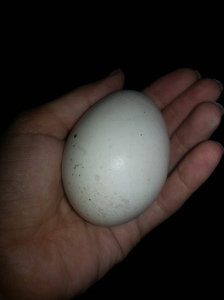
And this is something I just had to share with you – no, this huge egg isn’t from our chickens. It’s a peacock egg we found on a day trip to a lovely park where these gorgeous birds roam around freely. Unfortunately it didn’t appear to be viable, or we’d take it to put under one of our broodies. It’s beautiful and reminds me of a turkey egg.

Cats and chickens – can they coexist?

Read my latest Mother Earth News post to find out how this works for us.

catbabychicks1

“Our chick season usually starts in spring and lasts throughout the summer. How would we keep our cats from going after baby chicks? Cats don’t usually mess with adult hens, let alone roosters, but chicks and pullets can easily fall prey to them. One way, of course, is to keep the chicks confined in a secure pen or coop until they are big enough to no longer be threatened by cats.

However, our cats and chickens – along with baby chicks – live together harmoniously and, so far, we have not had problems. What I find most interesting is that our cats will, unfortunately, go after birds – but won’t even blink when they see a chick passing right next to them.”

Incubators or broodies? Pros and cons of each choice for hatching chicks

If you are a backyard chicken owner, it is likely that at some point you will want to add new birds to your flock. You have, then, two main options: either you buy chickens or breed your own. The latter is more labor intensive, but also more self-sustainable and, I believe, very rewarding.

chicks3

If you want to hatch some of your own chicks, you may do so by using an incubator or placing eggs under a broody. But which is preferable? Well, in my opinion, both options have their pros and cons.

Read my latest Mother Earth News post to find out what works for us.

“It was in the second year of our chicken-keeping that we felt the desire to increase our flock by means of adding some new chicks. We wanted to observe the entire process, from egg to softly chirping ball of fluff to productive adult egg-layer. We also felt that a truly sustainable flock maintains itself, by addition of a new generation each year, without us having to buy new pullets to replace aging layers.”

Updated: read Part 2 here.