Using less disposables

plastic cups holder

Do you use disposable kitchen utensils? I really, really wish I could ban these things from the house altogether, but still succumb to the convenience especially during busy times, such as Friday afternoons and the pre-Pesach rush. Still, I have taken some steps around here to use less paper and plastic. Read more in my latest Mother Earth News post:

“I have devised strategies to using less disposable plates, cups and utensils that work for us. The first and most obvious would be to buy less of them, and make sure they are reserved for such water-less emergencies as I mentioned above. Also, it makes sense to buy the flimsiest, least convenient sort, to make the use of them less tempting.

Another method is to keep disposable plates and cups well out of sight. When my husband bought a disposable cup holder and placed it on the kitchen counter, declaring it would be convenient, I declared it’s a bad idea. Of course it would be convenient! But we don’t want it to be.”

A Guide to Buying Second Hand

Image result for second hand shop

Buying second-hand – clothes, shoes, tools, books, toys, furniture – can save you a whole lot of money and give you high-quality products at the fraction of the cost – if you shop wisely.

An item’s value drops by the very fact of it not being brand-new – if I buy a pair of shoes, wear them once for five minutes and give them away to a second-hand shop, someone else can buy them very cheaply even though they are, essentially, good new shoes. Looking for such gently used items can be a very rewarding challenge.

On the other hand,  there are thrift shops and there are thrift shops. Not long ago I visited one which was packed with stuff, but everything was in such disarray that I was discouraged from even browsing and went away without buying anything.

A good,  well organized thrift store is well worth being put on your local map and visited regularly.  My top tips for making the most out of thrift shopping are the following:

1. Check the quality – there is no guarantee and often no returns in second hand shops, so before you buy, carefully look for any tears, rips, stains, dysfunctional parts, etc.

2. Be a regular.  Ordinary stores are somewhat predictable; second hand ones are full of surprises.  Make it a habit to pop in once in a while so you don’t miss new great finds.

3. Resist the temptation to buy too much because it’s cheap.  Remember, the goal is to save on what you really need, not fill your house with stuff.

4. When buying used furniture,  beware of wood pests.  You don’t want to risk infecting your whole house – getting rid of wood pests is a troublesome and almost futile task.

The things you will never regret

In our previous home, we had a separate room for a home office. Such privacy is very convenient, but it is also the pitfall of the computer junkie (which, I admit, I am). I could tuck children into naps or, at a period of time when I didn’t have any children young enough to need naps, I could let them watch a movie – while I got into the office to check my emails, etc.
The problem is, the “etc” only too easily turns into watching silly YouTube videos, participating in draining online discussions, making frivolous Google searches (“why does the top point of my left ear sometimes itch?”), and keeping up with the social media. The power of the click is just too alluring.
Of course, there are also the good things – reading excellent helpful articles, writing letters to friends, taking care of personal projects, working on my books. However, the good things are even more dangerous, in the way of justifying an extravagant amount of time spent on them. If you watch a video of a cat playing the piano, you’ll feel guilty for wasting your time after five minutes. But knitting how-to videos are okay, right?

Unfortunately, I became feeling entitled to that office time, alone behind closed doors. It was my time; I needed it. So when naps were broken, or squabbles interrupted movie time, I became unreasonably frustrated. I don’t have an exact estimate of how many hours were spent on lawful pursuits, and how many on mindless web browsing, but there is no doubt a large chunk of my time could have been better employed.

In this house, I have one computer in the living room for everybody’s use, faulty internet connection and a little one that really isn’t a very good sleeper. And I’m happier than ever; this change has been the best thing that could have happened to me. It taught me to prioritize; on a good day, I might have half an hour after lunch for answering emails, browsing ads, etc, and if I’m not too tired there’s an hour or two at night when I can write, read, research information or watch a movie in peace and quiet.

The thing is, when I look back on times enjoyably spent with my children – whether reading together, or taking nature walks, doing crafts, playing games, even just watching a movie together – I can’t think of one hour I would rather have spent doing something else. Even if a baby is colicky or teething, it means a night of precious snuggling with someone who needs me, just then, more than anything. I might be very tired, but I have no regrets.

But when I remember my “me” time, my feelings are not so unequivocal. There are many pages I wish unread or unwritten, many videos unwatched, many games unplayed, many conversations unspoken. Not because these things were bad in themselves, but because they took away from the truly important things I should have been doing.

You will probably never regret spending time with your children. The same cannot be said of other things, be it personal projects, volunteering, hobbies or social commitments. I keep that in mind every day, and it makes all the difference.

***

coverfront.jpg

Speaking on another matter, I’m very excited to tell that my upcoming novel, Wild Children, is now on Kindle Scout – which is essentially an Amazon-based contest the winners of which get their book signed up and promoted by Amazon. You can read the book description and first chapter and, if you feel it deserves to be supported , nominate it on its Kindle Scout Page.

Butter, eggs and food security

Last week my husband went grocery shopping and, though butter was on the list (as it always is) he came home without it. Upon my inquiry he told that plain simple unsalted butter was simply missing from the shelves, and there was nothing to be found but the fancy imported spreadable brands. This has lasted for some days now; butter, an important staple in our daily menu, is missing from the dairy aisle.

Of course, when there’s an overall abundance of food, it might not seem so very important. We can have toast with cream cheese instead of butter for breakfast. Butter can be replaced by coconut oil in baking. But in our culture, so used to affluence and to store shelves groaning under the weight of any food imaginable, it seems almost incredible that one might step out to get butter (or anything else, really) and find out that it’s not to be had.

I was born in a country where food deficit was the daily reality. There was no hunger, but it was common to walk into a store and find half its shelves empty, and make do with whatever was available. People stockpiled canned and dry goods and non-perishables; it was plain common sense.

Above: whole grains and pulses, stored in a tightly closed container, will remain in good condition for years and make a compact, useful, cheap and readily available food source. 

We might not like to hear it or even think of it, but a time may come – and not in the very distant future, either – when food is not as readily and abundantly available as it is today. Some products may become less common than they are now, on a temporary or permanent basis. Others may simply become more expensive. Either way, people who are opting to learn food security skills today will be the gainers.

Stockpiling is one valuable practice to be learned. It makes very good sense to have a nice stash of products that can be stored for a long time, rotating them every few months or so. Canned food, rice, beans and grain of all kinds, flour, yeast, salt, non-perishables such as soap and toilet paper, and much else, can make a nice safety cushion for emergencies or simply for lean times. We have lived largely off our pantry for months on end during several periods.

Growing your own wholesome, fresh food is the next big step. A productive vegetable garden and a chicken coop, even a very little one, contribute a lot toward the goal of food security. Even just having plenty of veggies and eggs can provide one with a variety of delicious meals. A couple of goats or a cow will further enrich the family’s diet. If we had a dairy animal now, we wouldn’t care if there is any butter at the store or not! I remember an egg deficit time a couple of years ago – we were lucky to have eggs from our chickens and so didn’t feel it at all. It might not happen soon, but I’m aiming to have a larger, more consistently productive vegetable garden, more chickens (and maybe other poultry), and dairy goats again.

Another thing to do would be to learn about foraging and which sources of wild-growing food are commonly available in your area. It can be berries, fruit, herbs, mushrooms, and much else. Always play safe and only consume what you know for sureto be edible.

If you are just beginning to learn about food security, I heartily recommend perusing the writings of Jackie Clay, a homesteader with many years of experience under her belt, and a real powerhouse of optimism, cheerfulness, resourcefulness and determination. You can start by looking up Jackie’s articles on the Backwoods Home Magazine archive, reading through the Ask Jackie archive, and visiting her blog.
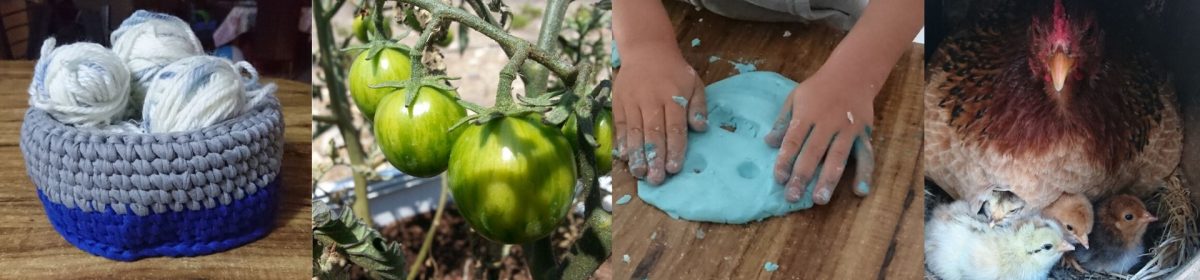
A collection of posts

For those who might have missed them, here are my most recent Mother Earth News posts:

goat

Choosing a Milking Goat

“Many assume that a “good milker” means an animal with high milk yields. In fact, the milk yield forms only one part of the milker quality equation, the other two parts being the state of the goat’s udder and teats, and the animal’s temperament.”

Natural Winter Skin Care

“Winter is here, and with it cold, dry air, sharp winds, and chapped, cracked skin. This can be a real pain, especially for those of us who still have to tend to outdoor chores every day. Last winter I suffered from a very bad case of red, dry, painful hands and spent a fortune on expensive medical-grade creams and lotions, but this was before I fully discovered the wonders of coconut oil and shea butter and the satisfaction of making one’s own simple skin care products.”

Make Chicken Waterer From Old Bucket

“In the past we provided water for our flock of backyard chickens using all sorts of dishes, bowls, pans and buckets. These were stepped in, pooped in, upturned, and in general quickly resulted in a messy coop and thirsty chickens. The problem was exacerbated when we had to leave home for a couple of days – we could heap up the feed, but the water just wouldn’t last.

Then, after some experimenting, my husband made a simple, cheap, DIY waterer using an old paint bucket and a few waterer nipples.”

Drying hyssop

hyssop

We don’t often find fresh hyssop in stores, so when we came across it we grabbed a bunch and I decided to take advantage of the dry, windy weather we’ve been having to dry it up.

Dry windy spells in winter are a pain. They make being outside unpleasant, they cause one’s hands to dry out and crack, and what’s more serious, they dramatically increase the risk of wildfires (by the way, thanks so much to those who have expressed concern for our family – we are thankful to say we are in no immediate danger of fire, but are keeping alert and hoping for rain). But these winds are perfect for drying herbs.

Drying hyssop – or any herbs, really – is very simple. All you have to do is take a good-sized bunch, tie it by the stems and hang it outside – or, if the wind is really violent like it was this time, put it in a mesh bag to prevent the leaves from scattering.

Of course, a food dehydrator or a simple oven can work just as well. Or you can hang the herbs inside. They will dry up eventually, only it will take longer. On the upside, they will make the room smell nice.

Once the hyssop is properly dry, remove and crush the leaves and discard the stems. The crushed leaves can be used as a seasoning in various dishes or, as is more common in Israel, mixed with olive oil, salt and sesame seeds to make za’atar, a popular local dip eaten with pita bread and/or cream cheese.

Your Own Hands Release and Giveaway

I’m very happy to tell that Your Own Hands: Self Reliant Projects for Independent Living is now available on my Amazon page.

yohcoverpreviewfront

The book is also available at my Payhip store in PDF format – with a special 30% discount for blog readers who choose to download it from there. Coupon code is 0HBO2YU1XO and it will be active until the end of November.

I am also excited to tell that I’m giving away three review e-copies of the book. Entering the giveaway is really simple: just drop me a line through my blog’s contact form. Winners, who will be chosen randomly one week from now, will make me really happy if they opt to review the book on Amazon or their social media or blogs (though it is entirely a matter of goodwill). You are also welcome, of course, to spread word about this giveaway on social media so more people can enter.

Thank you for your support!