Dairy goats: breeding, kidding and milking

goat

Read my latest Mother Earth News post on dairy goats, focusing on breeding, kidding and milking:

“Most dairy goat breeds have a clearly defined breeding season and will go into heat during the fall and early winter, generally from August to December-January. Gestation period lasts around 20 weeks, so kids will be born in late winter and early spring. If you have several goats, you can schedule breeding so that, for example, some of your does are bred in August-September and some in December-January. This way the milk production of your herd will be a lot more consistent and you’ll have milk practically year-round.”

Also, Dana (better known as Mama Zed) made my day with her awesome review of my book, Your Own Hands:

“Your Own Hands – Self-Reliant Projects for Independent Living” would be what I consider to be an absolute fantastic book for new homesteaders. The book covers a wide range of topics rather than written to cover one topic in great depth. These topics include gardening, home building and maintenance and even “artisan crafts” such as soap making!

And now I had better roll up my sleeves and jump right back into the midst of Pesach cleaning. Happy spring, everyone!

Butter, eggs and food security

Last week my husband went grocery shopping and, though butter was on the list (as it always is) he came home without it. Upon my inquiry he told that plain simple unsalted butter was simply missing from the shelves, and there was nothing to be found but the fancy imported spreadable brands. This has lasted for some days now; butter, an important staple in our daily menu, is missing from the dairy aisle.

Of course, when there’s an overall abundance of food, it might not seem so very important. We can have toast with cream cheese instead of butter for breakfast. Butter can be replaced by coconut oil in baking. But in our culture, so used to affluence and to store shelves groaning under the weight of any food imaginable, it seems almost incredible that one might step out to get butter (or anything else, really) and find out that it’s not to be had.

I was born in a country where food deficit was the daily reality. There was no hunger, but it was common to walk into a store and find half its shelves empty, and make do with whatever was available. People stockpiled canned and dry goods and non-perishables; it was plain common sense.

Above: whole grains and pulses, stored in a tightly closed container, will remain in good condition for years and make a compact, useful, cheap and readily available food source. 

We might not like to hear it or even think of it, but a time may come – and not in the very distant future, either – when food is not as readily and abundantly available as it is today. Some products may become less common than they are now, on a temporary or permanent basis. Others may simply become more expensive. Either way, people who are opting to learn food security skills today will be the gainers.

Stockpiling is one valuable practice to be learned. It makes very good sense to have a nice stash of products that can be stored for a long time, rotating them every few months or so. Canned food, rice, beans and grain of all kinds, flour, yeast, salt, non-perishables such as soap and toilet paper, and much else, can make a nice safety cushion for emergencies or simply for lean times. We have lived largely off our pantry for months on end during several periods.

Growing your own wholesome, fresh food is the next big step. A productive vegetable garden and a chicken coop, even a very little one, contribute a lot toward the goal of food security. Even just having plenty of veggies and eggs can provide one with a variety of delicious meals. A couple of goats or a cow will further enrich the family’s diet. If we had a dairy animal now, we wouldn’t care if there is any butter at the store or not! I remember an egg deficit time a couple of years ago – we were lucky to have eggs from our chickens and so didn’t feel it at all. It might not happen soon, but I’m aiming to have a larger, more consistently productive vegetable garden, more chickens (and maybe other poultry), and dairy goats again.

Another thing to do would be to learn about foraging and which sources of wild-growing food are commonly available in your area. It can be berries, fruit, herbs, mushrooms, and much else. Always play safe and only consume what you know for sureto be edible.

If you are just beginning to learn about food security, I heartily recommend perusing the writings of Jackie Clay, a homesteader with many years of experience under her belt, and a real powerhouse of optimism, cheerfulness, resourcefulness and determination. You can start by looking up Jackie’s articles on the Backwoods Home Magazine archive, reading through the Ask Jackie archive, and visiting her blog.

Dreaming of chicken coops

Image result for chicken coops

Ideally, the chicken coop I’d like to see in my yard looks something like this.

In practice, we have the below:

coop

This is the fifth chicken coop we have built, having moved several times during our married life so far, and we scrimped on a lot of things knowing we’re probably going to move again in a couple of years (not very conductive to homesteading, I know). Our coop is way too drafty (we only get away with this because we live in a warm climate and choose hardy breeds), only partially roofed, has a dirt floor, gaps here and there through which very small chicks can escape, and other inconveniences. We don’t have a run, our roosts need sanding down to keep splinters away, and I could go on and on.

I do hope that someday, we get settled in a more permanent place and build a good, sturdy, convenient, secure and pretty chicken house.

Read more about our chicken housing experiences here:

“A reliable chicken coop is a must if you don’t want your chickens to end up as the dinner of some fox, stray dog or whatever local predator you have in the area. Do yourself a favor and make an initial investment in a chicken house, a real sturdy shed you wouldn’t mind taking shelter in for the night. As we’ve moved house several times, we’ve had to make do with some makeshift coops that caused us a lot of alarm and frustration. We lost a lot of chickens to predators, and there’s no reason why you shouldn’t learn from our experience.”

A collection of posts

For those who might have missed them, here are my most recent Mother Earth News posts:

goat

Choosing a Milking Goat

“Many assume that a “good milker” means an animal with high milk yields. In fact, the milk yield forms only one part of the milker quality equation, the other two parts being the state of the goat’s udder and teats, and the animal’s temperament.”

Natural Winter Skin Care

“Winter is here, and with it cold, dry air, sharp winds, and chapped, cracked skin. This can be a real pain, especially for those of us who still have to tend to outdoor chores every day. Last winter I suffered from a very bad case of red, dry, painful hands and spent a fortune on expensive medical-grade creams and lotions, but this was before I fully discovered the wonders of coconut oil and shea butter and the satisfaction of making one’s own simple skin care products.”

Make Chicken Waterer From Old Bucket

“In the past we provided water for our flock of backyard chickens using all sorts of dishes, bowls, pans and buckets. These were stepped in, pooped in, upturned, and in general quickly resulted in a messy coop and thirsty chickens. The problem was exacerbated when we had to leave home for a couple of days – we could heap up the feed, but the water just wouldn’t last.

Then, after some experimenting, my husband made a simple, cheap, DIY waterer using an old paint bucket and a few waterer nipples.”

Incubators or broodies? Pros and cons of each choice for hatching chicks

If you are a backyard chicken owner, it is likely that at some point you will want to add new birds to your flock. You have, then, two main options: either you buy chickens or breed your own. The latter is more labor intensive, but also more self-sustainable and, I believe, very rewarding.

chicks3

If you want to hatch some of your own chicks, you may do so by using an incubator or placing eggs under a broody. But which is preferable? Well, in my opinion, both options have their pros and cons.

Read my latest Mother Earth News post to find out what works for us.

“It was in the second year of our chicken-keeping that we felt the desire to increase our flock by means of adding some new chicks. We wanted to observe the entire process, from egg to softly chirping ball of fluff to productive adult egg-layer. We also felt that a truly sustainable flock maintains itself, by addition of a new generation each year, without us having to buy new pullets to replace aging layers.”

Updated: read Part 2 here.

Jewish homesteading: an interview

A while ago I was contacted by Tachlis magazine, who were looking for information on the Jewish homesteading movement. My email interview with them is below:

Where do you live exactly?

I’m sorry, but as our privacy is important to us, I cannot state our exact location. I can only say we live somewhere in the Shomron.

What is your homestead like?

I wouldn’t call what we currently have a homestead, precisely; I look at it, figuratively, as the seed of what I would like to have. Right now we have a small flock of chickens, a small garden and a few young fruit trees. I would like to have a large, productive garden and orchard, more chickens, and ideally some sort of a dairy animal. This way, we would provide a significant part of our own food.

In the meantime, we are doing what we can with what we have, and learning relevant useful skills in gardening, improving soil and raising animals. We used to keep dairy goats so I know how to hand-milk and make cheese, and can easily go back to it again.

Is there a community where you live? Is there a minyan?

Yes and yes. We have some wonderful neighbors around here.

How did you decide to homestead?

I don’t think it was a one-time conscious decision. We did know, even when we first married, that we wanted to live on a piece of land, not in an apartment building. We are just taking baby steps in a certain direction, and anything we have accomplished so far has been largely thanks to my husband: sometimes you just need to jump in with both feet, and he can do it much better than I. He was the one who brought home a box with our first chicks, and he was the one who decided on buying goats. He has also accomplished various complicated projects around the household I couldn’t have done myself.

What do you feel your family is gaining from homesteading?

Even though I wouldn’t refer to us a homesteaders just yet, we are learning a whole lot from growing plants, raising animals and working on a plot of land. Our children know the thrill of a newly hatched chick and a newly sprouted seedling. They know how an incubator works and where is the best spot to plant tomatoes. They know all sorts of things I wish I had learned as a child.
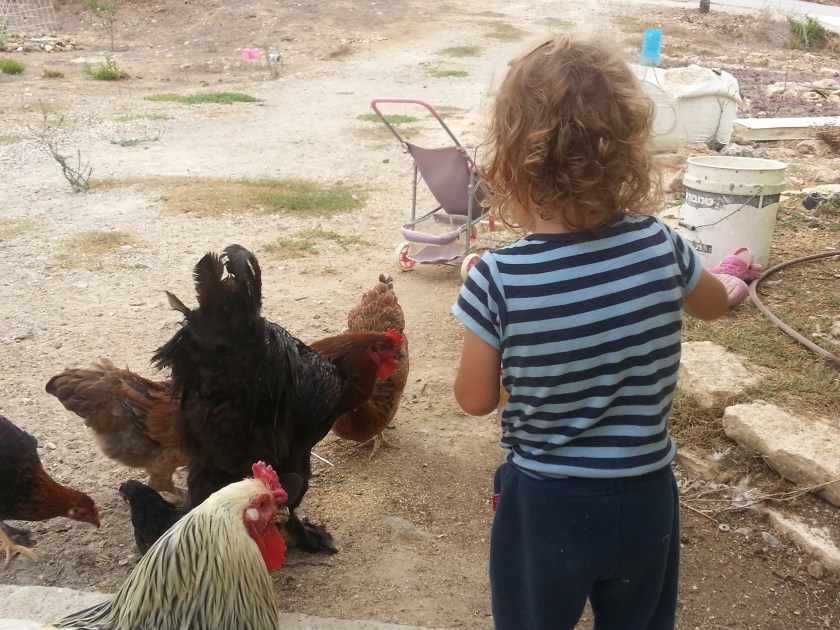
Israel+chickens3

Above: Israel, 19 months old, loves to feed the chickens.

I think one of the best things in growing your own food is that the experience does something to every member of the family, regardless of age. You can all share the excitement of newborn baby goats – nobody is too young or too old for that. And when you go foraging for wild-growing goods, you are all equally satisfied when you come home with full containers.

Our lifestyle has brought us together with many wonderful like-minded people, which has been a terrific experience and an education in itself.

And, of course, those who “graduate” to growing and raising a significant part of their own food will reap the benefits of a healthier diet and reduced expenses.

Does homesteading help you connect to the Torah in a deeper or more personal way?

Yes, certainly. Jewish life and working on the land are closely intertwined. Many of the mitzvot specifically refer to agriculture: ma’asrot (tithes), Shmita (the Sabbatical year) and the holy status of the firstborn male, to name a few, and of course anything that has to do with humane treatment of animals. When you grow plants and raise animals, even on a small scale, you get to experience this first-hand, not just learn it in theory. Then there’s everything Shabbat-related, such as the restrictions of tending to the garden (you must do everything before Shabbat) and milking (you can milk so the animals don’t suffer, but not collect the milk). Also, as we’re into poultry especially, we have learned there’s some doubt about the kosher status of certain heirloom chicken breeds (in particular ones with an extra toe). We have found out so many things we would otherwise have had no clue about!

You can read more about homesteading and small-scale farming in Israel in this post.
Health and homesteading

Check out my latest Mother Earth News post: what happens when physical limitations stand in one’s way to self-reliant life.

“Even in our modernized age when almost everything is done at the click of a keyboard, being able-bodied is still an essential part of building your own house, starting a homestead, and keeping it going. But what do you do if certain health problems interfere with your homesteading goals? Should you accept that some things just aren’t meant to be – like building with your own hands, for example?

It is my belief that there is an alternative way to do pretty much anything, and even to profit from the seemingly untoward circumstances that might seem as a death certificate to your dream.”

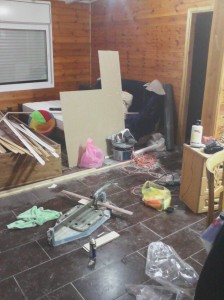
IMG_20141127_195847

Illustration: mid-renovations mess in our living room, just before our son Israel was born.