At this time of the year, I always wish I had the means to reach whomever set up the counterproductive tradition of combining the Passover chametz hunt with spring cleaning. That, and the founders of the waaaaaay overboard chumrot (unnecessarily tricky practices) like covering all the kitchen surfaces. Hello, aluminum foil, how nice to see you – NOT.
I’d file a collective lawsuit against them or something. Because when I toll the accumulated stress, chaos, frustration, exhaustion, and pangs of hunger of hundreds of thousands of Jewish children unable to get a proper meal in a disordered pre-Passover home, the mental damage is just unimaginable.
Jezreel Valley in spring
If my children grow up and decide to part ways with Jewish tradition, I’m laying the charge at Passover’s door. Yes, it’s that bad. I envy the rich people with holiday homes they can use just during this week.
But, on the up side, this year I managed to lower the level of insanity a tiny bit. I left ALL the bookcases and closets alone (other people in this house who are unhappy about it can roll up their sleeves and get busy – I never told them not to), and in the week before the holiday, I peeled off my scrubbing gloves and went with the kids on a hike through the woods.
Such lovely weather. So many different kinds of vegetation, especially lush after a generously rainy winter. This most beautiful time of the year, totally wasted on cleaning.
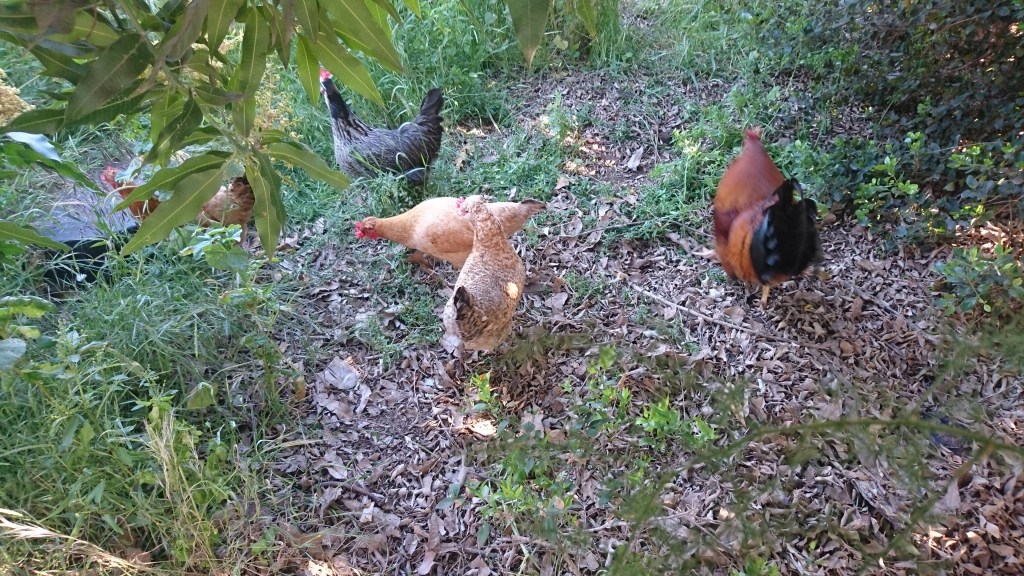
Chickens on a stroll
And here is just a random pic of the backyard flock roaming while I was cleaning out their coop. The rooster just showed up out of the blue over a week ago. Isn’t he a handsome boy?
You would think that now, barely a week and a half before Passover, wouldn’t be a likely time for me to complete a crochet project. But the truth is, I’ve had this shawl at about 90% done for a while and decided to make an effort and complete it so I could wear it during the holiday.
And, of course, so I could get to talk about the absolutely delicious yarn I used for this project – Malabrigo Silkpaca.
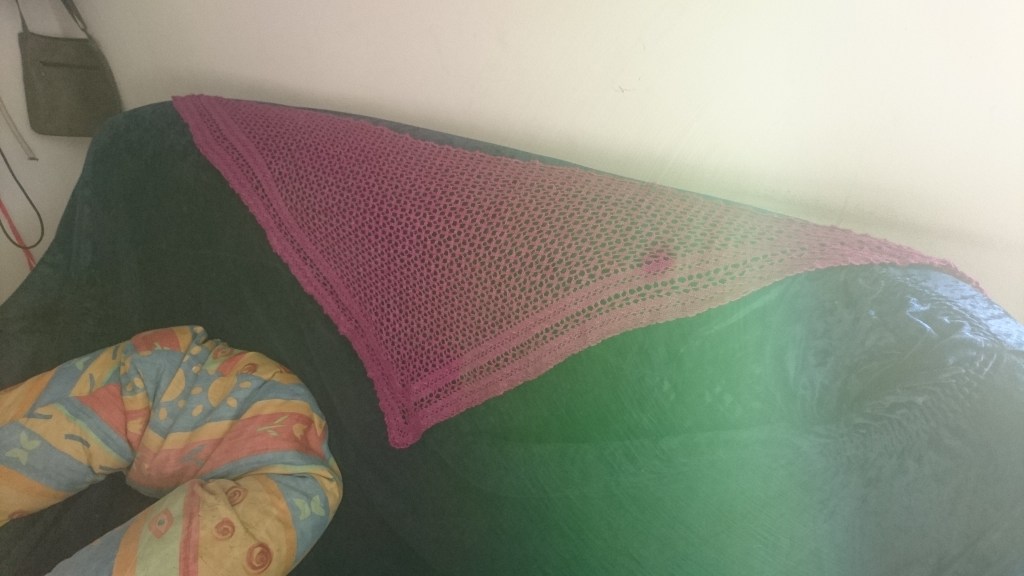
Draped over the sofa
This was my first time working with Malabrigo. I’ve been ogling their yarns for a long time but balked at the price. However, eventually I decided that I can and should use nice yarn for two reasons.
One, I’m not a high-volume crocheter. Definitely not the type of crafter who completes a huge afghan in a couple of weeks. Working on this shawl took me around two months. Since it required two hanks of Silkpaca, that’s one hank a month – something even a budget crocheter like me can deal with. Also, if I invest so much time in a project, it makes sense to use the best yarn I can afford.
Two, I love thin yarns, so I get more bang for my buck, weight/price vs yardage. Don’t get me wrong, I’m not immune to the allure of a chunky squishy worsted. But I live in a warm climate and therefore naturally gravitate towards lightweight, lacy, thin garments. Crochet creates a denser fabric than knitting, so a laceweight yarn like Silkpaca was just perfect for my project.
When I shared my plans for this project in my crochet group, someone doubted that two 50 gr hanks, a total of 100 gr, would be enough. As you can see, this is a nice-sized shawl – not a scarf or a little shawlette. That’s the advantage of working with lace and fingering weight yarns. You get a super nice yardage that really goes a long way.
What can I say about this treat of a yarn? It’s everything it promises to be. Nice to the touch, springy, slightly shiny, with a very very light fuzz. It’s 70% baby alpaca, which means it’s deliciously soft and 30% silk, which lends its strength and sheen to the yarn. Perfect for shawls, lacy scarves, and other diaphanous projects. And, of course, it comes in the gorgeous Malabrigo color palette.
I used Hollyhock, which is a solid color, but you don’t get really solid effects with Malabrigo, since it’s a kettle-dyed yarn. You get subtle variations, which are impossible to see in the photos. Personally, I think they add to the interest of the project.
Drawbacks? I can think of two. One, Silkpaca is a two-ply yarn, and it tends to split a bit. And two, because of the slight fuzz, this yarn is a pain to frog, so just pay extra attention when you work with it.
Pattern closeup
Finally, choosing the perfect pattern for this lovely yarn took me nearly as long as making the shawl. I wanted something lacy but not too busy, clean and crisp openwork that would showcase the beauty of the yarn. Then I came across the Nightfall Shawl pattern by Sylwia. It was made just for what I had – two hanks of Malabrigo Silkpaca. Bingo!
Sylwia offers a free version of the pattern, but being a girl who learned to crochet with vintage Soviet magazines, I had to have a chart, so I purchased the PDF pattern. Well worth the investment. I altered the border slightly and am extremely happy with the result.
I believe the future definitely holds more projects in Malabrigo Silkpaca for me. Also, once you try their yarns, you’re a fan. I purchased a few hanks of their other offerings to try them out, and once I do, I’ll review them here.
OK, here’s the long version. I’ve raised many chickens over about a dozen years now, and not one of them could resist a bit of Styrofoam packaging or a stray construction panel with Styrofoam insulation.
Chickens will go for Styrofoam even when they have fresh pasture
My chickens consume a diverse diet of layer feed, kitchen leftovers, and pasture. They choose Styrofoam over their feed, vegetable peels, fresh grass, and any food you can imagine. No, they won’t only eat Styrofoam, given the choice, but they’ll eat it before anything else.
It seems this isn’t an anomaly. Chicken owners all over the world report the same thing: their hens and roosters can’t resist Styrofoam. If I ever publish an updated edition of The Basic Guide to Backyard Livestock, I’ll be sure to include this phenomenon.
What do chickens find so appealing about Styrofoam? Its texture, I suppose. It’s easy to peck at, and when it scatters, it looks like crumbs. But surely when they taste it they should be disappointed?
Compared to humans, chickens have very few taste buds, so they don’t respond to taste the same way we do. However, they generally have an innate ability to choose nutritious foods. Styrofoam doesn’t quite fit the profile, though.
Will Styrofoam harm your chickens? I can only speak from experience. For years, I have tried to discourage my birds from eating Styrofoam. I offered distracting treats and shooed them away. I herded them out to patches of succulent fresh grass teeming with bugs. To no avail. If Styrofoam is available, they’ll come back to nibble on it. So far, my flock hasn’t sustained any visible damage.
Naturally, eating Styrofoam can’t be good for chickens. Theoretically, Styrofoam could impact a bird’s crop and cause suffocation. The only practical way to deal with this problem is to avoid leaving any Styrofoam lying around.
Do your chickens go crazy over Styrofoam too? Tell me in the comments.
Back in the day, when I was a starry-eyed young mom, I received an email from an equally young reader, a newlywed who wrote, “My husband landed an amazing position and I will never need to work again. Please give me suggestions on ways to fill my time until we have our first child.”
As far as I recall, I came up with various ideas for charity work, gardening, crafts, and housekeeping. Today, however, I would give that sweet lady – and my own daughters, when they reach the proper age -a completely different outlook.
I would say, Congratulations on your husband’s new position. I hope he will retain it throughout many years and provide the necessary financial stability for your family.
I also hope that your marriage remains healthy and happy, and that your spouse never makes you feel like ‘less than’ for not bringing in an income.
If you plan to stay home with your children, I applaud your choice. Children thrive when there’s a parent to be with them in their early years. Families thrive when one spouse has enough flexibility to keep the common ship sailing smoothly.
But no matter what, don’t put yourself in a situation where you’ve burned your bridges and locked yourself in. Keep something you can fall back on.
Whether it’s a flexible profession, a business you can upscale if necessary, or a degree that allows you to work from home, always have something to give you financial security in tough times.
This isn’t negativity or pessimism, any more than purchasing an insurance policy is. It’s just common sense.
We live in a hugely unpredictable world. Businesses fail. Wars rage. Global pandemics flare up. Economies flounder. People lose their health and earning capacity. And, sadly, sometimes marriages fail as well.
I have lived through this. I gave up on the ability to support myself, on the security of a husband’s good job and a house purchased outright. Then, when the job was lost and the house swallowed by a black financial abyss, I found myself in an isolated outpost, with no transportation, no stable internet access, and not even secure electricity or running water supply.
Eventually, I rallied and started fighting for financial independence (a process that’s still ongoing). But it was hard, and knowing that I put the torch to my own bridges didn’t make it easier.
You aren’t a less devoted wife and mother for having a plan B. Do what you must to protect yourself and your children. If you are lucky, you may never need it.
But if you do, you will be glad you prepared for every scenario.
As recent events have shown to all who still doubted it, government officials can seize private citizens’ money. They can do it quickly, unexpectedly, and for nearly any arbitrary reason. What is unthinkable today becomes acceptable tomorrow, or next week.
I have read messages on social media calling people to withdraw their savings, switch to cash, and invest in tangible assets like gold or real estate. While having some cash on hand is always a wise move, as is converting some money into hard assets, I doubt it will provide the common people with a real solution to universal corruption and ugly dictatorship.
First, if you have any substantial savings, withdrawing them all could be impractical. Second, a dictatorial government can limit the use of cash, as is already happening in Israel.
Third, paying cash for everything is hardly practical. I love how cash helps me limit spending at the grocery store, but when it comes to paying the utility bills, I do this online with my credit card rather than schlep to the local post office and stand in line with an envelope of cash.
I’m not sure I have an alternative solution. Like it or not, money is the cornerstone of our economy. For someone like me, who has fought tooth and nail for financial independence, money stands for security, comfort, capability, freedom, and so much more.
However, I am convinced that when the you-know-what hits the fan, money isn’t everything.
What if all our hard-earned savings disappear into a financial black hole tomorrow? What if money loses value, or even becomes temporarily unavailable? I am convinced that our survival will depend on our resilience, creativity, skill, and readiness to work as a community.
Bartering is not a universal remedy either, but it is an elegant solution that can bypass the money system in many cases. If you have skill, you can barter. If one person weeds another’s property in exchange for that other fixing their roof, and no money changes hands, it’s a small victory over a system based on dictatorship, surveillance, and control.
Above all, bartering is about human relationships. It is about mutual support. It is not so much about relying on “self” as trusting the small and local above the official and impersonal.
Call me an optimist, but I don’t anticipate total collapse. Call me a pessimist, but I don’t think we can avoid difficult times. Cherish your community. It is just as important to survival as a wad of cash and a hefty stockpile.
This season, I’m challenging myself to use up the yarn I have in my stash rather than keep drooling over delightful new yarn I’d love to order. So far, I’m pretty proud of myself. I’m fitting my stash into a compact storage space, I’m making useful things, and I’m being creative.
I’ve discovered headbands as a terrific way to use up half a skein of yarn (or less) when you don’t have enough for a hat. Headbands are cool accessories, work up quickly, and can function as earwarmers. They make great gifts or items for a craft booth when you need to make something quick.
My girls love their headbands and keep asking for more, although personally I’m ready to move on to more interesting stuff. These are literally simple rectangles, done in SC in the back loop, and sewed using the Simple Twist Headband method (look it up on YouTube).
For all who have wondered what cave I’ve been hiding in all this time, 2022 started off with a bang for me and I’m dealing with an avalanche of projects, not to mention sick kids and all the ensuing schedule disruptions. And, of course, whatever else happens, laundry hampers overflow, trash cans need emptying, and grocery shopping needs doing.
As I was doing my taxes for 2021, I passingly reflected on the importance of having boundaries as a freelancer/mom/household manager and all the many hats we wear.
I know many self-employed individuals struggle with self-discipline in a very straightforward way – it starts with “I’ll just check my email”, and three hours later you’re deep in a Twitter debate about animal conservation because there’s nobody to drag you to your desk and make you start working.
I battle a different affliction, commonly known as biting off more than you can chew. I apply to lots of different gigs and find it hard to scroll by when an interesting offer appears in one of my freelancer Facebook groups. However, I am pleased to say that I made progress in 2021.
In the early half of 2021, my income ledger showed entries from many different clients. I squinted at the chart a couple of weeks ago, barely recalling some names. Then I remembered. “Oh, that didn’t work out.” “This person wanted faster turnarounds than I could commit to.” “This one had unreasonable demands.”
In the second half of the year, I consolidated my efforts to a couple of steady clients – without losing income. Yet now I have more sanity, less frenzy, fewer emails to answer, and less juggling in my schedule. I also became far more confident in my communication: “I can do this and this by date X”; “I cannot commit to any day earlier than Thursday”; “I can promise X, but not Y.”
I used to be a huge people pleaser, which didn’t give me many opportunities to see how people react when you don’t give them what they want. In the past year, I saw how it goes: some walk away, leaving the ones you get along with. I believe it’s true in the personal as well as professional sense.
Today, I sleep better, read more paperbacks, take more walks, and have more time for my kids, all while being more productive.
I hope everyone has a nice, cozy January with a mug of hot cocoa and a stack of good books (except you in the Southern hemisphere – enjoy your summer!).