Educational Attitudes


There are some days when, if it weren’t for the necessity to go out and feed the chickens, I’d probably remain in my fuzzy pajamas all day long. As the critters do need to be fed, and as someone might pass by and wonder at seeing me in pink pajamas and fluffy socks at midday, I get dressed, put on my muck boots, and trudge out with a box of feed in hand. Moral: if you want to have more motivation for self-discipline, keep animals. If nothing else, it will make you get dressed properly in the morning.
For most families, structure is something integral to every day. They get up, fly through the routine of dressing and breakfast, and everyone goes off their own separate ways for the days. For those who both work and learn from home, the situation is very different. We are pretty much in each other’s hair every day and all day long, and that is by necessity a mess-generator (both physically and mentally). Structure is important; it doesn’t have to stick to conventional routines or hours, but it must be there.
One of my favorite homeschooling resources, The Homeschooling Handbook by Mary Griffith, has a chapter on schedules called Structure, or Can We Wear Our Pajamas to School? Here’s a quote:
“Often families who start out with a fairly rigid structure find themselves becoming more relaxed and flexible as they grow more comfortable with homeschooling, whereas those who began with an informal and casual style may discover the need for more structure.”
We’ve been in both these places. Some years ago, a homeschooling friend told me that in her family, and in all homeschooling families she knows, later hours and more flexible meal times for kids are the norm. I bristled. Not with us! Dinner at 6, bath at 6:30, story time at 7:00, bedtime and blissful silence by 7:30. And you know what, for a long while I adhered to these principles religiously. But I paid dearly for it. Stress, tension, and constant chafing with my kids became the norm. On the other hand, I wouldn’t adopt my husband’s suggestion of just letting them run about until they drop off from sheer exhaustion. These days I’m more flexible, but I do know, and so do my kids, that once we’re on the track of dinner-baths-reading time, it leads to bedtime and that’s that.
Another great quote from The Homeschooling Handbook:
“Figuring out which part of which ideas will work for you is not easy. Often the ideas you find most attractive and expect will best fit your family don’t work for you at all. Or they work for a year or two and then suddenly seem ridiculous. Just remember that your kids are growing and changing and the relationships among you all are changing as well. It’s unrealistic to expect homeschooling to remain the same in the midst of those changes.”
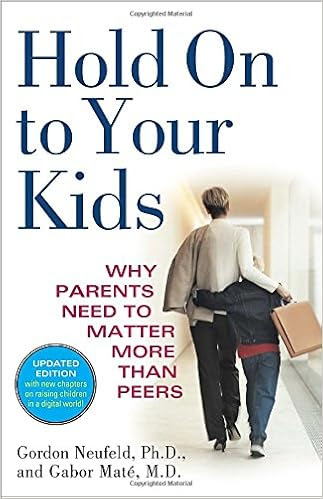
Hold On To Your Kids: Why Parents Need To Matter More Than Peers is a book with an important message (the headline itself, I think, speaks volumes!).
By Briana LeClaire:
“The overarching theme of the book is ATTACHMENT. To whom are your children more attached? Are they attached to you, their parents, and other adults? Or are they attached to their peers? To whom do they look for guidance? Whose star have they hitched their little wagons to?”
“My son is so independent,” a neighbor proudly told me once, “he has so many friends! As soon as he gets back home, after lunch, his friends come to visit him or he visits them, and he plays together with them until it’s time for supper. He hardly needs me at all!” Want to guess how old the boy was? Only 4. And the situation described above was seen by his mother as something most natural and desirable.
There is a perspective of my own I would like to add: while the authors of the book admit that attachment between parents and children, especially young children, is vitally important, and that early enrollment in daycare and preschool is more likely to make children peer-oriented (that is, dependent upon their friends in the development of social connections, goals, values, morals, language and habits), they also say that the most obvious (and, they confess, most desirable) solution – that of young children staying at home, usually with their mothers, is in most cases an impractical, outdated measure.
Their suggested solution is creating an attachment between the child and the “parent substitute” – babysitter, daycare worker, teacher, etc. While, of course, an invested and caring daycare worker is better than a detached, unaware one, I do not think a parent-child-like connection between the child and the care provider is possible or even healthy. There are too many children per caretaker and, above all, nobody can love your child like you do. Also, there is absolutely no guarantee the caretaker/teacher passes on values and messages you approve.
I vividly remember a 3-year-old niece who kept talking to us about her preschool teacher, whose name was Ruthie. That child was evidently engrossed by Ruthie and talked about her a lot more often than she mentioned her parents. Perhaps it is better that the child was so connected to her teacher, rather than her peers, but the fact remains that Ruthie (however capable of creating the attachment) did not care about the child in the same way. It was not her child, after all. At the end of the year, the child and her teacher would part, never to meet again. Is it really good for a child to give her heart to a teacher in such a way, when we know it is to be only a temporary relationship?
Even grandparents, aunts and uncles (the relationship with whom is permanent) are not supposed to be more than auxiliary figures in child-rearing. They can provide help, plenty of help, but the biggest chunk of the job of child-rearing (in time as well as authority) should belong to the parents.
Rather than say it’s impractical for young children to remain under the care of their mothers, it is better to stress the importance of such a measure, and to encourage families to stick to it as much as possible. You know how it works: when you are convinced something is truly important, and that there is really no equally good substitute, you will move mountains to make it happen. Of course, for some parents it will not be possible to keep their child at home, and then damage-minimizing tactics, as described in this book, are in order.

Being a writer myself, naturally I encourage my children to make up and record their own tales on paper. My daughters now each have their own notebook where they write down their stories – sometimes short one-shots, sometimes epic tales of many chapters and pages. They have been “pretend writing” even when they were very young, but now that they are actually creating legible, engaging stories, they enjoy reading them aloud to each other and to me, and also having their work read aloud by me to the entire family. This is so much fun.
We’ve taken this to the next level when I started writing, inspired by my daughters, a children’s humorous fantasy book about a fairy who is determined to tame an unruly dragon. In between readings-aloud, we all sat together at the table, drawing the dragon, the fairies and the enchanted forest kingdom (please don’t ask me to post any of my drawings :-)).
This was a lesson for me – used as I was to writing by myself and to myself, wrapped up in my own world, I now had to accommodate the wishes of an eager audience which wasn’t only constantly prodding me to get on and write down what becomes of the dragon, but didn’t hesitate to offer critique in the form of “this is stupid” or “change that whole chapter”.
Of course, creative writing helps children learn so many helpful language skills: spelling, grammar, composition, vocabulary; and retelling the story helps exercise logic and memory. It is really one of the best secret tools a homeschooler can use, but it’s important not to ruin the child’s creative genius by unpicking every spelling or grammar mistake, or it might put them off writing altogether, or of showing their creations to others.
One’s story or poem is a sensitive, visceral thing, and it’s better to leave a few misplaced commas in peace than discourage an enthusiastic young writer. Leave the corrections for specifically defined language exercises – and anyway, if a child reads and writes a lot, language skills and correct grammar and spelling will eventually be absorbed with very little help.

Israel’s second birthday is now drawing near – it has been almost two years since this wonderful little boy has joined our family, and we feel so happy and blessed to have him. Raising him is a privilege and a joy I feel keenly every day, and it just gets better and better.
Not that I can’t relate to the “Terrible Twos” discussions – after all, toddlers are indeed a handful. It’s easy to feel wiped out at the end of a long day with a little person who suddenly decides hot water and soap are his worst enemies. But I do love two-year-olds – they are full of energy, fun, enthusiasm and initiative, curious about anything and everything, always ready to explore and discover, and easy to amuse. And two is an age of amazing physical, verbal and cognitive development which is a marvel to just stand back and watch.
Furthermore, though they can definitely throw tantrums and sometimes make you want to hide yourself in a very small hole somewhere, at least toddlers won’t try to sass and outsmart you the way older children can. A six-year-old can make you feel really stupid on occasion. With a two-year-old, you can still be pretty sure of your superior intelligence.
Some of the challenges of having a toddler in the house come from clashes with older children who like to have their own space for quiet creativity and don’t like their projects to be stepped on, torn, chewed or drooled over. Some maneuvering might be necessary there, for example scheduling art projects for a toddler’s naptime or providing a place for the older child where a toddler cannot reach. My eldest (aged almost 8) likes to take her reading, drawing and cross-stitching to the top of the bunk bed she shares with her sister.
Around here, every day is an adventure and there is never a dull moment. And I wouldn’t want it any other way.
This week we’ve been struggling with a bout of flu that got all of the children in turn. As much as it pains me to see a little one sick, I consider this also an opportunity to slow down – which is especially important if I’m not at my best either – rest, unwind and do some quiet, enjoyable things there often isn’t enough time for:
Reading – listening to an interesting new story, or re-visiting an old friend of a book, is a soothing and relaxing activity that is perfectly suited for a day spent mostly in bed or on the couch. Older children can read quietly to themselves.
Crafts – drawing, stitching, beading and working with play-dough all stimulate the mind and creative senses without requiring too much physical exertion. Dress-up or building forts and hideouts with chairs and blankets are also fun.
Board games – pull out old favorites like Monopoly or Scrabble, or try something new. Forbidden Island is currently all the rage here.
Outdoor time – if the weather is nice, I see no reason to necessarily stay indoors. On the contrary, warm sunshine provides a cheering effect and may even help with nasal congestion. I do discourage sick children from “playing hard” – running, riding bikes, climbing trees, etc.
Outdoors we may also pick herbs to make medicinal tea and talk about their various healing properties, as well as of the importance of staying hydrated in general.
Fresh herbs from the garden make great tea for colds and flu
Movies – I like to restrict screen time, and especially so for sick children, because I find that prolonged staring into a screen is fatiguing, but a short cartoon or an educational video can be nice.
On days when the children don’t feel well, I usually dispense with school, but the girls may still choose to do some fun educational activities such as writing in their story notebooks.
The most important thing is to remember that this, too, shall pass. Slow down, allow everybody the time to rest and heal, and try not to mind the mess too much. There is always tomorrow for catching up with housework, gardening and lessons.

This neat little experiment comes from Science Bob.
You will need:
A glass or plastic bottle with a relatively narrow neck.
1 tbsp. of dry yeast
1 tbsp. of sugar
A funnel
A balloon
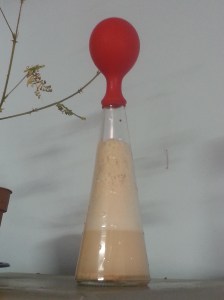
Blow up the balloon and then release the air from it to stretch a bit. Then, using the funnel, pour the dry yeast and sugar into the bottle and shake it all up with some warm water. Put the balloon over the neck of the bottle, making sure it’s firmly in place.
After a few minutes, the yeast will begin making foam and the balloon will start to blow up because of carbon dioxide emission. The foam may actually overrun the top of the bottle and escape into the balloon – that’s OK.
A couple of hours later, the yeast activity will fizz out, but the balloon will retain its size.
It’s a very easy, fun experiment which prompts interesting discussion with kids about micro-organisms, metabolic processes and properties of gas.