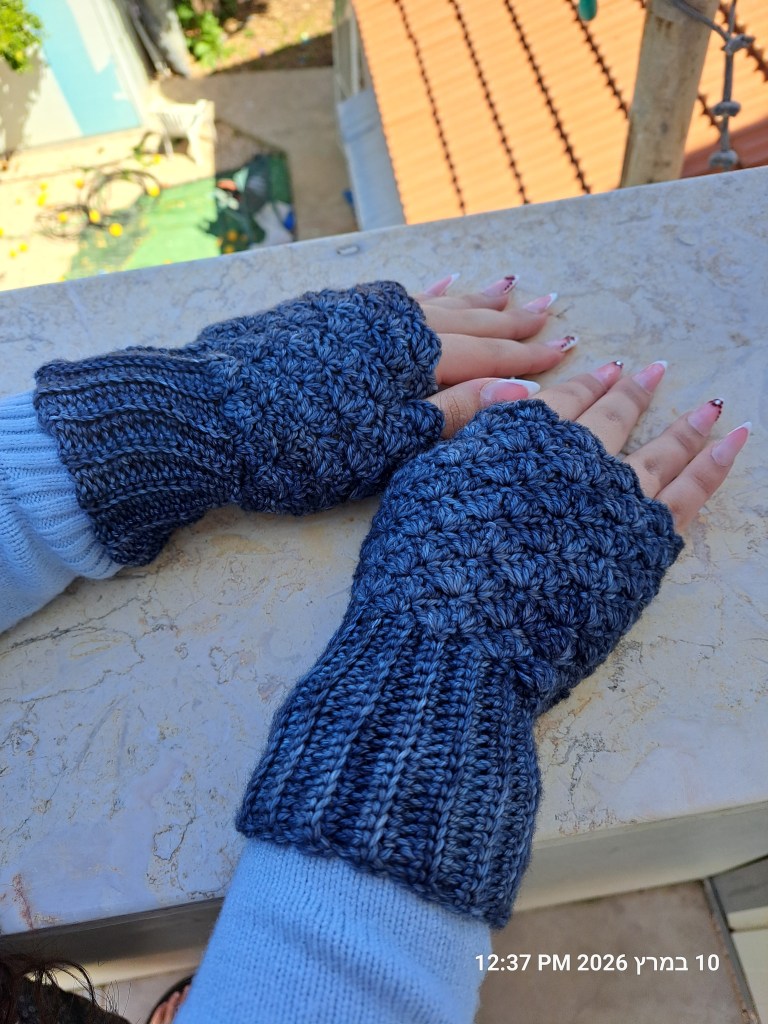
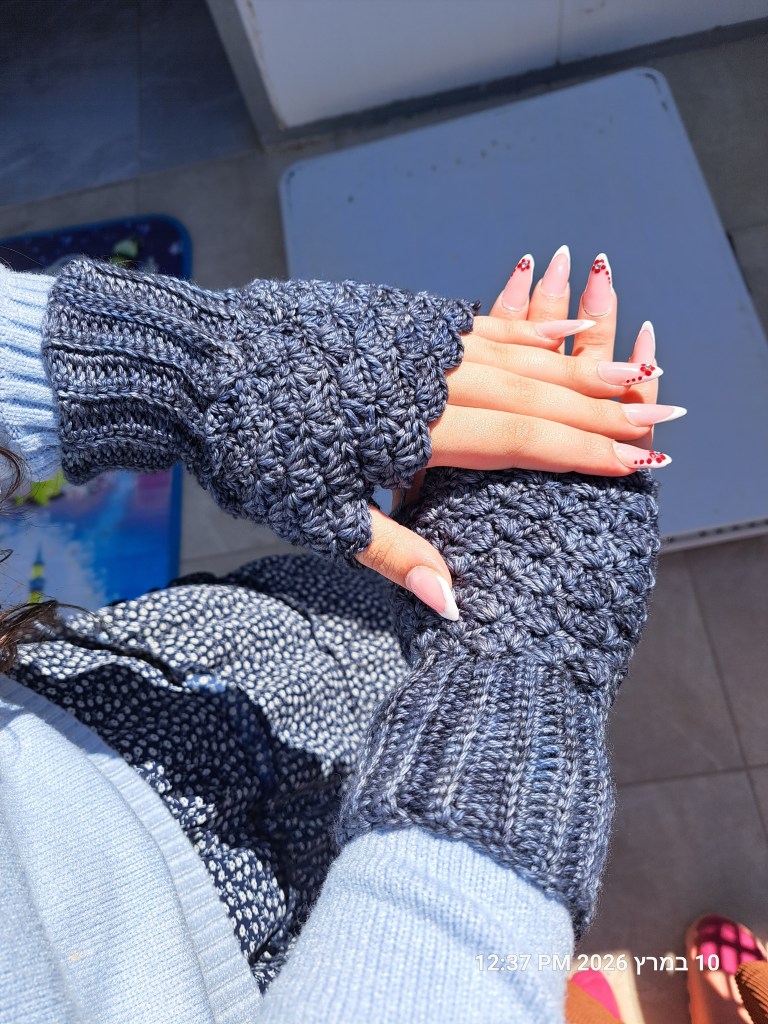
For a while now, I’ve wanted to crochet fingerless mitts similar to those I made in Malabrigo Silky Merino. These turned out to be a perfect little project to keep me calm and focused in the bomb shelter while we wait out Iranian missile strikes.
I worked with a 3mm hook and used about 50 grams (around 150 meters) of Malabrigo Arroyo in the color Cirrus Gray (845). This was my first time working with Arroyo; it behaves pretty much like its chunkier sibling Malabrigo Rios. For comparison, Rios contains 192 meters/210 yards per 100 grams, while Arroyo packs 306 meters/335 yards per 100 grams.
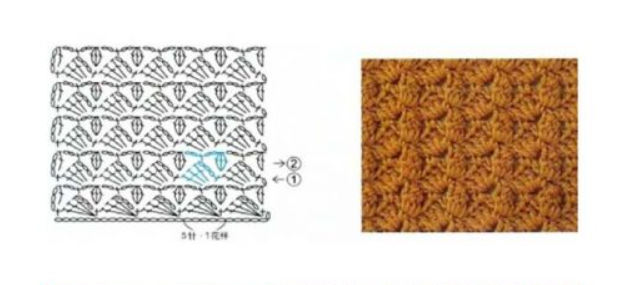
The ribbing for the wrist part is a rectangle made from single crochet in the back loop, then joined with slip stitch to form a tube. I then continued working the main part in this stitch:
Like other superwash Malabrigo yarns, Arroyo is smooth, uniform, and easy to work with. It comes in an array of vibrant colors and frogs easily if you need to go back and correct a mistake.
I’ve long since accepted that I belong to a family of pack rats who LOVE to accumulate stuff and find it extremely difficult to part with anything, from old T-shirts to frayed sheets or multiple dog-eared copies of the same book.
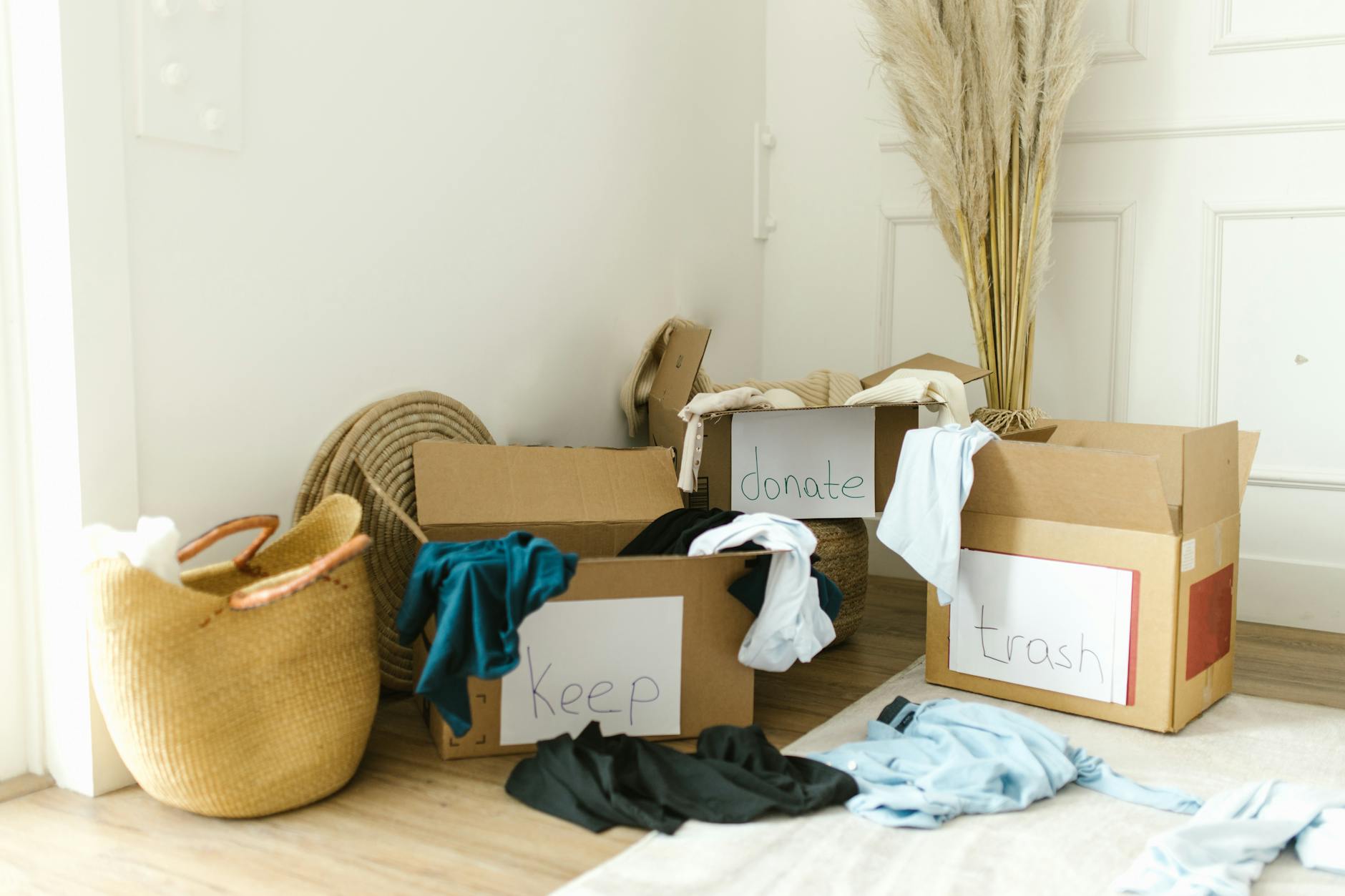
There are many days when I’m tempted to just pick up a large garbage bag and start chucking stuff into it. I fantasize about how much easier the house would be to clean and maintain in order if it contained 80% fewer things.
Unfortunately, trying something like this around here would start a full-blown war, so I’ve come up with a compromise that preserves my sanity while avoiding conflict: find one item, every day, that you can get rid of without regrets.
It can be anything: an empty perfume bottle, an ancient set of dried-out acrylic paints, a pair of shoes that pinch just a little (and that, if you’re honest with yourself, you know you’ll never wear). This strategy amounts to hundreds of unnecessary items a year, out of your house and of your life. And often, you’ll spot more than one thing you can toss.
On another note, today marks the release of my 20th fiction novel: Lethal Water, book 2 in the Storm of Elements steampunk-y fantasy series. A decade has passed since I self-published my first novel, after snatching away an hour here and there on the family’s clunky desktop while my kids were asleep. Here’s to many more exciting stories to come!
Recently, I’ve been browsing quite a lot of the AITA subreddit. You come across some interesting stories, like this take from a stay-at-home mom:
“It’s the hardest, yet most rewarding job in the world. It is work though and I feel like I should get at least some compensation for all that I sacrifice. My husband doesn’t feel that way at all, though.
I decided to draft up a list of the stuff that I do around the house. Daycare, cleaning, cooking, etc., and after the tykes were put down I presented it to him and explained that I would like to be have a separate bank account and be paid (min wage). I figured that was completely reasonable, but apparently not.”
So… should stay-at-home moms be paid? I don’t think so.
Now, I’ll be the first to admit that SAHMs are often taken for granted and not appreciated enough, even by themselves. I remember myself as a young mom with two toddlers, milk goats, a bunch of chickens, and a dog to take care of, constantly questioning whether I’m doing enough. Which, now I think about it, was crazy and kind of sad.
I also know from experience that stay-at-home parents are vulnerable and disadvantaged financially. It’s not just about the money you don’t make while you dedicate yourself to raising your children. It’s about employability. While you’re busy changing diapers and picking up toys, your professional qualifications are slipping away. Any degree you have might become less relevant with a ten-year gap on your resume. If you ever seek paid work again, you can’t pick up from the point where you left off as a college graduate or young professional. You have to start from scratch, and no one will be lining up to hire you.
Still, I don’t believe a stay-at-home mom should get money from her husband. I find this degrading. It reduces their relationship from life partners to boss-employee.
A husband and wife are one unit. Any money that one of the spouses makes belongs to both, and both should have equal access to the bank account unless there’s a good reason to do otherwise. The law agrees: in divorces, money earned by either spouse during the marriage is typically considered community property.
The stay-at-home mom from the Reddit thread above has access to the family’s money, but said she feels guilty using it for “stuff that’s just for me, like manicures or going out with my friends.”
This, I think, is the core issue here. Provided manicures and occasional outings are within this family’s budget, the mom should feel zero guilt giving herself these little pick-me-ups. She is an equal partner in the household, and shouldn’t need pin-money from her husband to validate that.
Of course, this raises questions. Has the husband ever made her feel bad about spending money on herself (as long as she doesn’t overspend)? Is he a financial control freak? Or does she simply feel uncomfortable using the money she didn’t put into the account? That’s the matter they should discuss and resolve.
The wife bailed out on their earlier agreement to put the baby in daycare when she refused to return to work once their baby was 6 months old. She realized she needed to be with her child.
So far, that’s perfectly natural. Many couples who planned their careers pre-kids underestimate the powerful way a tiny baby tugs at a mom’s heartstrings. At 6 months old, mom and baby are still practically one unit. The baby may still be exclusively breastfeeding. It’s VERY common to look at your tiny tot and realize that your priorities have changed.
The issue is with how the mom handled this situation. As the marriage partner who wanted this lifestyle change, she should have been ready for every effort to make it work. This doesn’t seem to have been the case at all:
She quit her job. She took care of baby during my work hours and wanted me to take care of cooking dinner on weekdays and cooking, cleaning and baby care on weekends because “stay at home mom deserves breaks too.”
The original poster states he had been working 80 hours a week. That’s like two full-time jobs! It’s insane and unsustainable for any length of time. I’m not sure what his field of work is, but assuming he makes more than minimum wage, the family could have probably gotten by with him working fewer hours.
This is the point where the wife should have said, “Honey, being home with Little One is the most important thing in the world to me right now. I’m ready to compromise on material things to make it happen. I’ll give up my car/ make a more frugal meal plan/ cut down on unnecessary purchases/ get baby’s things second-hand/ happily accept a staycation or camping instead of an expensive holiday.”
Or, “Let’s consider moving to a smaller house in a less expensive area.”
Or, “Let me look into flexible work from home options to contribute to our finances.”
Did she say that? If she did, the original post doesn’t mention it.
Next, it seems like the wife expected the husband to devote practically every moment at home to housework and chores “because stay-at-home moms deserve a break too.” I’m very sorry, but that’s not how this works.
Yes, everyone deserves a break, but it’s only fair that the stay-at-home parent takes on the larger share of housework, especially once the kid is past the newborn stage. If she gets a break anytime the husband is around, when does HE get a break? Especially remembering he works 80 hours a week.
Finally, once she knew the marriage is falling apart because of her attitude, she should have backpedaled. She should have realized that, if they divorced, the baby would end up in daycare anyway (as in fact did happen).
I was a SAHM for many years, and today I work from home as a freelancer. My husband never worked 80 hours a week. In fact, for extended periods, he didn’t even work 80 hours a month.
I always realized that I’m making a tradeoff: less money, more time and flexibility. I made some mistakes along the way, but overall, my priorities remain unchanged: I choose a smaller income and fewer material things in exchange for a better work-life balance. I don’t assume that the universe owes me the lifestyle I could have had if we had been a family with two full-time incomes. Fact: Today’s economy is wired for dual-income families. To make it work on one income, you need flexibility, creativity, compromises, and often sacrifices.
In short, this man didn’t divorce his wife because she wanted to be a SAHM. He divorced her because she was exploiting him and running him into the ground. It looks like the wife dismantled her own marriage with her selfishness and entitlement.
Years ago, we tried raising Japanese (Coturnix) quail. While these are delightful and easy-to-keep birds, our first experiment didn’t go that well, for two reasons: one, I think we subconsciously expected quail to act like mini-chickens (which they aren’t), and two, we underestimated our local predators.
We kept our quail in a bottomless cage placed directly on the ground, mistakenly thinking that its weight will deter anything that wants to snack on these feathery little nuggets. Big mistake. One morning, we walked out to discover that something had dug under the cage and carried off most of the quail.
The remaining birds escaped when transitioning between cages; we were totally clueless as to how well they can actually fly, and once they escape, you’ll likely never see them again. Letting them free-range is NOT an option.
Fast forward to now, when the kids began asking for some quails again. So we decided to give it another go and brought in this trio. The hens are supposed to start laying soon, and we may even try hatching some eggs in time.
Japanese quail are a great option if you’d like some home-grown eggs but live in an area that doesn’t allow chickens, or if you aren’t sure whether raising poultry is really your thing. They’re quiet (the males call, but it’s nothing compared to roosters), robust, and don’t take up a lot of space. You’ll need about 1 square foot per bird.
Japanese quail can pop out up to 300 tiny, delicious eggs per year. 3-4 eggs are roughly equal to one chicken egg in volume. Hens start laying as early as 8 weeks (!). Whenever I get to updating The Basic Guide to Backyard Livestock, I’ll be sure to include our experience with quail.
***
On another note, I’m excited to share that my dystopian trilogy, Wild Children, is now re-released with updated covers! The books follow a group of youngsters surviving and making a life for themselves in the wilderness. Among other things, they discover how essential animals are to food security.
When I was a very young child during the Perestroika, I once walked into a grocery store with my mom. The Soviet Union was on the brink of collapse, and the shelves were practically empty. I think it was then that I realized basic things we take for granted, like food in stores, can disappear.
Fast forward to today, I appreciate my well-stocked pantry full of canned goods, dried legumes and grains, hygiene products, toilet paper, candles, and basic medical supplies. Although, thankfully, we haven’t faced a full-blown collapse scenario yet, that stockpile really came in handy during times like COVID lockdowns and shortages caused by war.
Stocking up is also a great option for more trivial situations, like finding a really great deal on canned mushrooms and buying a total of 36 cans. Or when you predict prices are going to soar and take advantage of the last days or weeks when some products are relatively affordable.
Another big bonus of being well-stocked is not having to go shopping as often. When I run to the supermarket, it’s typically because I’m out of milk or other perishables, not dish soap, coffee, or shampoo.
I also have nice stashes of items that aren’t survival-oriented per se, but come in really useful, like printer paper, craft supplies, glue, and (guilty!) yarn. Keeping ourselves, not to mention fidgety kids, entertained during a shelter-in-place scenario is a challenge, and it’s nice to know you can always find something creative to do.
If you have animals, you’ll also want to make sure you have enough food for your furry or feathery friends. I get slightly anxious when the sack of chicken feed runs low, even though technically I know chickens are omnivores and could survive on leftovers for a few days.
The main thing that helps me keep my stockpile organized is the FIFO rule: first in, first out. I make sure to move the older packages to the front so I use them first, even if it means rearranging a whole shelf.
What about you? Do you stockpile, and what do you think you should keep more/less of around?
Recently, I’ve read about the Israeli government pushing to cancel 200-shekel bills, as part of a long-term drift toward a 100% cashless future. I was aware that large-scale transactions in cash have been limited for some time now, but until this moment, I kind of overlooked the final goal of abolishing cash altogether.
This is an alarming trend.
Going cashless will hurt the most vulnerable, like seniors and technologically challenged people. Or think about a woman in an abusive marriage, who can’t access a bank account or credit cards. Those little bits of cash she manages to stash away may be her only path toward an emergency escape.
When you have no access to physical money, you can instantly become completely destitute if the government decides to freeze your account for any reason, like protesting mandatory vaccination. Abolishing cash means stripping away a large part of our independence, freedom, and privacy.
In Israel, the official pretext for limiting cash is cracking down on criminal groups. But a capable government should have ways of fighting organized crime without cutting into the rights and freedoms of law-abiding citizens.
“Stash up cash” is common preparedness advice. If there’s a natural disaster, war, or a massive cyber attack, if the power or WiFi are out and people can’t access banks or use their credit cards, physical money may be the only way to buy food and other essentials. In a country like Israel, with so much instability, canceling cash is an extremely short-sighted move.
All of this makes me think: how can you prepare for an emergency situation or a long-term crisis, with cash being no longer available?
Precious metals like silver and gold can be a huge advantage in this situation, since they’ve kept their intrinsic value for thousands of years. Foreign currencies may likewise be useful. [As a side note, governments that want to chip away at people’s freedoms may also crack down on the possession of precious metals and other valuables.]
In a more long-term scenario, some societies can band together and establish alternative currencies. I won’t mention crypto, because again, I’m talking about situations where people are offline or off-grid.
Finally, let’s not dismiss the power of barter. Fresh produce, non-perishables, and various supplies can all be bartered, as can skills. People who are good with their hands may have many options of exchanging services for foods and other necessities.
During WWII, my grandmother survived by unraveling old wool garments people brought her and knitting or crocheting new items out of the salvaged yarn. She would accept food as payment. I hope none of us ever have to face a similar crisis, but it’s still wise to invest in skills and resources that might help us survive tough times.
***
P.S.: Tomorrow evening marks the start of a new year in the Jewish calendar. I wish all my Jewish followers Shana Tova and hope for a better, more peaceful year ahead.




 Domestic Felicity