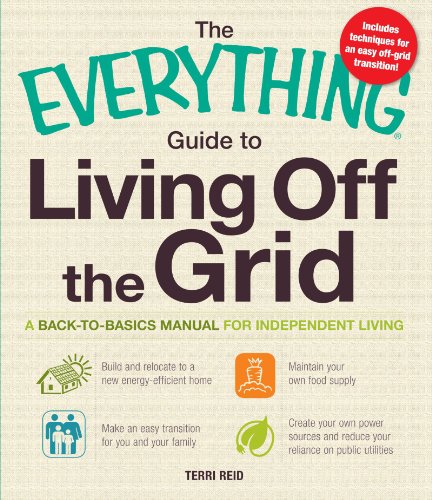
The Everything Guide to Living Off the Grid: Book Review

The Everything Guide to Living Off the: Reid, Terri

I’m now reading The Everything Guide to Living Off the Grid by Terri Reid and, though there are some sections which are obviously irrelevant to me (such as hunting, fishing and raising pigs), I have found this book a veritable treasure trove of useful information on planning a homestead, gardening, keeping livestock, getting and staying out of debt, and much more.

I have read some of the reviews on this title, and while many readers complain that, rather than provide in-depth information, each chapter barely skims the surface of the subject it discusses, I don’t necessarily find this a drawback. Yes, this isn’t a comprehensive guide on gardening AND building a house AND setting up an off-grid energy system – nor could it reasonably be, unless it were ten times longer; it’s more of a read to whet your appetite to learn more about each of these subjects, and make you brainstorm about what might be the right solutions for you on your individual path to sustainable living. In that capacity, it is certainly a useful book.

I would, however, recommend taking everything with a grain of salt, and cross-compare your information by also seeking out other sources, as I have spotted some obvious mistakes in the text; for example, the author states that beekeeping has been around for 150 years, while in fact it is an ancient practice dating thousands of years.

All in all, I would still recommend this to anyone interested in simple living, sustainability and self-reliance, but not as an exclusive and one-in-all guide. My overall rating: 3.5 stars out of 5.

Beautiful hobbit house

I love hobbit houses with lovely rounded corners and natural materials – and, though living entirely off grid seems a little daunting, I’d move into this super cute little house if I only had the chance! Straw bale building fascinates me so much that I’ve been itching to try it for a while now.

It’s a great inspiration to us all to watch people fight back against mass building and insane housing prices by raising shelters that are sustainable, affordable, beautiful and easy to maintain. In Israel, however, the main obstacle in the way of lowering housing prices are the prices of land. Land is scarce (in most regions – some are sadly underpopulated), and there is also the unfortunate phenomenon of widespread land piracy by Bedouins – which, despite the romantic image of the uncivilized nomad, cannot be tolerated in a small country with few and precious land resources (and, indeed, would not be tolerated in any country with a semi-developed legal system).

I hope, and dream, and pray that one day soon, our government will recognize the potential benefits of low-impact living, with eco-friendly building, environmental awareness and reduced energy exploitation, and will encourage people who would choose such a lifestyle, wishing to tread gently and lightly upon the face of this earth.

Does Self-Reliance Pay Off?

Not long ago, as I was working in the tomato patch, my 8-year-old strolled over and asked, “why bother growing tomatoes? Buying at the store is easier.”

This is a legitimate question, and one many people much older than her have asked. Why should anyone bother growing their own tomatoes, raising their own chickens, mending their own clothes and repairing their own plumbing? Well, one can easily come up with half a dozen ready answers, such as, “it’s fun”, or “I can grow healthier food in my backyard”, or “I like tinkering with my own stuff”, or “I save money that way”, but at the core, this is a conflict between two basic attitudes; one that is for making more money, which can be turned into goods and services, and another, that is for making do with less money, and meeting more of your needs on your own.

Read more on the topic in my latest Mother Earth News post:

“Products and services that are readily available today might not be so in the near future. It is the belief of many wise people that our current economy is not sustainable. I do not have the ability to predict whether we are facing something like the Great Depression in the near future, or simply economical fluctuations, or even nothing at all – but it’s good to be prepared. In case prices go up and store shelves empty, the people who know how to grow their own food, fix their own roof and make a little go a long way will be a lot more comfortable than those who have become used to a lifestyle of frivolous spending.”

Making Things Last

Image result for making things last
Part of living economically is not only the avoidance of unnecessary purchases, but also making things last; by “things” I mean anything you would use long-term – clothes, shoes, appliances – as well as your non-perishable grocery store items, such as toilet paper, shampoo, toothpaste, soap, cleaning products, etc.

With clothes it’s really straightforward. We have work/play clothes, which we tend to treat a little more carelessly (and more often than not, we either got them for free or for a bargain), and we have good clothes, such as for Shabbat. Clothes go into the wash because they need a wash, not because they had been worn once. Of course, with children’s clothes, being worn once usually means a wash is in order!..

Doing less loads of laundry means reducing your expenses of electricity, water, detergent, and wear and tear on the clothes and on your washing machine. Line-drying minimizes wear and tear, too, not to mention it also saves electricity.

Good shoes receive regular treatment of shining, oiling and polishing, which makes them last longer. I have a black pair for summer and a black pair for winter, and they are in such condition that I hope they might last years. Of course, for walking, yard jobs and home, I also have sneakers, mud boots, and slippers.

When it comes to non-perishables, I guess disposables should be mentioned. I wish I could say I don’t use disposables, but I will be honest. I do. Sometimes we have friends over and I use paper cups because it’s late at night and I can’t face waking up to a sink full of dirty glasses. Sometimes, when you go out for a picnic, for example, using disposables makes sense. But generally I try to minimize that.

As for other non-perishables, I don’t mean to imply gross things such as that you shouldn’t wash your hair, skip washing your hands, etc. Use what you need – but not more than you need, like the manufacturers of every product would have you do (so that you run out soon and go and have to buy more). Have you noticed the enormous holes they make in toothpaste tubes? If I’m not careful and squeeze just a little bit too hard, half the toothpaste comes out at once.

I used to wash my hair three times a week, and thought I needed it. But then, one winter it was cold and I only washed two times a week, and I noticed that very soon, my scalp adjusted its oil production so that I had the same result as when I washed three times a week. Now I wash once a week, and find it more than enough to keep my hair in good condition. This, obviously, means I use three times less shampoo and conditioner.

It’s important to keep your hands clean, especially when working in the kitchen, but you don’t have to use soap every time. Using too much soap makes your skin dry. When I use detergents – such as for laundry, for floors, for windows, etc – I always use less than is recommended, and the results are very satisfactory. Remember, the instructions on the package are made by people who want you to use it all up and go buy more!

Thrifty finds

Image may contain: people standing, sky, tree, outdoor and nature

Yesterday our local second hand store threw a huge fair, and I found several nice little dresses for the girls, and one for myself. This morning, up they went on the cheerful sunny clothesline (two leftmost and third on the right). I’m very happy with them. They cost next to nothing, and are of much higher quality than anything I could have afforded to buy new.

Enjoying another nice summer day of homemade lemonade, working in the garden, playing with the baby chicks and hand-feeding Little Pea, our peafowl chick, who now runs to us to get a treat whenever we approach.

I would also like to take this opportunity to thank the amazing people who were among the first buyers and readers of The Landlord. I know some of the downloads came from the blog readers, and I am truly overwhelmed by your generosity. I hope you will take a few minutes to leave a review once you finish reading – it would mean the world to me.

A Walk With Grandma

Image result for i like to walk with grandma

I hope it’s normal that, every time I happen to come across this poem, I just sit for a minute and cry. These simple words are so touching. I also remember my own Grandma, who was such a quiet and soothing presence, and who was always ready to play board games and tell stories about her childhood, early life, and numerous relatives whom I had never met.

Grandma is wise. She knows there is really nothing bigger, better and more beautiful than the fluffy clouds in the sky, the flower growing at the roadside, the butterfly fluttering around a rosebush. She has done it all. She has seen it all. She knows there is nothing more important than telling a story, taking a walk, baking cookies on a cold winter afternoon.

We don’t have to live to Grandma’s age to appreciate the little things that really matter. Though our lives are busy, may we not let this prevent us from slowing down and walking with “short steps” alongside the child in our life, or the little child hidden within us.
***
P.S: my latest novel, Wild Children, is currently at a 0.99$ discount on Kindle (until next Thursday), so if any of you are looking for a new dystopian/light SciFi read, you might want to check it out!

Stockpiling for sustainability

stockpile

If you aren’t stockpiling yet, you definitely should. It saves time on shopping, enables one to take advantage of the best deals, and has the potential to tide one over a tough period. In several instances we have eaten our way through our stockpile, relying heavily on it when times were rough.

Read more on stockpiling in my latest Mother Earth News post:

“My husband would see something on sale, and buy several items instead of just one for immediate use. There’s often something at a good price that can be stored for a long time – canned vegetables, pasta, rice, beans and barley, non-perishables such as shampoo and toilet paper. I must admit that back then, I felt a little pang in my heart whenever I saw the grocery bill, thinking to myself that here are things we could do without, taking up storage space. Time proved that I was wrong.”