Why Large Families Are Environmentally Friendly

Image result for large family cartoon

There’s an argument going on among some radical environmentalists claiming that having more than two children is about the greatest sin one can commit against the planet. While many developed countries are characterized by reduced reproduction rates, I would like to argue that large families – and now that we have four children, I believe we have officially crossed that bridge – are often a lot more environmentally friendly than households with no kids, or two children at most.

We are frugal. On average, with each child added to a family, the per capita income is lower. In addition, it’s more likely that one parent, usually the mother, will stay home to be the primary caretaker. This forces large families to be creative with their resources, and make a little go a long way. Around here, a lot less food gets thrown out now than when we were newlyweds. We use less disposables, among other reasons, because when you need to put out plastic dishes for a lot of people, it gets pricey.

Our households are more efficient. The more people live in the same household, the less, on average, they use up per capita in terms of space, water and energy. Children share rooms. Our electricity bill has grown with the addition of children, but not proportionally to the number of people in our family. That’s because the same amount of energy is used, for example, to bake a casserole for two people or for seven (you just use a larger pan). When we use the water heater, we take advantage of every drop of hot water. We take shorter showers because there are other people waiting to use the bathroom, and often two children will share a bath. Oh, and we have much more incentive to declutter and bring less junk into the house to begin with, because we just don’t have the room!

We are hand-me-down experts. Not only are clothes, shoes, toys, books, baby equipment, etc, passed from child to child, but we’ve become experts at looking for, and finding, the best second-hand deals. That’s because the price of new clothes, shoes, toys, and so on, even if you choose the cheapest bargain, really adds up. It makes a lot more sense to buy a gently used item of good quality, or accept hand-me-downs from friends and family. I currently have three huge bags of children’s clothes to sort through. I’ll choose what we’ll keep, and pass the rest on.

We travel less. Before I got married, I traveled abroad on average once a year. I’ve never boarded an airplane since, and now, with four children, it’s unlikely we’ll do that in the foreseeable future (unless it’s relocation for purposes of my husband’s work). With the addition of a fourth child, a standard 5-seat vehicle is no longer enough. This means we need a bigger car – which burns up more gas, that’s true, but here’s the incentive to drive around less! Plus, when you have a bunch of kids and no babysitter, you have to tote everyone around, and this teaches you to be efficient with your errands.

Our entertainment is more family-centered. The more kids you have, the more expensive (and more of a hassle!) it becomes to take everyone to eat out, to the movies, to an amusement park, or indeed to any paid entertainment venture. Finding a babysitter is more challenging, too. Our outings, if we go out, are family friendly and free – to local parks, the library, farms, farmers’ markets, etc.

Disclaimer: we are religious and do believe that earth was created for the benefit of mankind, and not the other way around. Nevertheless, it is our duty to be good and diligent stewards of the resources we have been given, and make sure we “waste not, want not.”

Nursing on demand and parental authority

Image result for breastfeeding

There is a lady who writes in an Israeli magazine, whose articles on parenting I always look forward to. She speaks a lot about parental authority, delegating responsibilities to children, resisting worldly influences and other subjects I find instructive. Her most recent article was no exception. She lamented the fact that so many parents are encouraged to choose the so-called “child-centered” lifestyle, becoming slaves to the child’s choice of friends, clothes, toys, extra-curricular activities, and… nursing on demand.

Nursing a newborn on demand? Why, yes. “In the past,” she writes, “new mothers were told to breastfeed according to a schedule. Now it is recommended that you do it whenever the baby feels like it.”

I felt compelled to send this lady a personal email, in which I pointed out that all the examples she used in her article were good ones, except nursing on demand, which in no way “spoils” the baby or harms the mother’s authority. Quite simply, the fact that the recommendations in hospitals changed is due to finding out that nursing on demand (or rather, on cue) is actually the easiest and most intuitive way to establish successful breastfeeding – which is important not only for the baby, but for the mother’s health as well; try skipping a feeding for the sake of a schedule and you may end up with painful engorgement, complete with a plugged duct and high fever.

She wrote back. Her response was polite but self-assured. “Our mothers breastfed on schedule,” she said, “and we turned out a lot better brought up than the current generation of children.” True? Perhaps. Cause and effect? Not in the least.

I responded and said that, indeed, our mothers were told to breastfeed on schedule – and not coincidentally, it was a generation of formula-feeders. My mother-in-law, for example, was told to breastfeed her newborns every 4 hours. No more, no less. Baby is crying? Let him cry until the set hour. Baby is sleeping and you are thinking of taking a nap yourself? No way – wake him up to nurse. Unsurprisingly, her milk “just ran out” after 1 month, after which she had to give her children’s cow’s milk (as formula wasn’t readily available), and  many years later told me how she “was one of those women who just couldn’t produce enough”.

I also heartily recommended this lady to discuss the matter with a lactation consultant, and to consider all the facts. After all, it is a pity if a new mother who threw feeding schedules out of the window reads her article and thinks, “what if I’m spoiling the baby? What about my ‘authority’ as a parent?”

Imagine the following situation. It’s nearly evening, and I’m busy making dinner. A five-year-old is hanging around and says, “Mom, I’m hungry.” “Dinner will be ready in an hour,” I say. “But I’m still hungry,” she insists. “Alright, then,” I say, “if you feel you really need to eat something right now, you can get yourself an apple.” She proceeds to do so, and settles down with her little snack while I continue making dinner in peace.

Does the exchange above make my household “child-centered”? No. Does it make me less of an authority figure as a parent? No. Would it be better if I barked at my little child, “wait for dinner!”? Again, no. By the way, those who have been reading this blog for a while know I’m very much in favor of regular family meals. But if I get myself an unscheduled snack, sometimes before dinner or right before bedtime, and find it acceptable, why should I refuse when it comes to my children? I’m not speaking about things like sweets and cakes, of course, but about an apple before dinner or a slice of cheese before bedtime.

So what is the difference when we’re talking about a baby? A baby is completely dependent. She cannot get up and get her own snack. She cannot communicate her needs in words or negotiate. All she can do is signal to me that she needs to be picked up and fed – which, if the baby is exclusively breastfed, can only be done by me. So there is no getting around the fact that I must, indeed, nurse when the baby needs it, not when it is most convenient for me. This has nothing to do with authority, and everything with meeting the most basic need of a tiny human being.

Think of a novel concept: scheduled diaper-changing. After all, why must we be slaves to the baby’s whimsical schedule of bowel movements or wet diapers? Why must we hurry with a new diaper in hand every time? As parents, we are the leaders, and thus the baby must follow. She must learn that she is part of a family, and adapt to the family schedule. Thus, from now on, diapers will be changed – regardless of how wet or dirty they are – five times a day, at set intervals, and once at night. Try this for a few days, and you will see how your baby soon stops crying because of a messy diaper!

Sounds ridiculous? Of course. But in my eyes, this concept really is no different from feeding on cue vs. feeding on schedule. Some day, your baby will be able to go to the bathroom without your help. Some day, she will open the fridge and make herself a sandwich. But babies need their parents to provide those primary needs, and it is the parents’ job to do so.

Easy Homemade Chocolate Spread

My latest MEN post features a recipe for homemade chocolate spread that is delicious, easy to make, and far better for you than anything store-bought. It contains exactly four ingredients, and one of those is water.

“Do you like chocolate spread on toast, pancakes or waffles? My kids are ready to eat it by the spoonful if we would only let them, but the kind of commercial junk that passes for chocolate spread in the industry doesn’t have a place on our pantry shelves (Nutella, for instance, contains about 55% sugar and 30% oil, leaving only 15% for anything else).”

The detailed recipe is here.

Frugal Finds

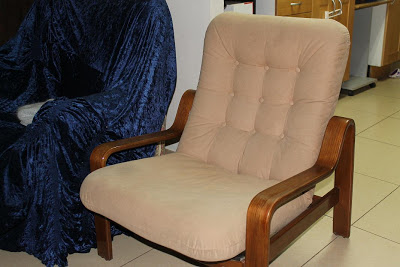
Above: this armchair, a really great find by someone from the family, ended up finding a home with us because we happened to have an extra bit of space in the living room.

Someday (perhaps when I’m a Granny) I might sit down and compile a little book titled “How to Get Good Furniture for Next to Nothing”. Can you visualize this? Chapter 1: The Landfill. It seems to me this has the potential of a bestseller, doesn’t it? :o)

 
Basically, whatever it is that you need, you can be pretty sure that it either lies abandoned somewhere and just needs a little dusting off, or someone somewhere is looking to give it away or to sell it for a fraction of its store price. It might take a little search and effort, but very often it’s just a matter of looking about. Why bother, you are asking? Well, the money-saving element is obvious, but there are other advantages to not following the want, grab, pay routine.

* You get satisfaction in giving new life to items that were discarded as “useless”. And sometimes, surprisingly, the “old junk” is actually something of much better quality than what you can buy for a reasonable price today. I’ve seen old furniture that looks like it will endure for eternity, but today, I get the feeling manufacturers say, “let’s make junk so it breaks down sooner and people will have to buy more from us!” Thus, if you use the old instead of buying new (when you can) you are withdrawing your financial support from a wasteful industry.

* Since your “new” acquisition cost you nothing or next to nothing, you can get creative with it. Basic carpentry skills can often be applied to making shelves from discarded bits of wood, and you can experiment with paint, varnish, gluing a mosaic of glass or pottery onto an old coffee table (I’ve seen this done very artfully) or whatever your heart desires. Lovely slipcovers and seats can be sewn, knitted or crocheted for sofas and chairs.

* You get the additional benefit of not having to fret as much if your children spill something on the sofa or vomit all over their bed. And as we all know, it will happen. I’ve been to many homes (with resident children) where people have bought their furniture new, and after a surprisingly short time it doesn’t look any better than our “oldies”. I remember Susan Schaeffer Macaulay in her book, “For the Family’s Sake”, told about an old table she had. “It was my luxury,” she writes. Was it such a fancy expensive table? Oh no; it was an old giveaway, and its surface was all ruined, so the children could comfortably draw, paint, and get creative with playdough on that table. And when it’s covered with a lovely tablecloth, it looks good as new.

Of course, if money isn’t a consideration at all, it’s nice to just walk into a store and get yourself whatever new gorgeous set of table and chairs your heart desires. But many people who have very little, waste too much of the little they have on things they could have gotten for free or nearly for free, and that is a pity.

OK, I’m on a roll here. If I don’t stop now I’ll press right on to Chapter 2: Give-away Websites, so I’d better get off my soapbox and wish you good night.

The Great Curriculum

DSC_0627

If there is one recommendation I feel qualified to give regarding teaching young children (especially – but also older children, and adults, too), it would be spending as much time as possible, weather permitting, out of doors.

No matter where you live, there is always something to do, learn and observe outside – tending to your own garden and animals, foraging, taking notes on the various plants, insects, birds and animals in your area, etc.

The outdoors are particularly suited to little ones, in not having the limitations we almost unconsciously enforce at home. There young children can shout and laugh loudly, run without fear of bumping into furniture, jump, climb, and in general let out their energy without bothering anyone.

Too many children suffer from severe shortage of unscheduled and free outdoor time – and by ‘outdoor’, I mean not so much neat and orderly playgrounds without a stray blade of grass to be seen anywhere, but wild-ish old parks with ancient trees, open fields, orchards and groves, the sea shore or the river side – whatever humble bit of nature you have in your area.

What about learning? It comes organically when children come back to you from a romp with a collection of leaves and questions; when they squat to observe an anthill for a whole hour together; when they measure the depth of a puddle with a stick, or take notice of the change of weather and seasons.

Here are some more ideas for nature-based activities:

– Drawings or playdough sculptures of interesting objects;

– Collections of leaves, stones, pinecones, seashells, etc, and crafts based on those;

– For slightly older children: nature diaries and photographs that can be made into beautiful collages;

And the best part of it is, you’ll likely have as much fun as your kids!

In the photo: Israel, 3 yrs, is trying to coax a tortoise to peek out of its shell.

Seriously Simple Sesame Cookies

DSC_0606

Although it’s hard to compete with the oatmeal coconut no-flour cookies, these cookies are lately gaining a place of favor in our family. They are delicious, extremely easy to make, convenient for little hands to shape, and not that bad in nutritional terms. Lovers of sesame seed, like us, will find these addictive.

Recipe is as following:

1 cup flour (almost any kind will work)

1 cup sesame seeds

4 tbsp of your preferred sweetener (maple sugar, date sugar, honey)

1 egg

5 tbsp coconut oil

1 tsp baking powder

Mix everything together. You should have a pliable, workable mass. If it comes out too dry, add a little water or an extra egg.

Form round flat cookies, place on cookie sheet and bake until edges are just slightly golden. It should only take a few minutes. Don’t overbake!

Allow to cool and store in airtight container.

Home Remedies In Your Kitchen

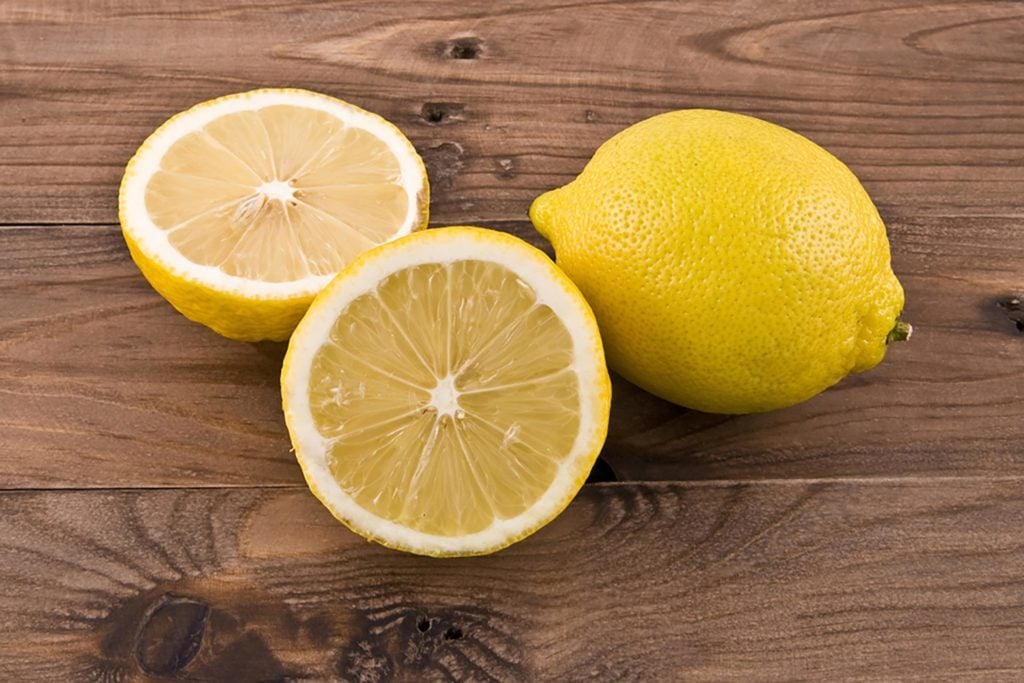
Image result for lemon

“I love exploring various home remedies, and am a strong believer in everyone raising a patch of medicinal herbs in the yard, on a balcony, or even in a row of pots on the windowsill. Mint, rosemary, sage and lavender are all easy-to-grow, delicious-smelling herbs with a variety of uses, both medicinal and culinary.

But are you aware of the fact that not just herbs, but many staples which you almost certainly have in your kitchen, can also be used in a variety of safe, effective and healthy home remedies?”

These humble health-promoting compounds include black tea, salt, baking soda, and more.

Read the rest in my Mother Earth News post here.

Also, there are now two more places where you can follow me: Pinterest and YouTube. I plan to upload regular video snippets of our daily projects, so stay tuned! You can watch my first little video here: