Little homes, creative solutions

Lately I’ve been greatly enjoying Teri’s blog, Homestead Honey. Teri and her husband live in a charming tiny cabin of 350 square feet (just over 32 square meters) that they had built themselves. They have two children, whom they homeschool.
How do four people fit into 350 square feet? On her blog, Teri talks about some creative solutions that have enabled them to live in their small space. They have, for instance, an outdoor kitchen and an outdoor shower. And, of course, despite having a storage shed they need to be very selective about which possessions they keep.

We live in a house of about a 100 square meters, or 1070 square feet. In addition, we have a storage shed of about 15 square meters (about 160 square feet). Our house is by no means huge, but I confess we do have a lot of poorly utilized space. First, our storage shed is filled to bursting with stuff we hardly use. We also have an office and a guest bedroom that are seldom used for their direct purpose, and a lot more for accumulating junk. In addition, we have three bathrooms in our house, out of which one is used very, very rarely, and its shower not at all – I consider it completely superfluous.

So, while it’s certainly nice to have a roomy house and lots of space to put our stuff, it’s an undeniable fact that a family like ours can downsize and live in a smaller house that is easier and cheaper to heat (or cool), clean and maintain. Also, in Israel, the smaller your house is, the lower the occupation tax you pay.

Of course, you wouldn’t pay occupation tax for an outdoor kitchen, an outdoor shower, a storage shed or a covered front porch/deck/pergola that would enable you to place garden furniture, benches, swings, hammocks, and spend many pleasant hours outside! The only hitch I see in this arrangement are the days when you are confined to the interior of your house – when it’s too rainy, windy, stormy, cold or, as more often happens in Israel, too hot.
img_9932

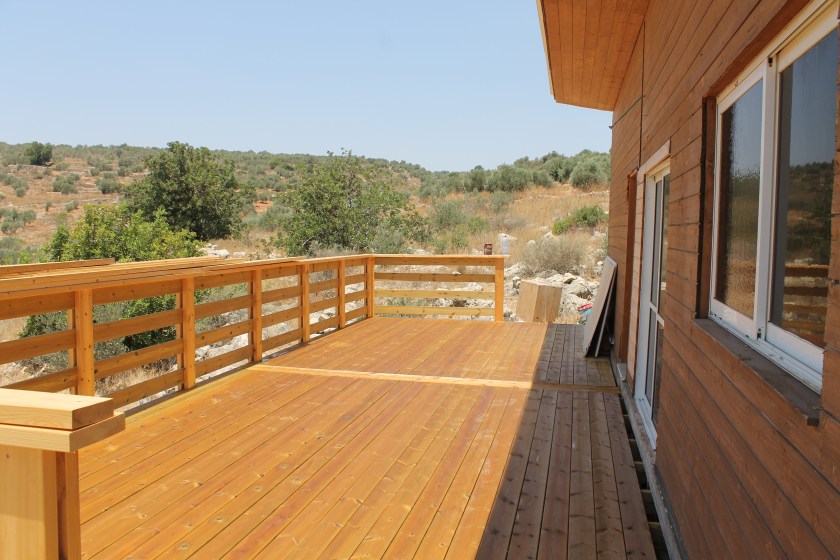
Above: deck at our new cabin

I do have to be fair and acknowledge that all these wonderful outdoor extensions are only possible if you are living on the land. In city apartments, you just make do with your space (though I’ve seen some very neat space-utilization practices done in apartments too). But if you have some land, however little, you can work wonders.

We have been married close to nine years now, and we are on our fourth house, so far. Despite my desire to get settled in a permanent home (as much as anything can be permanent in this world) straight away, I think it was a blessing in its way, because it did force us to go through our possessions from time to time and decide what we can’t do without. When you must pay to have your stuff moved, you’ll probably let go of that old broken-down washer than has been sitting in your back yard for years, waiting to be turned into a potter’s wheel or some other marvelous engine (talking from experience here). Still, we tend to accumulate possessions at an alarming rate.

At this time, we are facing the prospect of moving to a smaller house. When it first began to dawn upon me this is a serious possibility, it was daunting. How would I sort through all our things? Obviously we wouldn’t be able to keep everything. We’d have to get rid of stuff, possibly a lot of stuff. How would we fit into a smaller space? But now that I’ve found Teri’s blog, and the testimonies of other people who have downsized and are happier for it, I’m not nervous anymore, but rather looking forward to this as a challenge. In the future I hope to post updates of our progress.
Easy Coconut Cream

Every time I’m whipping up a dessert, my husband hopefully asks, “is it parve“? Parve essentially means a dish that contains neither meat nor dairy. Since Orthodox Jews must wait six hours after consuming meat or chicken before they can eat dairy, it’s no wonder most people try to make their desserts parve. Unless they are vegetarians, in which case it doesn’t matter.

Unfortunately, in many cases this leads people to use unhealthy ingredients such as margarine or fake cream with partially hydrogenated vegetable oils in the desserts they make – and a whole lot of sugar to make the entire thing more palatable. For me, parve dessert has usually meant fruit salad or, in season, chilled melon or watermelon… that is, until recently I discovered the wonders of coconut cream.

Coconut cream contains natural, stable, healthy fat (in particular containing large amounts of lauric acid, which is renowned for its antibacterial, antiviral properties) and, when chilled, has the perfect consistency for whipping – in fact, it acts almost exactly like normal cream.

coconutcream

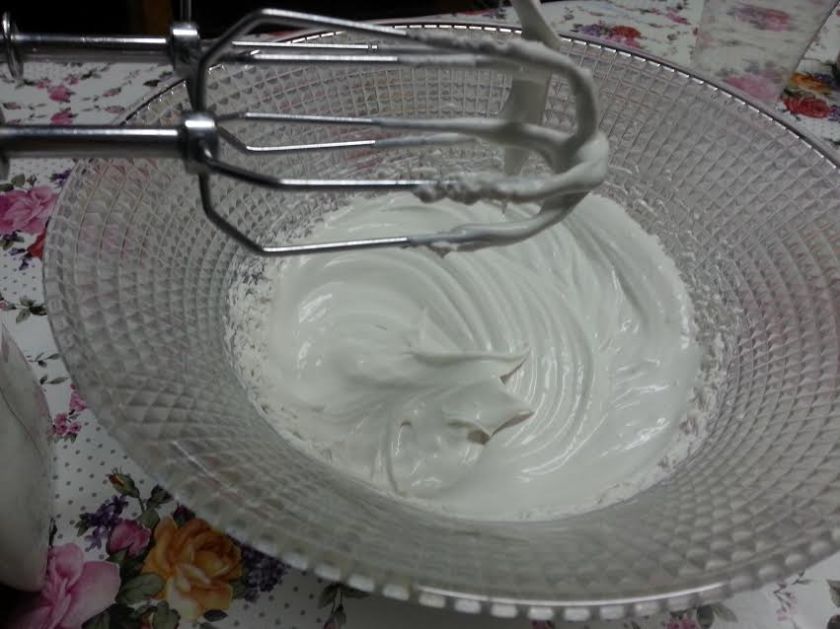
Whipped coconut cream. Doesn’t it look just like the real thing?

So here’s how you do it: pick  a can of coconut cream containing at least 17%-18% fat and chill overnight. A hard fatty layer will form on top; skim it off carefully with a spoon and add a little of the liquid at the bottom (use the rest of the liquid in baking or smoothies). The cream can be whipped and combined with all sorts of flavorings to create a variety of desserts. Yesterday I made delicious halva mousse by whipping up the coconut cream with raw tahini and some honey. I imagine it would go equally nice with chocolate… yum! I imagine it can also be frozen to make natural, dairy-free ice cream.

Personally, I love coconut, but the taste of it is very mild in the cream, so even those who aren’t coconut-crazy can enjoy this.

***

I also wanted to let everybody know that the work on Your Own Hands, the new simple living book, is going well and at this point I have most of the first draft complete. I also put some improvements and formatting changes into The Practical Homemaker’s Companion, which is now 122 pages long. I left the Payhip price at 4$, less than the print and Kindle version, as I really prefer people to download from Payhip because it only takes a small commission compared to Amazon and payments are instantly transferred to our Paypal.

When everyone is sick

About a week and a half ago, I woke in the middle of the night because Israel vomited all over me (what a way to wake up, huh?). At first I thought (hoped) it was only a fluke, but when he continued being sick in the morning, and my two other children picked up after him, I realized we’re in trouble. Then, as my husband and I I began feeling sick ourselves, I had this sinking uh-oh feeling, because few things are more exhausting than caring for a bunch of sick children when you are not on your best form yourself. I vividly remember the night when I had to get up every hour to take care of another vomiting kid, and then found it difficult to fall asleep again because I felt so queasy. On the up side, it was an opportunity to finish reading a book I’ve been hacking at for ages.

Luckily, it didn’t last long – a couple of days at most – but these were a very intense couple of days which left us totally drained and with a mountain-high pile of stinky clothes and bedding to wash. Oh, and should I mention that exactly at that time, the water pump leading to our area broke down? The stinky pile had to wait, while it got stinkier and stinkier and, eventually, some sheets developed horrible mold and had to be thrown out.

What a time. I also wrote a post about this on Mother Earth News:

“If you also have to deal with a houseful of sick little ones, this can be particularly challenging, especially if your kids, like ours, are used to running in and out of doors at all times and find it frustrating to sit or lie down still and quiet. It helps to provide some quiet amusement in the form of books, coloring books, sketching pads, and other quiet, non-messy crafts. Let your children curl up with you in bed for some reading together, or allow them to spread a board game or puzzle on the floor while you are relaxing on the couch. Movies can have their place, too, of course, but in general I find that prolonged staring into a screen contributes to fatigue and doesn’t promote the overall sense of well-being.”

The Diaper Debate

stardiapers_secondarypackshot_355x215

A long time ago, when I was pregnant for the first time and we had many lofty ideas about our own capabilities, my husband and I talked about cloth diapers. We pretty much decided we are going to use them, for the sake of frugality, sustainability and baby’s skin health. It just seemed the right choice all around, until one day, when I was getting pretty big, we had the following conversation.

DH: “But where would we wash the diapers?”

Me: “What do you mean, where? We put them in the washing machine.”

DH: (wrinkling his nose): “What, you’ll put poopy diapers in the same machine that we use to wash our clothes?”

Me: “Not in the same cycle. We’ll wash them separately, you know.” 

DH: “I still think that’s gross. Think of all the bacteria that will be left over.”

Me: “Well, what do you suggest?”

DH: “My Mom always washed our diapers by hand.”

Do I have to tell you? We’ve been using disposables ever since. And at times I’ve been feeling guilty about it, too, especially when I haul out a big garbage bag full of almost nothing but diapers and think about it adding to some tremendous landfill.

It wasn’t just the gross factor that put us off; we’ve had plenty of poop in our washing machine anyway over the years, what with newborn blow-outs and all. There were periods when changing a poopy diaper equaled changing a whole baby outfit, every time. We’re still all alive and well.

It was also that conveniently made cloth diapers are a pretty hefty initial investment, one we hesitated to make, and I’m not up to sewing my own. And, of course, there’s the convenience; at times, I’ve been so overwhelmed by laundry (especially not having a drier, on long rainy weeks in winter) that voluntarily adding more seemed an effort of will beyond my capability.

As a compromise, I have tried doing early potty-training, with babies running around bare-bottomed around the house on many a summer day. The little tushies got a pleasant breeze, we saved some money on diapers, and I felt better about the ecological aspect of it all.

In the place where we live now, we have frequent electricity and water shortages, up to the point that everybody living in the neighborhood often gets requests to save on electricity and water as much as possible by trying to minimize the usage of air conditioners, ovens and, of course, washing machines. An extra load of diapers every day or two just doesn’t seem feasible in such conditions.  I actually believe that in Israel, where water is a precious commodity, bio-degradable diapers may be more eco-friendly than cloth.

There had to be, however, a compromise: green and convenient; eco-friendly but disposable. So lately I’ve started looking into the option of switching to bio-degradable disposable diapers, such as these. I’d love to hear from any of you who care to share your experience. Cloth? Bio-degradable? Plain ol’ Pampers?

Melons

ripemelon

Above is one of the melons we grew this season. We only grew a couple of vines for the experiment, from seeds we saved a couple of years ago from an especially delicious specimen (which we bought at the store, by the way). We planted rather late and the melons sure took their time to ripen, but the wait was definitely worth it. The fruit was small, but very fragrant and sweet, since we allowed it to fully ripen on the vine before picking. I think I’m going to save seeds from this one too, to plant next year.

And, yes, in the background you can see some more hot peppers! The bounty sure doesn’t stop, and I’m going to make some more hot sauce soon.

You can read more about growing food from supermarket scraps here and here.

Yarn

yarn

My mother-in-law has given me a whole bag of yarn which she doesn’t think she’ll use anymore. I haven’t quite decided what I’m going to do with it yet. There isn’t enough for a large project, but I will probably be able to make a hat or scarf or two. The smallest bits will go towards making doll clothes or hair.

I also shared some yarn-related family stories in my latest Mother Earth News post:

“Whenever I go into a yarn shop and look at all the stacks of brand-new colorful yarns of any type you might possibly want, I think of Grandma. What may be a hobby – and not a cheap one, either – to people today was a venue of survival to her.”

Last chicks of the season

Above you can see a hen hanging out with her newly hatched brood – probably the last chicks of the season (along with another brood that it due to hatch in a day or two), since it’s already October and egg production is going to decline as the days shorten.

We’ve experienced many setbacks with our chickens this season. We lost about a dozen chicks to an especially sneaky fox, and among the remaining over half were males. Then a lovely, seemingly healthy point of lay pullet just died unexpectedly. We know many people who gave up on poultry-keeping entirely following such disappointments, but in this area, like in almost everything else, perseverance is essential and will eventually be rewarded.

peacockegg

And this is something I just had to share with you – no, this huge egg isn’t from our chickens. It’s a peacock egg we found on a day trip to a lovely park where these gorgeous birds roam around freely. Unfortunately it didn’t appear to be viable, or we’d take it to put under one of our broodies. It’s beautiful and reminds me of a turkey egg.