Weeding Made Easy

tomatobed - Copy

Do you have a least favorite garden chore? Mine is probably weeding, but with raised beds, things have been a lot easier for some time now. Read more in my latest Mother Earth News post:

“The best time to pull weeds is after a good rain, when the ground is nice and soft. Once our ground dries, it gets the consistency of hard clay and weeding becomes increasingly difficult. This doesn’t go for the raised beds, of course, which are always kept nice and fluffy. I have taught my kids to always give the beds a quick look-over and pull up every tiny weed they can find – sometimes we even make a contest as to who pulls up most.”

Keeping chickens significantly reduces weed level as well (one of the many benefits of having our feathered friends around!). Also, things do get better with each year that passes one the same plot, if you are diligent and pull up young weeds without letting them go to seed. When I look at our yard today, I actually think to myself, “wow, this looks almost well-kept considering to what it was two years ago!”

Growing Fenugreek from seed

DSC_0181

A few months ago I thought I’d try to sow some dry Fenugreek seeds from the store as an experiment, and they thrived in a sunny spot in the garden during the winter and spring. Yesterday, as the plants were already exhausted, I pulled them up and sowed some beans instead.

Fenugreek seeds grow in pods, much like peas and beans, (though the pods are smaller, of course) and can be eaten both fresh and dry. The plant has many beneficial properties, among them lowering blood sugar and stimulating milk production in nursing mothers. The dry seeds can be soaked and made into hilbe spread, after the Yemenite tradition, and also added to soups and stews.

For more information on using Fenugreek, read here.

Coping with chicken loss


There are few things more painful to me as a chicken owner than the untimely loss of one of the flock. Our chickens are all lovingly hand-raised, and it’s enough to drive one mad when a sneaky predator gets past one’s defenses, or when a disease you can do little about makes its rounds in the coop.

Still, I guess that this knowledge, this acceptance of the fact that there will be some losses, is what enables us to bounce back and keep raising chickens.

From my latest Mother Earth News post:

“Losing animals is an inevitable part of raising them. No matter how careful and diligent you are, at some point you will have to deal with saying goodbye – and not just due to old age, either – to some members of your flock or herd. This is heartbreaking even if your animals were meant to end up as dinner at some point. So much more if you treat your livestock somewhat like pets. I remember one time years ago, crying and telling my husband I’d rather give it all up and never keep anything living but plants again.”

Spring, an exciting thing

I spent some time in the garden this morning (while I really should have been getting the house in order for Pesach, but never mind) and as you can see, the sage is in full bloom and the first beans are hopefully poking their heads up.

My tomato seedlings look a bit puny,but I hope they will improve as we get more sunlight hours.

Moreover, we already have our first two broodies of the season! So hoping for some chicks soon.

DSC_0121

Our neighbor’s dog has had a litter of puppies. My kids are delighted. Here you can see the mother dog looking on intently (but not at all in a hostile manner) as Israel is gently touching one of her babies.

The garden is coming to life!

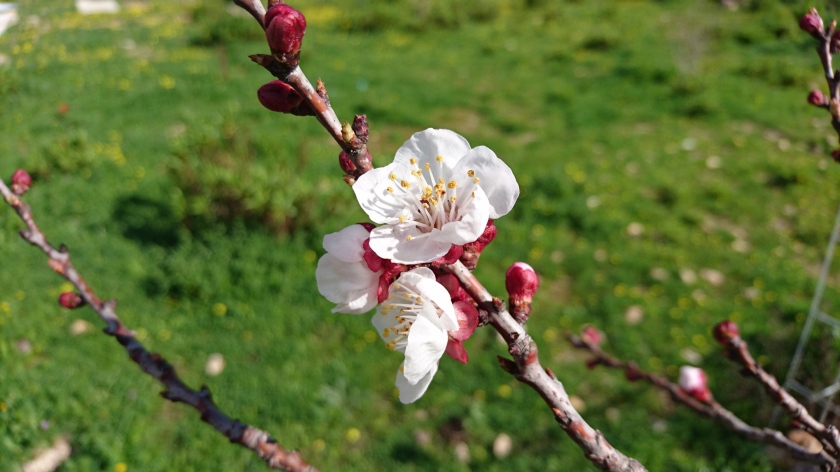
apricotblossom

After a long time asleep, our trees are finally coming back to life! This week I was excited to see these beautiful snowy-white apricot blossoms. It is a young tree, only about 4-5 years old, but last year it bore excellent fruit. Other trees are stirring awake as well, the rosemary and sage are in bloom, and I have a bunch of tomato seedlings started indoors, from seeds we had never tried before, which promise especially large tomatoes (I don’t recall the exact name at the moment. It’s written on the packet). We ordered some and thought we might as well give it a go this year.

Overall, spring is here in earnest: a beautiful and exciting season, full to burst with juices of life but, alas, also of necessary chores such as getting the house in shape for Pesach, which prevents me from being outdoors as much as I would have liked in this glorious weather.

Getting the chicken coop ready for spring

leghornchick

Check out my latest Mother Earth News post, about preparing the chicken coop for spring:

“Though we’re still in the deep of winter, days are beginning to lengthen and, at least around here, spring really seems to be just around the corner. The spring-like feeling is validated by the new grass – as winter is the green season here – and by the narcissuses and cyclamens that are beginning to pop up.

Our chickens pick up the cue of longer days and generally resume laying around February, even though it’s still cold. The young pullets hatched at the end of last season – say, September or October – are generally ready to start laying in February or March.”

With warmer weather, greens all around, and a steady supply of fresh eggs, I begin to look forward to a productive spring and summer for our little flock, with lots of eggs, new layers as last autumn’s little pullets mature, and of course the excitement of new chicks, which will probably begin arriving around late March or April.

Spring Chickens

Displaying DSC_0034.JPG

Yes, I know that it’s only the end of January; days are still short, nights are still cold (I hear you folks up north snorting at me with disdain… you don’t know what real cold is, you are saying), but fine days in winter feel like spring in Israel, with everything turning green and fresh and blooming, and chickens busily digging around among the new grass.

In the photo above you see two of our hens, quite happy to be turned out of their coop, which I was at the time cleaning out (a long-overdue practice). I spread some of the manure and rotten straw around our fruit trees, not working it into the ground but just on the surface to let it slowly sink in with subsequent rains.

We’ve had an up-and-down season with our chickens this year; many chicks, but also many losses to predators. We have acquired some few more nuggets of wisdom, I hope, and are ready to apply the lessons we learned now that our girls are picking up laying again. More on this topic in my latest Mother Earth News post:

“We’ve always been big enthusiasts of free-ranging our backyard flock and, in fact, have practiced this for the larger part of our career as chicken owners. Recently, however, we had to rethink our strategy a bit due to the appearance of a particularly sneaky fox that started to make its way on our property at the most unexpected hours.”