Time passes more quickly than I can grasp, and before I knew it, we’re in 2025 already. We’re having a pleasant, warm winter, and the weather has been so nice that our newest pullets have actually started laying already!
Although the weather doesn’t feel very winter-y, it’s still cool enough for my beloved laceweight wool crocheted scarves. I’m working on another triangular scarf/shawl in Malabrigo Lace (review coming when it’s done, hopefully before summer rolls around).
Regionally, it seems like things are starting to calm down a bit, too. Although you never know what the future may bring, I’m optimistic in looking forward to a period of relative calm.
An exciting announcement: Yours truly has started writing for Emergency Prep Guy, a great resource for preparedness and survival. Check out my contributions here.
Recently, I’ve read about the Israeli government pushing to cancel 200-shekel bills, as part of a long-term drift toward a 100% cashless future. I was aware that large-scale transactions in cash have been limited for some time now, but until this moment, I kind of overlooked the final goal of abolishing cash altogether.
This is an alarming trend.
Going cashless will hurt the most vulnerable, like seniors and technologically challenged people. Or think about a woman in an abusive marriage, who can’t access a bank account or credit cards. Those little bits of cash she manages to stash away may be her only path toward an emergency escape.
When you have no access to physical money, you can instantly become completely destitute if the government decides to freeze your account for any reason, like protesting mandatory vaccination. Abolishing cash means stripping away a large part of our independence, freedom, and privacy.
In Israel, the official pretext for limiting cash is cracking down on criminal groups. But a capable government should have ways of fighting organized crime without cutting into the rights and freedoms of law-abiding citizens.
“Stash up cash” is common preparedness advice. If there’s a natural disaster, war, or a massive cyber attack, if the power or WiFi are out and people can’t access banks or use their credit cards, physical money may be the only way to buy food and other essentials. In a country like Israel, with so much instability, canceling cash is an extremely short-sighted move.
All of this makes me think: how can you prepare for an emergency situation or a long-term crisis, with cash being no longer available?
Precious metals like silver and gold can be a huge advantage in this situation, since they’ve kept their intrinsic value for thousands of years. Foreign currencies may likewise be useful. [As a side note, governments that want to chip away at people’s freedoms may also crack down on the possession of precious metals and other valuables.]
In a more long-term scenario, some societies can band together and establish alternative currencies. I won’t mention crypto, because again, I’m talking about situations where people are offline or off-grid.
Finally, let’s not dismiss the power of barter. Fresh produce, non-perishables, and various supplies can all be bartered, as can skills. People who are good with their hands may have many options of exchanging services for foods and other necessities.
During WWII, my grandmother survived by unraveling old wool garments people brought her and knitting or crocheting new items out of the salvaged yarn. She would accept food as payment. I hope none of us ever have to face a similar crisis, but it’s still wise to invest in skills and resources that might help us survive tough times.
***
P.S.: Tomorrow evening marks the start of a new year in the Jewish calendar. I wish all my Jewish followers Shana Tova and hope for a better, more peaceful year ahead.
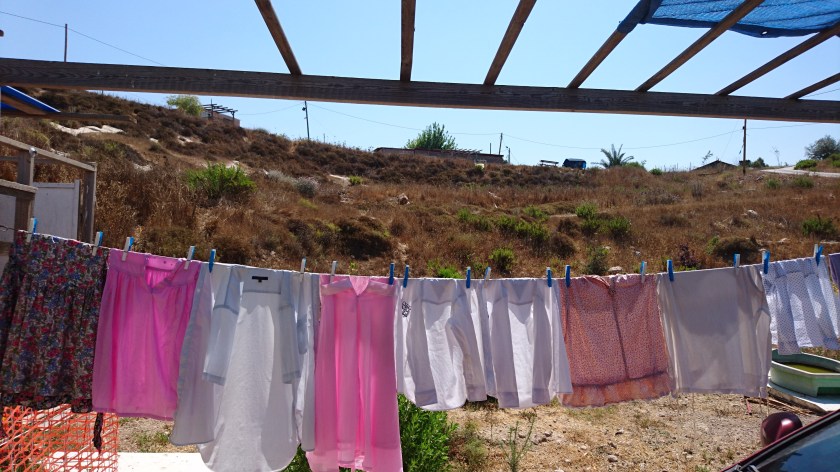
Every winter, I think that maybe it’s time to finally splurge on a dryer. And every year, by the time I’ve almost decided to take the plunge, the rainy season is over and I can happily go back to this:
I’m lucky enough to live in a dry climate with plenty of sun and whole seasons without rain. But when it rains, I have to resort to indoor drying racks, which can be extremely annoying. Washing bedlinens usually waits for good weather days.
Here are a few tips to make indoor air drying more effective:
One, place the clothes with as much space between them as possible to help air circulation. I often use two racks when I could fit everything onto one, because clothes dry faster that way.
Two, go back after a few hours to a day and flip the clothes over to the other side on the rack. Yes, it’s a bit of extra hassle, but it speeds up drying.
Three, if space allows, place the drying rack in a room that you’re heating anyway. It will add moisture to the air, and your items will dry more quickly.
Finally, a bit of foresight: I love natural fabrics, but during stretches of rainy weather, we often wear synthetics. Synthetic materials dry in a flash, while my favorite cotton long-sleeved shirts can take almost a week to dry indoors completely.
And, of course, make sure you have enough changes of socks, pants, and other items, especially for kids. Young kids aren’t terribly careful with keeping clothes out of mud and puddles.
Spring is here, which in Israel means a brief respite of pleasant weather before a 6-month stretch of unbearable heat. But my geraniums won’t mind: just give them enough water, and they’ll thrive through the summer.
That’s reason one why I love geraniums so much. They’re hardy. I don’t do well with any plants that are too delicate or too particular about their growing condition.
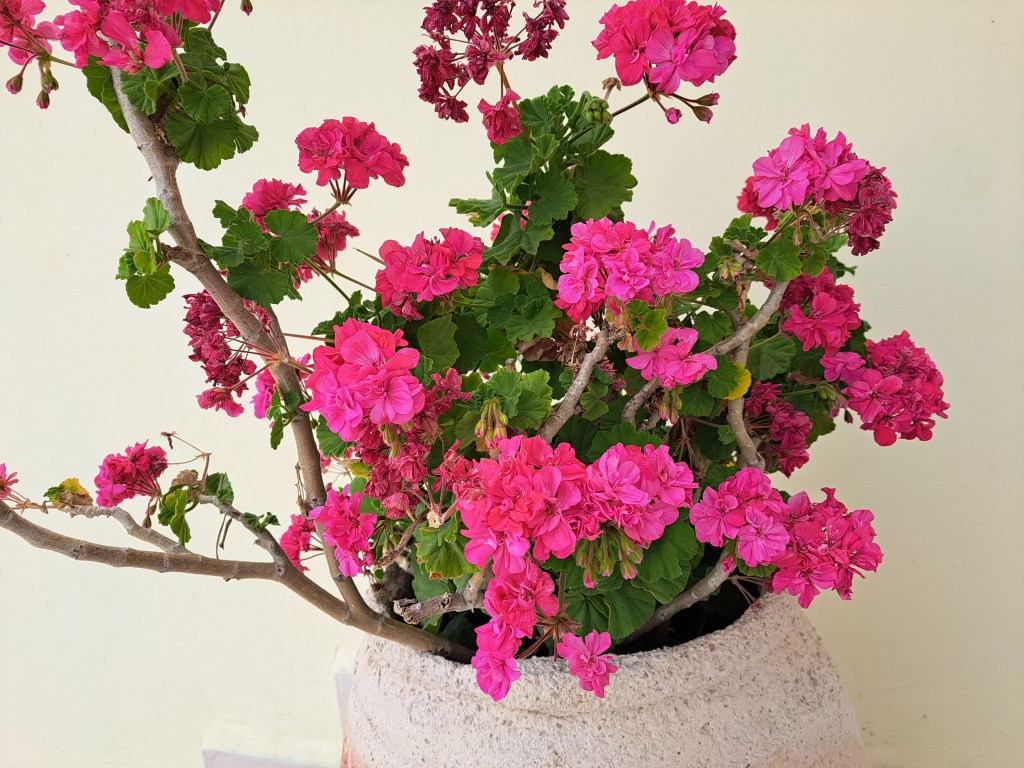
The second reason, which should actually get a bump up to the top of the list, is the color. Geraniums add the most vivid splashes of color to any flowerbed or balcony. This hot pink you see above is my favorite, but you also get orange, red, pale pink, and other stunning color variations.
Third, geraniums smell great, especially rose-scented geraniums like the one here:
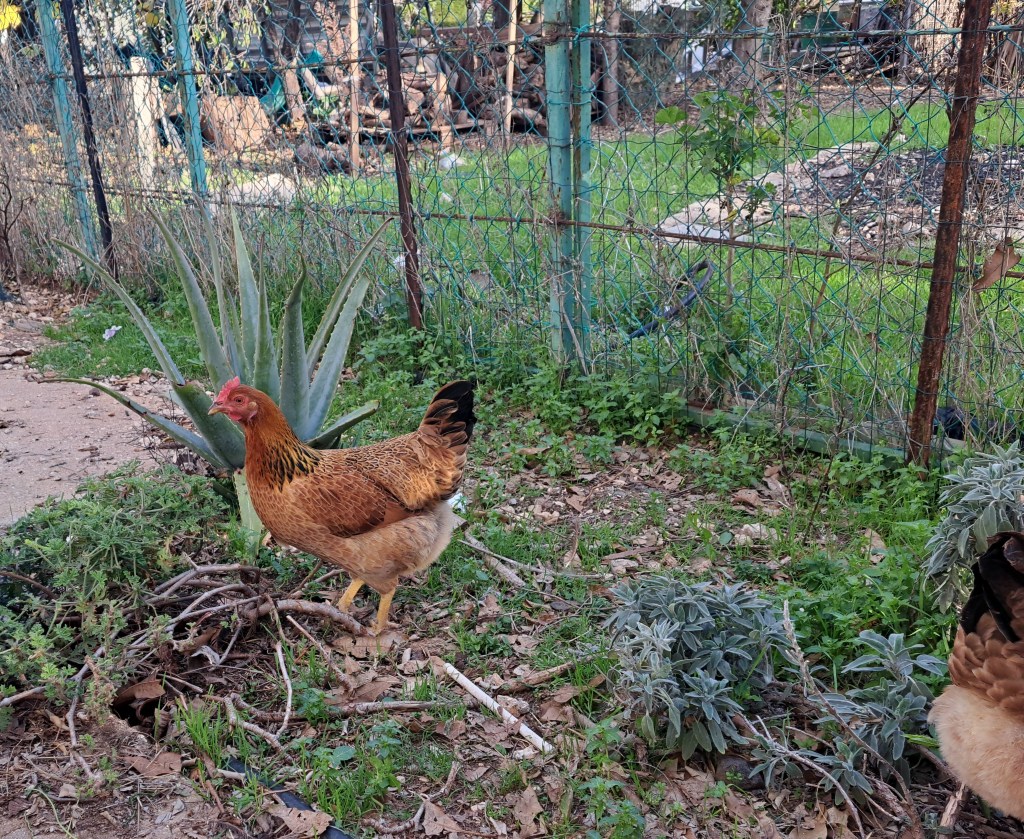
I keep mine in a cage because the chickens really love to snack on it, but I’ll soon need to find another solution because it grows really fast!
Reason four, geraniums are super easy to propagate. Just stick a cutting in damp soil and keep it moist:
You can make lots of cute geranium seedlings to give as gifts or sell.
Five, geraniums make a wonderful refreshing herbal infusion that is great for colds, inflammation, or immune system reinforcement.
Six, geraniums repel insects. Plant some and enjoy fewer mosquitoes in your garden on hot summer nights.
Did I forget any perks of this popular plant? Tell me in the comments!
Israel’s new government is about to cancel two consumer taxes the previous government has put in place: a tax on disposable plastic tableware and a tax on sugary drinks (which also go out onto supermarket shelves in plastic bottles). Many people see this recent move as pandering to the Israeli ultra-Orthodox population and have a lot of things to say about those nutty religious fanatics who can’t bother to wash their dishes.
I’ve often said that large families have a huge environmentally friendly potential. Modest lifestyles, a limited amount of car and airplane travel, and lots of using hand-me-downs make religious families with many kids a lot less wasteful than many families with just one or two kids who burn up gas like there’s no tomorrow and order huge boxfuls of cheap stuff from Shein that’s going to end up in the landfill after a couple of wears.
Basically, I believe there are two elements that keep most large families in Israel from becoming truly environmentally friendly: time and brain-space.
I know what it’s like when you have a bunch of kids come indoors from playing, look into the sink, and discover it’s still full of last night’s dishes. Then you desperately reach for the stack of disposable plates and cups on the upper shelf, promising yourself you won’t procrastinate with dishwashing next time (or, in my case in the past, telling yourself you’ll have to wash those dishes the moment the running water supply resumes!)
Sidenote: As far as I know, most Haredi families in Israel don’t use a dishwasher. One reason is Jewish dietary restrictions: most strictly observant families would use the dishwasher either for meat or for dairy dishes, which would still leave them with huge amounts of kitchenware to wash by hand. Another reason is that the initial investment would seem daunting to many large families on a shoestring budget. And, finally, a dishwasher takes up space, and many Haredi families live in cramped apartments with tiny kitchens.
Another thing is brain-space or, if you prefer, lack of awareness. Ultra-Orthodox schools and society rarely emphasize environmental studies (although I definitely believe they should). Some even disparagingly call caring about the environment “the secular religion” and go on a tangent, saying that people “worship” the environment instead of caring about the “really important things”, like helping people in need. Of course, it’s a false narrative that often covers up one simple truth: when you have five kids under six, it’s hard to care about anything but day-to-day survival. You do what you need to do to keep your head above the water, even if it creates bigger landfills – which is ultimately one reason I chose not to cloth-diaper. I do try to improve and make more environmentally friendly choices, though.
A friend who lived in the U.S. for a few years told me that in her opinion, the Israeli reliance on disposables is unprecedented in the developed world. I think it’s a shame, especially since, in my opinion, disposables don’t really save as much work as people think.
First, you need to remember to buy them, and then you panic if you don’t. And sometimes you end up running out to the store just because you’ve run out of plastic dishes and you haven’t geared up with a “real” dish set for the guests that just arrived at your doorstep.
Also, since plastic kitchenware (especially the cheap kind most Haredi families use) tips over, tears, and breaks easily, it will create more spills and messes when children use it. And finally, disposables clog up your garbage can so you need to empty it more often.
Plus disposable kitchenware is just plain yucky. Food both looks and feels so much nicer when served in glass or crockery.
The second tax that is now being revoked involves sugary drinks. My feelings about this one are more mixed. On the one hand, I don’t believe in a condescending, paternalistic attitude that tries to teach people what’s good for them by punishing unhealthy food choices through their wallet. I also have great faith in a free market. My suggestion is that, instead of revoking the tax, it’s time to roll it to the bottled drink manufacturers who destroy public health with their sugar-loaded offerings.
Finally, we should all remember that the consumer’s power is in our hands. Whatever taxes the government imposes or cancels, we can all choose to make an informed decision about what we eat, drink, or use in our kitchens. We can all take responsibility for our food and consumption habits and work towards making our own private household healthier and more environmentally friendly.
I love a bit of shopping as much as the next person – especially if it’s thrif shopping. In fact, it’s thrilling to know you’ve scored and got a quality item for a fraction of the price. I have a pair of knee-high genuine leather boots, which I got for about $20 in a second-hand store and wear almost every day, every winter.
But here’s the problem with shopping, even and especially when you get a great deal: we all have limited space on our shelves and in our closets, and no one wants their house to look like something that belongs in an episode of Hoarders.
Cue a simple but effective rule I’ve been implementing lately for purchases that aren’t absolutely necessary: one goes in, one comes out.
Here’s how I do this: if I consider buying a pair of shoes for myself or my kids, I challenge myself to go over all our shoes and part with at least one pair. It can be something that doesn’t fit anymore or just something that hasn’t been worn in a while.
This actually works great, because:
a) I put stuff in order as I go through it
b) I keep the house from being overrun by surplus items (does stuff breed when I’m not looking, or what?)
c) As I go over our things, I usually find more than one item we can do without, so it usually ends up being “one goes in, two or more go out”
These days, I apply this rule to pretty much anything: clothing, toys, books. With items that get used up, like art supplies and yarn, I adjust the rule to “finish one, then buy another”.
So that’s my current strategy. Rather than do one big seasonal declutter, just keep clutter from accumulating as much as you can.
I’ve always considered myself a fairly eco-conscious person. I line dried, hand washed, repurposed, and tried to minimize the use of disposables. With one exception: plastic tablecloths for the Shabbat table.
I sort of felt I gamed the system when I spread out that transparent rustling sheet of plastic over my table. I didn’t need to worry about spills. Cleanup was a breeze. And I could still see my pretty cloth tablecloth through the plastic.
No, I didn’t feel too good about myself when it was time to shove that giant wad of plastic into the trash can. But I told myself, “You do enough laundry. You have tiny kids. You’re just surviving.” It was that word, “surviving”, which I used to justify a lot of lack of effort in many areas.
I could, of course, put on reusable waxed tablecloths, but there are limitations to cleaning on the Shabbat. For example, you can’t clean with a cloth and then wring it.
Then, one day, we switched to buying a long plastic roll rather than individual pre-cut pieces to save money. The problem is, you need to cut your plastic cover before the Shabbat, and if you forget to do that, too bad.
One such time, I nearly threw a fit when I realized that I’ll need to use cloth tablecloths and wash them. We lived in an area where we’d regularly get stuck without electricity or running water for days. But I still couldn’t help noticing how much nicer it was to eat without touching plastic with our hands and elbows.
I still wasn’t ready to give up on plastic table covers because of the aforementioned patchy utilities. There were many times when I delayed washing the dishes and was stuck with a full sink for three days. But when we moved, I no longer had to obsess about getting every load of laundry or stack of dishes done as soon as possible.
Then I started ghostwriting for one eco blog, which really got me more aware of how harmful plastic actually is and how important it is to minimize its use. I decided to lay my Shabbat cloth with no cover.
All in all, I needed three cloths for the three Shabbat meals. They took about half a load in the washer. And there was not a single stain, despite multiple spills of oil, wine, and tomato sauce.
For over a year now, I haven’t looked back. I just took my three favorite tablecloths off the line. They are perfectly clean and smell delicious – and they are ready to go on the table tomorrow night.





 Domestic Felicity