Why I love bartering

Image result for barter

As terrific as it is to buy from small local businesses, bartering is even more awesome. It allows one to bypass the money economy entirely. When I trade something I have a surplus of for something I need, I feel like sticking my tongue out and saying, “ha ha ha, mighty Tax Authorities, I fooled you! You won’t get any share of money from this exchange!” (Very mature, I know). Also:

1. Bartering fosters close community ties and allows one to meet awesome, like-minded people. It develops personal connections that may grow into real friendships.

2. Bartering is the very essence of the saying, “one man’s trash is another man’s treasure”. In season we may have so many fresh eggs, for example, that we literally don’t know what to do with them – but other people living right next to us are in need of those fresh organic gold protein nuggets. They, in their turn, might have something else we need (fresh veggies, artisan products, skills). If each side takes something they don’t want/need and trades it for something they do, everybody wins.

3. Bartering is creative and allows for much more interesting business-making than just stepping into a store and buying whatever you need.

Read more in my latest Mother Earth News post:

“While I’m not naïve enough to believe we can opt out of the money economy altogether – the modern world is too populous and complex for that – bartering can still work exceedingly well in small communities with close-knit personal relationships where people choose to earn less, spend less, and support each other rather than a large chain-store or a mega-farmer.”

The rewards of making bread

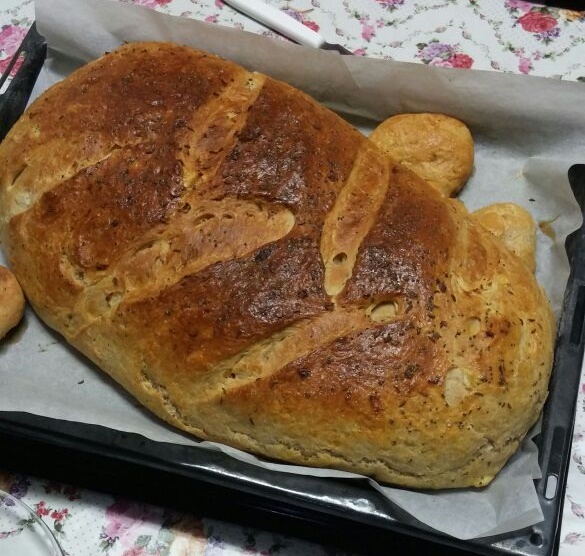
bread

Above: a fresh, hot out of the oven, deliciously smelling loaf of bread with onions, caraway seeds and poppy. It was made, in concession to my family’s preferences, with instant yeast and half whole wheat, half white flour. 

Bread is one of the most rewarding and cost-effective things you can make in your own kitchen – anything you bake yourself will save you money, too, vs. any store-bought bread of comparative quality. Far from being time-consuming, it simply requires some planning ahead. Here is the total time it takes to produce a beautiful loaf like the one I made yesterday afternoon:

  1. Mix dough – 15 minutes, more or less, including kneading.
  2. Wait for dough to rise: this varies according to weather, flour used, and yeast (instant or sourdough starter). Can be anything between 1 and 24 hours, but during this time you don’t need to babysit your bread – you just put the dough in a warm place to rise and go on doing other things.
  3. Punch dough down after it has risen – 1-2 minutes.
  4. Wait for dough to rise again: the second rise is usually shorter.
  5. Roll out/shape into loaf (or loaves): 5-10 minutes.
  6. Bake: 20-40 minutes, depending on size of loaves and heat of oven.
  7. Clean up: 10 minutes max.

Total work time: 30-40 minutes. This really isn’t so much at all, when taking into account the deliciousness of the bread and the fact that I know exactly what I put in it (olive oil, organic maple syrup and home-grown eggs, vs. cheap commercial oil, white sugar and I don’t know what else).

So roll up those sleeves, take out your rolling-pin and get to mixing, kneading and baking. You can read more of my posts about bread-baking here, here and here.

The things you will never regret

In our previous home, we had a separate room for a home office. Such privacy is very convenient, but it is also the pitfall of the computer junkie (which, I admit, I am). I could tuck children into naps or, at a period of time when I didn’t have any children young enough to need naps, I could let them watch a movie – while I got into the office to check my emails, etc.
The problem is, the “etc” only too easily turns into watching silly YouTube videos, participating in draining online discussions, making frivolous Google searches (“why does the top point of my left ear sometimes itch?”), and keeping up with the social media. The power of the click is just too alluring.
Of course, there are also the good things – reading excellent helpful articles, writing letters to friends, taking care of personal projects, working on my books. However, the good things are even more dangerous, in the way of justifying an extravagant amount of time spent on them. If you watch a video of a cat playing the piano, you’ll feel guilty for wasting your time after five minutes. But knitting how-to videos are okay, right?

Unfortunately, I became feeling entitled to that office time, alone behind closed doors. It was my time; I needed it. So when naps were broken, or squabbles interrupted movie time, I became unreasonably frustrated. I don’t have an exact estimate of how many hours were spent on lawful pursuits, and how many on mindless web browsing, but there is no doubt a large chunk of my time could have been better employed.

In this house, I have one computer in the living room for everybody’s use, faulty internet connection and a little one that really isn’t a very good sleeper. And I’m happier than ever; this change has been the best thing that could have happened to me. It taught me to prioritize; on a good day, I might have half an hour after lunch for answering emails, browsing ads, etc, and if I’m not too tired there’s an hour or two at night when I can write, read, research information or watch a movie in peace and quiet.

The thing is, when I look back on times enjoyably spent with my children – whether reading together, or taking nature walks, doing crafts, playing games, even just watching a movie together – I can’t think of one hour I would rather have spent doing something else. Even if a baby is colicky or teething, it means a night of precious snuggling with someone who needs me, just then, more than anything. I might be very tired, but I have no regrets.

But when I remember my “me” time, my feelings are not so unequivocal. There are many pages I wish unread or unwritten, many videos unwatched, many games unplayed, many conversations unspoken. Not because these things were bad in themselves, but because they took away from the truly important things I should have been doing.

You will probably never regret spending time with your children. The same cannot be said of other things, be it personal projects, volunteering, hobbies or social commitments. I keep that in mind every day, and it makes all the difference.

***

coverfront.jpg

Speaking on another matter, I’m very excited to tell that my upcoming novel, Wild Children, is now on Kindle Scout – which is essentially an Amazon-based contest the winners of which get their book signed up and promoted by Amazon. You can read the book description and first chapter and, if you feel it deserves to be supported , nominate it on its Kindle Scout Page.

Butter, eggs and food security

Last week my husband went grocery shopping and, though butter was on the list (as it always is) he came home without it. Upon my inquiry he told that plain simple unsalted butter was simply missing from the shelves, and there was nothing to be found but the fancy imported spreadable brands. This has lasted for some days now; butter, an important staple in our daily menu, is missing from the dairy aisle.

Of course, when there’s an overall abundance of food, it might not seem so very important. We can have toast with cream cheese instead of butter for breakfast. Butter can be replaced by coconut oil in baking. But in our culture, so used to affluence and to store shelves groaning under the weight of any food imaginable, it seems almost incredible that one might step out to get butter (or anything else, really) and find out that it’s not to be had.

I was born in a country where food deficit was the daily reality. There was no hunger, but it was common to walk into a store and find half its shelves empty, and make do with whatever was available. People stockpiled canned and dry goods and non-perishables; it was plain common sense.

Above: whole grains and pulses, stored in a tightly closed container, will remain in good condition for years and make a compact, useful, cheap and readily available food source. 

We might not like to hear it or even think of it, but a time may come – and not in the very distant future, either – when food is not as readily and abundantly available as it is today. Some products may become less common than they are now, on a temporary or permanent basis. Others may simply become more expensive. Either way, people who are opting to learn food security skills today will be the gainers.

Stockpiling is one valuable practice to be learned. It makes very good sense to have a nice stash of products that can be stored for a long time, rotating them every few months or so. Canned food, rice, beans and grain of all kinds, flour, yeast, salt, non-perishables such as soap and toilet paper, and much else, can make a nice safety cushion for emergencies or simply for lean times. We have lived largely off our pantry for months on end during several periods.

Growing your own wholesome, fresh food is the next big step. A productive vegetable garden and a chicken coop, even a very little one, contribute a lot toward the goal of food security. Even just having plenty of veggies and eggs can provide one with a variety of delicious meals. A couple of goats or a cow will further enrich the family’s diet. If we had a dairy animal now, we wouldn’t care if there is any butter at the store or not! I remember an egg deficit time a couple of years ago – we were lucky to have eggs from our chickens and so didn’t feel it at all. It might not happen soon, but I’m aiming to have a larger, more consistently productive vegetable garden, more chickens (and maybe other poultry), and dairy goats again.

Another thing to do would be to learn about foraging and which sources of wild-growing food are commonly available in your area. It can be berries, fruit, herbs, mushrooms, and much else. Always play safe and only consume what you know for sureto be edible.

If you are just beginning to learn about food security, I heartily recommend perusing the writings of Jackie Clay, a homesteader with many years of experience under her belt, and a real powerhouse of optimism, cheerfulness, resourcefulness and determination. You can start by looking up Jackie’s articles on the Backwoods Home Magazine archive, reading through the Ask Jackie archive, and visiting her blog.
Of kitchen sinks and gratitude

Image result for kitchen mess comic

Illustration photo: Huffington Post

Last Friday I awoke to the sounds of gushing water from the kitchen. It actually sounded like a small, gurgling stream. Bleary-eyed, I rolled off the bed and went to see what’s the deal; I discovered a small lake spreading out from under the kitchen sink.

Of course, I did what any rational woman would do in such a situation – I ran to shake my husband awake, panting, “Quick! Quick! There’s an emergency! We’re all drowning!”. My husband opened one eye, stepped into the kitchen, took a look at the whole thing and closed off the pipeline leading to the sink. While I was mopping up this miniature Lake Windermere, he remarked, “Well, at least the kitchen floor will be clean.”

He explained to me that there’s something wrong with the kitchen pipeline (you don’t say?!). Did it rust through? Got nibbled on by mice? Punctured by evil aliens? I didn’t care; I just wanted the use of my kitchen sink back. It didn’t help that Friday is the busiest day in Orthodox Jewish households, growing progressively crazier as the clock ticks toward afternoon and the lighting of Shabbat candles.

In case you are wondering, washing dishes in the bathroom sink is not very convenient.

I’m sure my husband, who is a real handyman, will put this right eventually, but this kitchen sink incident got me thinking of all the other things we normally take for granted – our comforts and conveniences, the abundance of food and clothes, our spacious, well-heated homes, our civil rights and freedoms, our families, health, and very life. So let us stop for a moment to appreciate it all. Celebrate the kitchen sink!

This week we marked our son Israel’s second birthday. I am so happy and grateful to be the mother of this little boy. With my older girls, I was very young and newly married and it was Mommy Boot Camp all the way for the most part. But once Tehilla, our second daughter, was out of her toddler years and I realized I might never have another baby again, I shed many tears. When Israel was born all felt like a gift; it still does. For the past two years, I am grateful to say I have been able to appreciate so many things about his infancy and toddlerhood – just relax, enjoy and let go. We all sit on the floor a lot, playing with Lego, blocks or toy trains, and I no longer have that itch telling me I have to get going and move on to do something more important.

I guess this post is just a record of thanksgiving. For children, families, life, and comfortable homes with modern conveniences. I thank God for what I have, really I do.

Just please, fix that kitchen sink.

Dreaming of chicken coops

Image result for chicken coops

Ideally, the chicken coop I’d like to see in my yard looks something like this.

In practice, we have the below:

coop

This is the fifth chicken coop we have built, having moved several times during our married life so far, and we scrimped on a lot of things knowing we’re probably going to move again in a couple of years (not very conductive to homesteading, I know). Our coop is way too drafty (we only get away with this because we live in a warm climate and choose hardy breeds), only partially roofed, has a dirt floor, gaps here and there through which very small chicks can escape, and other inconveniences. We don’t have a run, our roosts need sanding down to keep splinters away, and I could go on and on.

I do hope that someday, we get settled in a more permanent place and build a good, sturdy, convenient, secure and pretty chicken house.

Read more about our chicken housing experiences here:

“A reliable chicken coop is a must if you don’t want your chickens to end up as the dinner of some fox, stray dog or whatever local predator you have in the area. Do yourself a favor and make an initial investment in a chicken house, a real sturdy shed you wouldn’t mind taking shelter in for the night. As we’ve moved house several times, we’ve had to make do with some makeshift coops that caused us a lot of alarm and frustration. We lost a lot of chickens to predators, and there’s no reason why you shouldn’t learn from our experience.”

Mean Green Cleaning Machine

Do you like to clean? I think I see a couple of you shaking their heads and smiling… yes, I mean you. And I’ll be brutally honest – while I, in fact, appreciate a clean bathroom and floors, there are many other things I’d rather be doing – like baking cookies, taking a walk with the kids, digging in the garden or writing.

However, cleaning must be done in order to maintain a livable, inviting atmosphere, and while I’m at it I’d rather avoid harsh dangerous chemicals as much as possible (and save money along the way, too). Check out my latest Mother Earth News post on this subject:

“When standing in the household supplies aisle in a supermarket, it’s easy to be dazzled by all the various cleaning agents in colorful bottles and packages. However, most of that stuff isn’t just outrageously expensive, it’s harmful for the environment and can even be downright dangerous. Luckily, it’s possible to clean house simply and effectively, just the way our grandmothers did – combining simple materials which don’t cost a lot and aren’t dangerous to keep around small children.”

citric acid crystals

Above: citric acid crystals – one of my favorite green cleaning little tricks.