When you are just swamped

Image result for overwhelmed mother

You don’t remember when you’ve last had a night of uninterrupted sleep. You haven’t washed your hair in three weeks. Your friends send anxious messages asking if they’ve offended you somehow, because you haven’t returned their calls for ages. There’s a dark unrecognized sticky puddle under your fridge that you are going to tackle as soon as you have the opportunity – and you’ve been saying this for two months at least.

It seems you are on a treadmill, running and running and never getting anywhere.

Congratulations! You are a Mom to little ones.

This is often the picture of my day-to-day life. Sometimes toddlers can actually be even more intense than newborns. So it’s not like things don’t get done… but admittedly, very little gets done, and this little costs a major effort. The two things that get me through right now are the following:

1. Appreciate the small things. You’ve washed the dishes? Emptied the garbage can? Wiped the bathroom mirror? Great! So what if these aren’t major projects or fancy meals you can show off at the end of the day (because, you know, a sink can refill itself in the span of an hour around here). You still deserve to be appreciated for your efforts in keeping a clean, livable home.

2. Take advantage of the little snippets of time. If the baby is settled down on the rug with a couple of toys, you know you probably don’t have hours to rearrange your closet. But you do have five minutes to take the washing off the line or water the house plants.

And, finally, this too shall pass. From my experience babies get a lot better at entertaining themselves once they start crawling. And, in the more distant future, they might find the company of other people to be more exciting than their mother’s. So we had better enjoy this while it lasts.

Coping with chicken loss


There are few things more painful to me as a chicken owner than the untimely loss of one of the flock. Our chickens are all lovingly hand-raised, and it’s enough to drive one mad when a sneaky predator gets past one’s defenses, or when a disease you can do little about makes its rounds in the coop.

Still, I guess that this knowledge, this acceptance of the fact that there will be some losses, is what enables us to bounce back and keep raising chickens.

From my latest Mother Earth News post:

“Losing animals is an inevitable part of raising them. No matter how careful and diligent you are, at some point you will have to deal with saying goodbye – and not just due to old age, either – to some members of your flock or herd. This is heartbreaking even if your animals were meant to end up as dinner at some point. So much more if you treat your livestock somewhat like pets. I remember one time years ago, crying and telling my husband I’d rather give it all up and never keep anything living but plants again.”

Have you brushed up on your survival skills?

Once in a while it strikes me how singularly fortunate we are compared to past generations: so many of the things we take for granted would have been unthinkable luxury, or even science fiction, a mere 20 or 30 years ago. Truly we live in a time of plenty… yet on the other hand, the future feels so precarious that every time I watch the news (and believe me, this doesn’t happen often), I feel like checking that my pantry is full and that we have a good supply of drinking water in case anything happens. I wish we were more self-sufficient when it comes to food and energy.

Read more in my latest Mother Earth News post:

“It all seems to be asking the following question: if the world is turned upside down and we can no longer rely on the fancy tools of modern man, do we stand a chance?

Well, do we? Honest introspection leads me, and many others, to conclude that we are less resourceful, resilient and capable than our forefathers. We do less things with our hands. We walk less on our feet. We don’t exercise our minds as much, because the convenience of the Internet is just too alluring. Many times, when struggling to remember a piece of information, I open up Wikipedia at once rather than strain my memory.”

Wild Children is here!

coverfront

The big day is here! Wild Children, my newest fiction release, is now up and available for purchase in print and on Kindle.

The novel is set in a dystopian world where reproduction is strictly controlled and transgressions punished. Those who are born without a permit grow up on the fringes of society and are cast out into the wild abandoned lands at the age of twelve.

A boy is born despite a law that states he has no right to live. His mother loves him, though he puts her entire family in danger. Circumstances force her to give up her son, but nothing can tear the love out of a mother’s heart.

The book should appear to lovers of post-apocalyptic fiction, pioneer life, and survival in the wild.

Also, my publisher is still looking to give away a few review copies (print+digital in the US, digital only in the rest of the world), so drop me a line through the contact form or in the comments if you are interested.

What is learning?

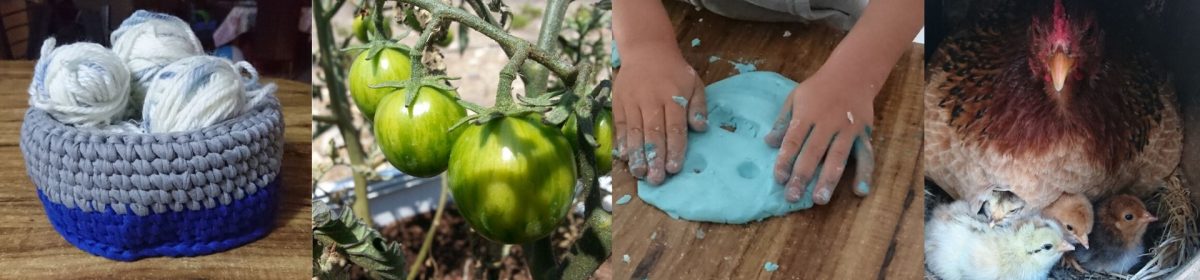
Above: images of spontaneous learning which takes place around here on a daily basis.

Some time ago, I was really pleased to come across this article, which speaks about a new research showing that early academic achievements aren’t necessarily beneficial to a child’s learning process in the long run. Actually, the same principle has been discussed 25 years ago in the excellent book Better Late Than Early.

Not long ago, we were at a social gathering with another family. Their children, aged 5 and 3, dazzled us all with a display of their mathematical and foreign language skills. Turns out that such things are now taught in private preschools. To me, however, it sounded more like parroting than actual learning, encouraged for the parents’ bragging rights rather than for the children themselves.

Of course it’s possible to argue that each child learns at a different pace, and we’ve all heard of prodigies who have learned to play the piano at the age of 3, wrote advanced poetry by the age of 5, etc. However, here we are talking about a roomful of 3-year-olds who are all sat down in a circle and drilled until they memorize counting until 30, or the names of the days in the week in English (we’re talking about children whose mother tongue is Hebrew, of course).

Naturally the daily drill is sugar-coated by fun, games, colorful flashcards and lots of positive reinforcement (clap hands! Clap hands! What clever little children!). However, I believe putting an emphasis on this kind of achievement hinders the child-led learning, free thinking and free play which are so important for young children’s physical and mental development. Furthermore, the children are being robbed of the delight of learning for its own sake, of the thrill of discovery. They do what they do for rewards, attention, peer competition or in order to please their parents and teachers.

Some will say that these are musings of a lazy parent who is unwilling to teach her children anything. I disagree. Encouraging children to memorize facts and rewarding them for it with sweets or stickers is easier than promoting their independent efforts to explore what interests them, let alone finding time to answer their many questions about life and the world we live in.

Chickens: predators and prey

fencedgardenbed1

Above: garden bed fenced against digging chickens.

Chickens are both predators and prey: you have to protect them from ending up in the belly of a fox, but you also have to protect your garden from your chickens eating whatever is in their sight, or just turning your lovingly made flower bed into a dust bath.

Read more in my latest Mother Earth News post:

“We free range, which of course exacerbates the losses to predators, but the overall pros of free ranging are so evident that I truly believe it’s the only practical way for us to keep chickens. Not only do we save a bundle on feed as our chickens forage and find their own food, but we get the benefit of a pest free yard and can get away with a smaller coop – it’s OK for chickens to be a little crowded some of the time if they mostly have the whole yard to themselves.”

Just Being Home

Image result for there is nothing like staying at home for real comfort

I think the best, most effective, and most enjoyable way to save money at home actually isn’t about pinching pennies, or utilizing the contents of our freezer and pantry to the utmost efficiency, or saving electricity and water (although all these practices are good and valid, of course). It is simply staying home, as opposed to running/driving about.

Of course, we all like to go out sometimes. Day/field trips, visits with family/friends, even shopping trips are fun – but it’s all about the proportion of time spent in vs. out (by “in”, I also mean on your lot – in your garden, on your deck, on your sun roof, etc, not necessarily in your living room).

It is really quite straightforward: when you are pleasantly occupied in your home, instead of browsing shop-windows, for example, you have less temptation to buy stuff you don’t really need. Also, you don’t waste money on gas.

Naturally, this means you have to put in the effort to make your home a place of fun, enjoyment, wholesome activity, family togetherness, usefulness, comfort and recreation. And there is really no limit to all those things, even in the smallest, most humble home.

This doesn’t mean you need to have expensive decorations or furniture, or spacious rooms. A welcoming home is cozy and well-organized, without being oppressive to children or visitors (as in, making people wary of touching anything for fear of ruining a perfect arrangement).

A day or two ago, my daughters complained about “having nothing to play with”. Now, if you had seen their room, you would have known the claim was simply ridiculous – because though we’re not at all consumerism-driven when it comes to toys, still, gifts from grandparents and friends, and giveaways, etc, make for quite enough to be getting on with. As a matter of fact, they had a couple of new board games and puzzles they had hardly touched. All these, however, were lost in a jumble of toys all piled atop one another.

So, you need to make books, games, toys, and art and craft supplies easily accessible.

Another point is to create inviting areas for all sorts of activities: reading, drawing, sewing, etc. We have one all-purpose table in the kitchen that serves us for eating, studying, ironing, board games, and all sorts of projects. Being so much used, it’s easy for our table to overflow with stuff. I must be careful to keep it clean and clutter-free, so that when my children want to draw, they won’t need to restrict themselves to the last tiny corner of free table space.

Do interesting things at home and thereabouts. We currently have seeds going on indoors, several experiments on the go, our chickens, our garden, and always plenty of reading to do. Naturally, in the winter when it’s too cold and rainy, and in the summer on the hottest days, we are more restricted to indoor activities. The spring and autumn are the pleasantest seasons where we live.

PS: Isn’t it funny how some of my favorite Jane Austen quotes are actually put in the mouths of characters I can’t stand? The above “staying home for real comfort” was said by Mrs. Elton.