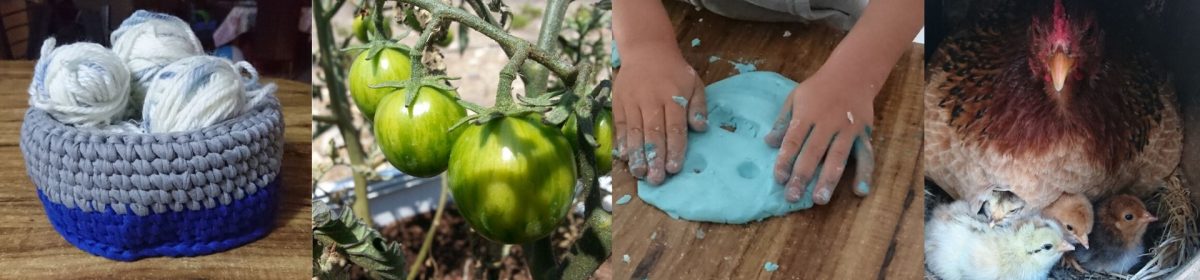
First chicks of the season

DSC_0135

The first chicks of the season are here, though we’ve had the unexpected setback of low fertility rate in our hatching eggs.

Our alpha roo is a black Brahma, so our chicks all have feathered legs and most of them are black. I love Brahmas for their size, docility and fluffy feathers, and hope to get good stock for a purebred flock.

So far we’ve let our broodies do the job this season, but we also plan to set up a salvaged incubator and see how it works. I’ll let you know how it turns out.

By the way, we never buy chick starter. Instead we feed our chicks regular layer’s mesh, supplemented with hard boiled eggs and, very early on, all sorts of kitchen scraps. Pros would probably frown upon this, but we have raised many generations of happy, healthy chicks this way.

Happy hatching to all backyard flock owners!

Building Mistakes

Image result for building mistakes

Read my latest Mother Earth News post about the lessons we learned while building our cabin:

“Mistakes are an integral part of a learning process and can be expected if you are an amateur builder, but it might also be very frustrating, since this isn’t just a practical lesson – it’s a real dwelling you are trying to raise and make livable and comfortable, often under great constraints of time and money. It would be wise to mentally prepare for making mistakes and fixing them as you go.”

Also, this will probably be my last post before Pesach, so happy Pesach to all my Jewish readers, and a happy spring to everyone else!


Pesach: a time to clean (and declutter!)

Image result for decluttering

Image source: Decluttering Queen

Pesach is associated with the seder, the haggadah, matzo balls soup and, of course, cleaning. Starting about a month before the holiday, Jewish households begin to be turned upside down as every nook and cranny is searched for stray crumbs of leavened bread. If you think doing this outside the kitchen is an exaggeration, you should know that I found a coated peanut in the girls’ room two days ago. I have no idea how long it had been living under their bookshelves and how it got there. Probably the same way as the broken ventilator or the rolled-up length of garden hose I found under a pile of toys.

I’ve never been what you might call a cleaning freak – give me a choice between cleaning and reading a good book, or cleaning and baking, or cleaning and working in the garden, and I don’t have to lie awake all night trying to make my mind up. Which, of course, is why I constantly seek out ways to make cleaning more effective – I want it to be done as quickly and efficiently as possible! Normally, I hugely resent the pre-Pesach frantic rush for disrupting my routine and depriving me of peace, sleep, downtime, and fun activities with my children. But there is something I relish about the pre-holiday prep, and that’s decluttering.

We all have too much stuff in our homes (well, I know I do. Maybe you don’t. If so, you have my fervent admiration). Every year before Pesach as I go through the clothes, bookshelves and toy shelves, I find piles upon piles of stuff that can be given away – or, let’s be honest, that should have found its way to the dump a long time ago. This year, we freed up our home from bags upon bags of old, outgrown or unused clothes, and two large boxes of toys. I can guarantee that none of this stuff will ever be missed. Last year I did an especially rough purge of the toy piles and, taking advantage of a spell when the children were playing outside, just hauled out half of it all. Nobody ever missed or asked about what was taken away.

Some useful decluttering tips can be found here.

Dairy goats: breeding, kidding and milking

goat

Read my latest Mother Earth News post on dairy goats, focusing on breeding, kidding and milking:

“Most dairy goat breeds have a clearly defined breeding season and will go into heat during the fall and early winter, generally from August to December-January. Gestation period lasts around 20 weeks, so kids will be born in late winter and early spring. If you have several goats, you can schedule breeding so that, for example, some of your does are bred in August-September and some in December-January. This way the milk production of your herd will be a lot more consistent and you’ll have milk practically year-round.”

Also, Dana (better known as Mama Zed) made my day with her awesome review of my book, Your Own Hands:

“Your Own Hands – Self-Reliant Projects for Independent Living” would be what I consider to be an absolute fantastic book for new homesteaders. The book covers a wide range of topics rather than written to cover one topic in great depth. These topics include gardening, home building and maintenance and even “artisan crafts” such as soap making!

And now I had better roll up my sleeves and jump right back into the midst of Pesach cleaning. Happy spring, everyone!

Educational Attitudes

Image result for unschooling
For a long time, I had felt that unschooling is the very thing for each and every child of every age; I literally felt guilty every time I tried to teach reading or math, even if my children responded well, and doubly so if they bristled. After engaging in some very enlightening discussions with other parents, I went through a process of in-depth introspection which convinced me that:

– It’s quite alright and, in fact, advisable to actively teach children older than 6 to read, write and count.

– It’s quite alright to gently but firmly enforce discipline in homeschooling, just as in other areas of home life (chores, meal times, times of visiting friends, etc).

– I’m not a bad parent if I sometimes make my children do things they don’t like. I will occasionally encounter tears, tantrums, whining, and complaints, and my confidence as a parent should not be undermined by that. I don’t need to be afraid that they will hate me for setting some rules, on the contrary (as long as it is all done with good intentions and a loving spirit).

– I’m not destroying spontaneous learning or my children’s interests/hobbies/curiosity if I introduce some structured learning into our day. The total of the basic subjects (spelling, reading, math) I aim to cover each day takes approximately two hours, spread through the morning: for example, an hour of math after breakfast, then a break and mid-morning snack, and another hour of writing/spelling before lunch. We don’t have homework. So this still leaves plenty of time for the children to pursue their interests, do crafts, play outside, read, write, draw or look at picture books, meet friends, and so on.

I am still a big proponent of plenty of quiet free time, especially exposure to nature, for each child, every day. When I say “free time”, I don’t mean sitting in front of the TV or computer, naturally, but anything that stimulates curiosity, creativity and imagination: reading, crafts, dress-up, exploring the outdoors, etc.

I have made a quiet resolution that I will correct my daughter’s written work only during “school time”, but not when she shows me a story she had written for her own and her sister’s amusement (unless she specifically asks me to check her spelling). I believe that a child who perhaps struggles a little with spelling at this point, but who loves to write and does it all the time, eventually will become a better writer, with a richer language, than a child who does everything in a perfectly neat and orderly way, but only as a school exercise.

This need for free time and unstructured play is felt by me especially strongly in the winter days, which are so short. I see school children coming home when the best part of the day is already gone – barely two hours left before sunset, when it gets too cold to be out. The children, as young as 6, are already so bogged down with homework that one of my daughters’ friends told us once she might not be able to attend the birthday party at our house because she has so much homework. This, I believe, is tragic. Surely little children deserve better balance in their lives.

Wild Children now available for pre-order!

coverfront

I’m very excited to announce that my upcoming novel, Wild Children (to be released under my pen name, Hannah Ross) is now available for pre-order in both print and Kindle formats. Official release date is April 28-th.

It has been quite a journey with this book. I was pregnant with Israel when I first began writing it, and now he’s two years old! I’ve also completed the first rough draft of the sequel and began outlining the third book, so there’s plenty to look forward to.

From the description:

In a post-war world, where reproduction is strictly controlled and transgressions severely punished, they are society’s rejects. Unwanted and unloved, they are raised in an orphanage until age twelve, then taken beyond the Boundary and left to fend for themselves, to survive or perish.

One child was different, though he didn’t know it. He was wanted, he was loved, and he was hidden for three months. But reason prevailed. A third child meant a lifetime of concealment, a lifetime of fear and loneliness, and discovery would mean social and financial ruin for his parents and siblings, so one rainy night, his mother did what she must. As her heart broke, she walked up the path to the orphanage and surrendered him.

Wild Children is a story of abandonment and survival, of hope and determination, and of a love that refused to die.

Conquering Sugar Cravings

תוצאת תמונה עבור ‪sugar cravings‬‏

Because of our social conditioning, love of sugar is one of the most difficult harmful food cravings to conquer. Not only is sugar everywhere, it forms part of such cherished memories as Grandma’s cookies, birthday cakes, holiday treats, etc. Therefore, trying to cut refined sugar out of one’s diet, or one’s children’s diet, can get a pretty serious emotional kickback: “Are you telling me we’re going to have a birthday party without a Double Sugar Bomb Birthday Cake? Do you mean to say I can’t take my grandchildren out for an ice-cream?” Just try it, and you’ll see how personally people take it.

In my experience, the number one vulnerability factor that leads people to succumb to sugar cravings is hunger and the low blood sugar levels it evokes. It’s very, very hard to resist a scrumptious glazed cookie when one hasn’t eaten all day. Therefore, the number one defense against sugar cravings is not just to eat on time, but to have satisfying meals that stave off hunger and delight the taste buds. For me this might be a slice of artisan sourdough bread, spread with butter or homemade cream cheese, and a big salad; or a bowl of lentil soup and a platter of fruit; or an omelet made of home-grown eggs and some sliced veggies with a dip.

Even so, merely not being hungry makes no guarantee against sugar cravings. If it were that simple, there wouldn’t be so many sugar addicts. Awareness, distraction, alternative rewards (buying a book instead of a cake) and educating oneself on the dangers of sugar consumption all help, but truly I have no perfect solution – if I did, I’d be very rich (and probably not very popular with the food industry, for whom cheap, easily added, infinitely stored white sugar is a godsend).

I will probably be battling sugar cravings for as long as I live, but I’m in a much better place than I was several years ago, when I wasn’t even aware of how harmful sugar is, given how socially acceptable it is and how its dangers were smoothed over even while I was taking nutrition courses in university. At least now I know what sort of a many-headed monster I’m up against; as soon as I cut off one head in the form of an ice-cream box I don’t put in the supermarket cart, it rears another as my mother-in-law offers me some cookies. But my sword – my knowledge, determination, and wish for better health for myself and my family – is ever ready.