Book update

I’m quite excited to tell you that I’ve made a lot of progress with Your Own Hands. I’m still open to receiving more stories and testimonies from homesteaders and simple living enthusiasts, but overall the first draft is pretty much put together and will soon be proofread, formatted and sent out to the people who had been interviewed so everyone can review their own part before release. Once I get the OK from everyone, it won’t be long before the book is out. I was fortunate enough to have the participation of people who contributed some awesome stories and gorgeous photographs and am really happy with how it’s all coming together.

For more updates, visit my Facebook page.

yohcoverpreviewfront

Above: one of the possible cover versions (I’m still tinkering with it).

Little homes, creative solutions

Lately I’ve been greatly enjoying Teri’s blog, Homestead Honey. Teri and her husband live in a charming tiny cabin of 350 square feet (just over 32 square meters) that they had built themselves. They have two children, whom they homeschool.
How do four people fit into 350 square feet? On her blog, Teri talks about some creative solutions that have enabled them to live in their small space. They have, for instance, an outdoor kitchen and an outdoor shower. And, of course, despite having a storage shed they need to be very selective about which possessions they keep.

We live in a house of about a 100 square meters, or 1070 square feet. In addition, we have a storage shed of about 15 square meters (about 160 square feet). Our house is by no means huge, but I confess we do have a lot of poorly utilized space. First, our storage shed is filled to bursting with stuff we hardly use. We also have an office and a guest bedroom that are seldom used for their direct purpose, and a lot more for accumulating junk. In addition, we have three bathrooms in our house, out of which one is used very, very rarely, and its shower not at all – I consider it completely superfluous.

So, while it’s certainly nice to have a roomy house and lots of space to put our stuff, it’s an undeniable fact that a family like ours can downsize and live in a smaller house that is easier and cheaper to heat (or cool), clean and maintain. Also, in Israel, the smaller your house is, the lower the occupation tax you pay.

Of course, you wouldn’t pay occupation tax for an outdoor kitchen, an outdoor shower, a storage shed or a covered front porch/deck/pergola that would enable you to place garden furniture, benches, swings, hammocks, and spend many pleasant hours outside! The only hitch I see in this arrangement are the days when you are confined to the interior of your house – when it’s too rainy, windy, stormy, cold or, as more often happens in Israel, too hot.

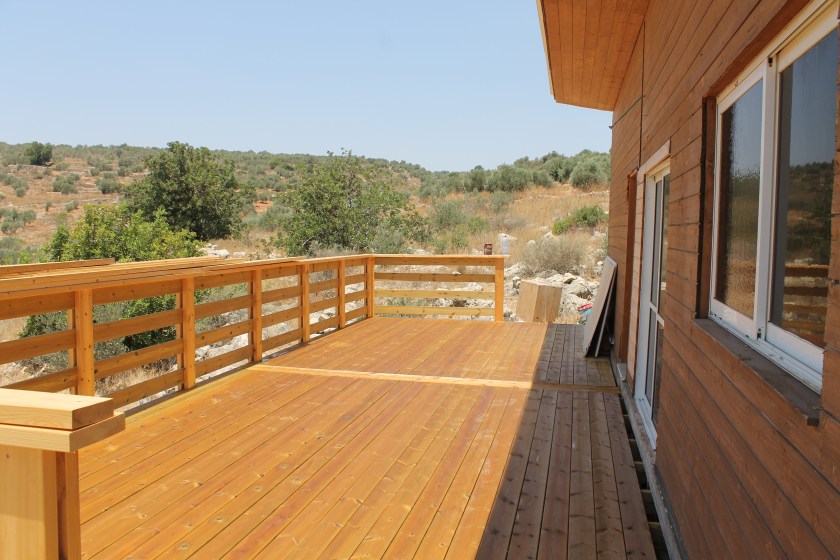
img_9932

Above: deck at our new cabin

I do have to be fair and acknowledge that all these wonderful outdoor extensions are only possible if you are living on the land. In city apartments, you just make do with your space (though I’ve seen some very neat space-utilization practices done in apartments too). But if you have some land, however little, you can work wonders.

We have been married close to nine years now, and we are on our fourth house, so far. Despite my desire to get settled in a permanent home (as much as anything can be permanent in this world) straight away, I think it was a blessing in its way, because it did force us to go through our possessions from time to time and decide what we can’t do without. When you must pay to have your stuff moved, you’ll probably let go of that old broken-down washer than has been sitting in your back yard for years, waiting to be turned into a potter’s wheel or some other marvelous engine (talking from experience here). Still, we tend to accumulate possessions at an alarming rate.

At this time, we are facing the prospect of moving to a smaller house. When it first began to dawn upon me this is a serious possibility, it was daunting. How would I sort through all our things? Obviously we wouldn’t be able to keep everything. We’d have to get rid of stuff, possibly a lot of stuff. How would we fit into a smaller space? But now that I’ve found Teri’s blog, and the testimonies of other people who have downsized and are happier for it, I’m not nervous anymore, but rather looking forward to this as a challenge. In the future I hope to post updates of our progress.

The Diaper Debate

stardiapers_secondarypackshot_355x215

A long time ago, when I was pregnant for the first time and we had many lofty ideas about our own capabilities, my husband and I talked about cloth diapers. We pretty much decided we are going to use them, for the sake of frugality, sustainability and baby’s skin health. It just seemed the right choice all around, until one day, when I was getting pretty big, we had the following conversation.

DH: “But where would we wash the diapers?”

Me: “What do you mean, where? We put them in the washing machine.”

DH: (wrinkling his nose): “What, you’ll put poopy diapers in the same machine that we use to wash our clothes?”

Me: “Not in the same cycle. We’ll wash them separately, you know.” 

DH: “I still think that’s gross. Think of all the bacteria that will be left over.”

Me: “Well, what do you suggest?”

DH: “My Mom always washed our diapers by hand.”

Do I have to tell you? We’ve been using disposables ever since. And at times I’ve been feeling guilty about it, too, especially when I haul out a big garbage bag full of almost nothing but diapers and think about it adding to some tremendous landfill.

It wasn’t just the gross factor that put us off; we’ve had plenty of poop in our washing machine anyway over the years, what with newborn blow-outs and all. There were periods when changing a poopy diaper equaled changing a whole baby outfit, every time. We’re still all alive and well.

It was also that conveniently made cloth diapers are a pretty hefty initial investment, one we hesitated to make, and I’m not up to sewing my own. And, of course, there’s the convenience; at times, I’ve been so overwhelmed by laundry (especially not having a drier, on long rainy weeks in winter) that voluntarily adding more seemed an effort of will beyond my capability.

As a compromise, I have tried doing early potty-training, with babies running around bare-bottomed around the house on many a summer day. The little tushies got a pleasant breeze, we saved some money on diapers, and I felt better about the ecological aspect of it all.

In the place where we live now, we have frequent electricity and water shortages, up to the point that everybody living in the neighborhood often gets requests to save on electricity and water as much as possible by trying to minimize the usage of air conditioners, ovens and, of course, washing machines. An extra load of diapers every day or two just doesn’t seem feasible in such conditions.  I actually believe that in Israel, where water is a precious commodity, bio-degradable diapers may be more eco-friendly than cloth.

There had to be, however, a compromise: green and convenient; eco-friendly but disposable. So lately I’ve started looking into the option of switching to bio-degradable disposable diapers, such as these. I’d love to hear from any of you who care to share your experience. Cloth? Bio-degradable? Plain ol’ Pampers?

Yarn

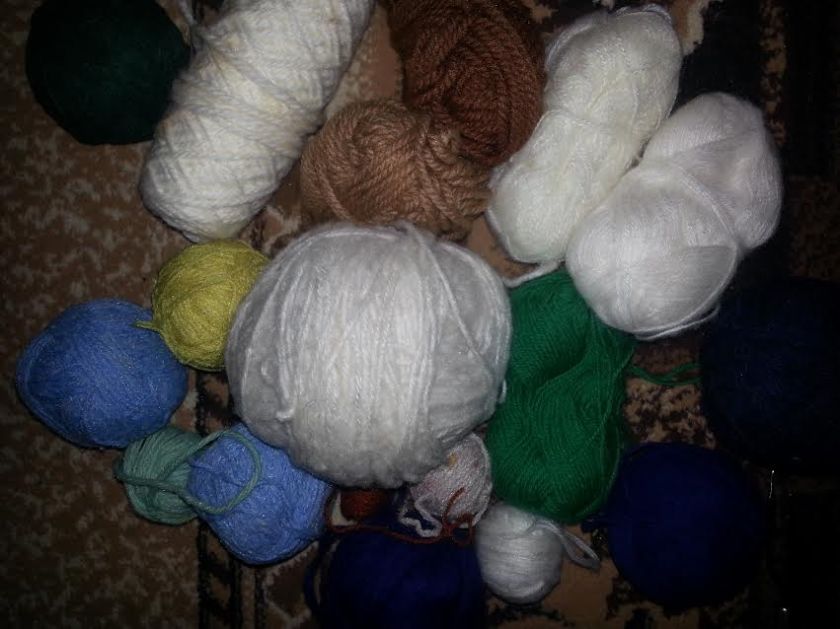
yarn

My mother-in-law has given me a whole bag of yarn which she doesn’t think she’ll use anymore. I haven’t quite decided what I’m going to do with it yet. There isn’t enough for a large project, but I will probably be able to make a hat or scarf or two. The smallest bits will go towards making doll clothes or hair.

I also shared some yarn-related family stories in my latest Mother Earth News post:

“Whenever I go into a yarn shop and look at all the stacks of brand-new colorful yarns of any type you might possibly want, I think of Grandma. What may be a hobby – and not a cheap one, either – to people today was a venue of survival to her.”

Your Own Hands

I’m very excited to share with you that I’ve begun working on a book titled Your Own Hands: Self Reliant Projects for Independent Living. The work is progressing quickly and I have plenty of interesting material to fit in. Prospectively, it will be a book with both a good amount of practical topics and discussion of local and alternative economy. I will give updates on the progress here and on my Facebook page.

As I’m aiming to create something more than a how-to book or social essay, I’m looking for real-life stories to add a more personal dimension, and here is where you come into the picture! If you are a homesteader, organic farmer, artisan, or local business owner; if you’ve built a unique and interesting house, created a productive backyard garden or designed a useful water-recycling system; if, in short, you have a story relating to any aspect of simple, sustainable, self-reliant living, I’d love to hear from you.

Simply write to me through the blog contact form and share your experience, along with your full name, place of residence and, if relevant, a link to your website or social media page.

Preparing for emergencies: water shortages

In my previous post, I discussed what we do during power shortages. Now let’s move on to a situation when the tap isn’t running.

Drinking water – always keep a supply of fresh water on hand for drinking and cooking. A little while ago, a new family moved into the neighborhood and one day when the tap stopped flowing we went to check on them. It turned out that the mother was alone in the house with a nursing baby and had no water to drink. The oppressive heat outside made her reluctant to venture out and ask any of the neighbors for water, so she just sat hoping that the problem would be fixed soon (it wasn’t, until the next day). I dispatched the older children to her house with a couple of water bottles, which were gratefully received – but you don’t want to depend on the kindness of others in such situations.

Flushing the toilet – we have three bathrooms in the house, so the water in the toilet tanks is generally enough for flushing for a day or two, but remember that you don’t have to flush every time (even if it goes sorely against your habits). When there’s no running water, I tell my kids – pardon the details – to only flush when they poop.

Dishes and laundry – the key word here is prevention. Running water issues can be unexpected (a pipe suddenly busting due to excessive heat, for example), so I try not to procrastinate when it comes to dishes and laundry. I do my best to wash dishes right after a meal, and clothes as soon as I have a full load. There are few things more annoying than leaving a sinkful of dishes overnight saying, “I’ll do this tomorrow”, and then tomorrow brings no running water.

Disposable dishes – plastic plates and paper cups are not very classy, economical or environmentally friendly, but when you have no running water for a day or two they can be a sanity saver. Besides, my kitchen cupboards are small and I simply don’t have enough plates for the whole family to keep using for two days straight without the possibility to wash them. I always keep a stash of disposable kitchenware to be taken out as needed.

The garden – this can be a serious issue. 48 hours without water, combined with a heat wave, can easily kill plants, especially those which don’t have deep roots. In such cases, I cover young plants. I also cover some of my garden beds with a mulch of straw to prevent moisture loss.

Finally, I save the water from my baby’s bath and use that for watering the plants. It isn’t much, but it can help tide some plants over until water flows in the pipes again.

I do realize, however, that we need a larger water container for our plants, especially now that our garden is expanding. We are currently planning to set up a greywater tank that will hold all the water from our showers, to use in the garden.tomato

A thriving garden can be killed off very quickly by a combination of heat and lack of water.

Water cisterns – several families in our neighborhood have water cisterns that provide, on average, all their water needs for up to two days. When other people have no running water, they carry on as usual – cooking, bathing, doing laundry – and hardly notice anything is amiss, except perhaps a little reduced water pressure. We are considering making an investment and installing such a cistern, which will eliminate nearly all water-related issues from our lives. The cistern will need to be set up above our house, so that the water runs down by force of gravity.

Electricity and running water are two things that, in the developed world at least, are considered so basic we usually take them for granted. When they are suddenly taken away, people are prone to panic. However, short-term power and water issues are easy enough to deal with, and need not disrupt your daily life – if you are prepared.
Preparing for emergencies: power shortages

Earthquake. Tsunami. Nuclear attack. These are the things that often come to mind when you think “emergency”. Fortunately, in most cases an emergency is something a lot more trivial – think a temporary power outage due to strong winds, or a blizzard that leaves you trapped at home for a couple of days. Or you just wake up one day to discover that your tap isn’t running, and receive a message that the water line won’t be fixed until tomorrow afternoon.

To put it simply, you know the world hasn’t ended and things will soon be back to normal, but for now you need to deal with this unexpected inconvenience that has come your way.

In the area we live in, the electricity and water lines are patchy and we often experience power shortages (especially during the winter) and water shortages (mostly during the summer).  This essentially means that every now and then, we will spend up to 24 hours without electricity and up to 2 or 3 days without running water. We have learned to expect these events and know how to prepare for them so they don’t turn into real emergencies. Here is how.

For power shortages:

Lights – we have emergency lights in the kitchen/dining room area, as well as plenty of candles and oil lamps on hand. When I think the power might go out, I light a fat beeswax candle in the bathroom as I head into the shower, even if the electricity is still on. You don’t want to find yourself groping your way out of the shower when it’s pitch-black – or try to maneuver when you’re bathing a baby and suddenly the lights go out.

p1090643

Above: candles on a rainy day

Heating – we have a gas heater which we connect in the living room. I close the bedroom and bathroom doors to keep the heat in one area, and we all camp out where it’s warm. Many people in our neighborhood prefer to use woodstoves instead, but we find that with gas, we can provide heat more quickly and efficiently.

Warning: heating with gas can be dangerous if you don’t provide some air circulation. I open the window a crack now and then when we use the gas heater.

Cooking – I always use a propane gas stove for cooking. It does have electric ignition, but can be also lit with a match. If needed, I can even bake flat bread in a pan on the stove. I just have to make sure, now and then, that we always have plenty of gas.

Food storage – the food in your freezer and refrigerator can usually survive a 24-hour power outage with relative impunity, depending on the temperature outside, your refrigerator’s insulation and how often you open it. Recently, when it was actually quite warm, the power was out for 27 hours, during which we have refrained from opening the freezer altogether. When the power was back, I peeked into the freezer and was very glad to find all the food still frozen solid. It helps to keep your freezer packed (stuff it with plastic water-filled bottles if you have some extra space) and make sure it’s well-insulated.

Backup generator – during our first winter here, we toyed with the idea of getting a backup generator, but eventually gave up on it as too expensive. Practically, surviving a day without power is quite possible and not very disruptive to your usual routine as long as you have light, heating and the ability to prepare food.

Going off-grid – this, of course, would be the ultimate solution to our problem. We are currently considering the option of investing in a solar energy system, which will free us from the power fluctuations and save us money in the long run. The initial cost is a little prohibitive, but the idea of generating our own energy is very appealing.

Stay tuned for part two: preparing for water shortages!