Is sharing finances with your spouse always the right choice?

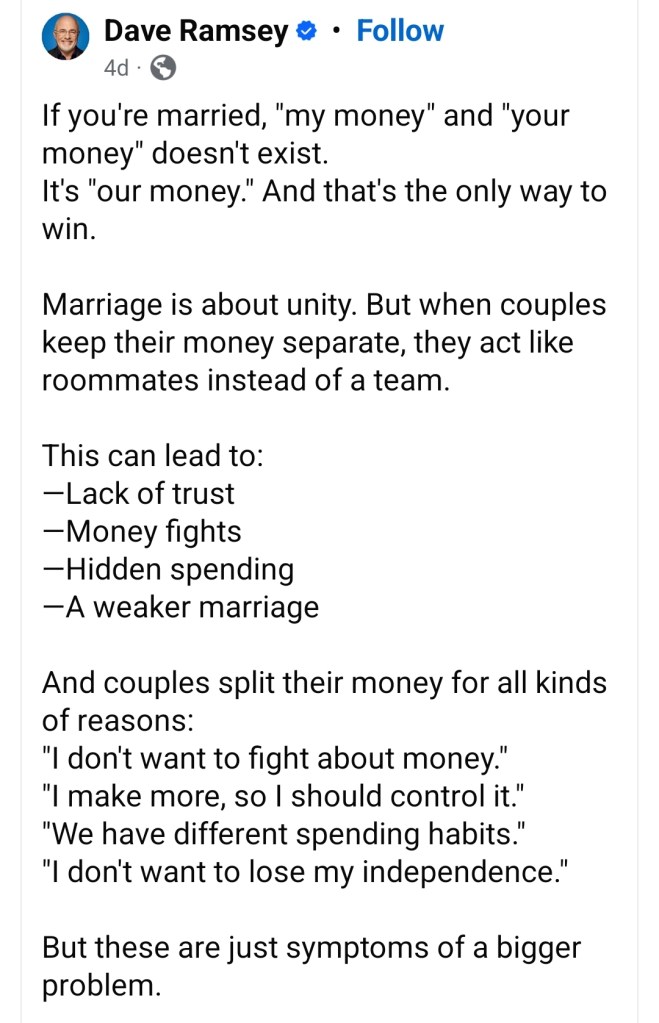
I recently came across the following Facebook post by Dave Ramsey:

Dave proceeds to suggest that spouses should address whatever underlying issue that’s preventing them from sharing finances. While true in theory, this view is incredibly simplistic and naïve.

I agree that in a perfect world, all married couples would be on the same page financially, and would have no reason to keep their money separate. However, this doesn’t always work this way.

I can think of many situations in which sharing finances could, in fact, cause a lot of trouble. Here are just a few:

  • One spouse’s destructive financial habits, like compulsive shopping and inability to budget
  • Gambling and other addictions
  • A spouse carrying debt from before the marriage
  • People in blended family situations, i.e., each spouse brings kids from a prior marriage and is responsible for covering their own kids’ expenses

And that’s even without getting into the issue of financial abuse, like one spouse (often a stay-at-home parent or the one who earns less) being blocked from freely using joint accounts and instead getting “spending money” from the main breadwinner.

Reddit is full of stories like this one, with the self-explanatory title of “Recently discovered extent of my wife’s shopping addiction. The poster proceeds to tell that his wife blew “$6200 on high end cloths this last month with $5200 the month before that.”

So, according to Dave Ramsey, this couple should work on budgeting and aligning their financial goals. Which is a great suggestion, actually! But what if this doesn’t work out?

Suppose the overspending wife doesn’t acknowledge the extent of her problem. Or, suppose she does and makes an effort to fix it, but relapses. Should the financially responsible husband shoot himself in the foot by sharing funds with his wife at all costs, because “marriage is about unity”?

He could divorce her, of course. Many marriages fall apart because of disagreements over money. But is breaking up the only option if spouses can’t agree on money matters?

Let’s say this Redditor wants to stay together with his wife. Maybe they have a good relationship otherwise, and money is their only major disagreement. Maybe his wife actually wants to improve her spending habits, and maybe she even will at some future point, but in the meantime, what can he do to keep up with mortgage payments and put food on the table?

Separate their finances, obviously. It’s better than drowning together with your spouse because “there’s no such thing as your money/my money anymore.” Overall, I believe everyone should do what works for them, whether it’s shared or separate accounts.

Warm winter days

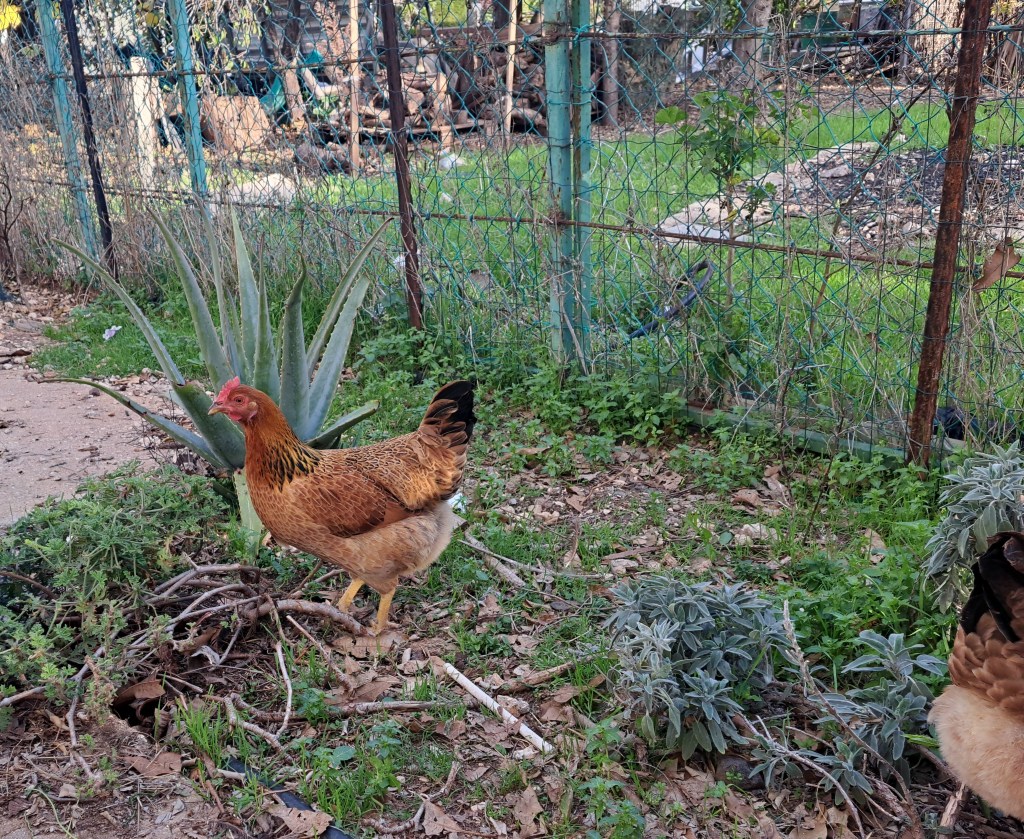
Time passes more quickly than I can grasp, and before I knew it, we’re in 2025 already. We’re having a pleasant, warm winter, and the weather has been so nice that our newest pullets have actually started laying already!

Although the weather doesn’t feel very winter-y, it’s still cool enough for my beloved laceweight wool crocheted scarves. I’m working on another triangular scarf/shawl in Malabrigo Lace (review coming when it’s done, hopefully before summer rolls around).

Regionally, it seems like things are starting to calm down a bit, too. Although you never know what the future may bring, I’m optimistic in looking forward to a period of relative calm.

An exciting announcement: Yours truly has started writing for Emergency Prep Guy, a great resource for preparedness and survival. Check out my contributions here.

The moment I realized food can disappear

Photo by Patrick Winzler on Pexels.com

When I was a very young child during the Perestroika, I once walked into a grocery store with my mom. The Soviet Union was on the brink of collapse, and the shelves were practically empty. I think it was then that I realized basic things we take for granted, like food in stores, can disappear.

Fast forward to today, I appreciate my well-stocked pantry full of canned goods, dried legumes and grains, hygiene products, toilet paper, candles, and basic medical supplies. Although, thankfully, we haven’t faced a full-blown collapse scenario yet, that stockpile really came in handy during times like COVID lockdowns and shortages caused by war.

Stocking up is also a great option for more trivial situations, like finding a really great deal on canned mushrooms and buying a total of 36 cans. Or when you predict prices are going to soar and take advantage of the last days or weeks when some products are relatively affordable.

Another big bonus of being well-stocked is not having to go shopping as often. When I run to the supermarket, it’s typically because I’m out of milk or other perishables, not dish soap, coffee, or shampoo.

I also have nice stashes of items that aren’t survival-oriented per se, but come in really useful, like printer paper, craft supplies, glue, and (guilty!) yarn. Keeping ourselves, not to mention fidgety kids, entertained during a shelter-in-place scenario is a challenge, and it’s nice to know you can always find something creative to do.

If you have animals, you’ll also want to make sure you have enough food for your furry or feathery friends. I get slightly anxious when the sack of chicken feed runs low, even though technically I know chickens are omnivores and could survive on leftovers for a few days.

The main thing that helps me keep my stockpile organized is the FIFO rule: first in, first out. I make sure to move the older packages to the front so I use them first, even if it means rearranging a whole shelf.

What about you? Do you stockpile, and what do you think you should keep more/less of around?

1 year since the Simchat Torah massacre

We’re now only days away from the Hebrew anniversary of the October 7th massacre, which brought our world crashing down on last Simchat Torah.

I will always remember that day. I was enjoying a quiet morning in the park with my kids when I heard people around me talking in worried voices. Rumors were flying. Apparently, a war had broken out, but I didn’t grasp the full extent of the disaster until the evening, when the holiday was over and I could turn on the phone and get updates.

We were instantly plunged into a nightmare of shock, grief, terror, and anxiety. The war is still ongoing, but I feel an immense sense of peace and pride in my country knowing we’ve now eliminated Mohammed Deif, Ismail Haniyeh, Hassan Nasrallah, and Yahya Sinwar – the four greatest evil leaders plaguing our borders.

To all those who said, “We must grant safe passage to Sinwar and other Hamas chiefs to secure a hostage deal” – no, nope, absolutely not. This level of evil needs to be burned down, not appeased or negotiated with. The world needs to know that every enemy of Israel and the Jewish people will get their comeuppance.

Of course, this isn’t over yet. I know that these trolls were Iranian proxies. But I hope and pray that we’ll see the axis of evil broken at last.

Happy Sukkot to all Jews around the world!

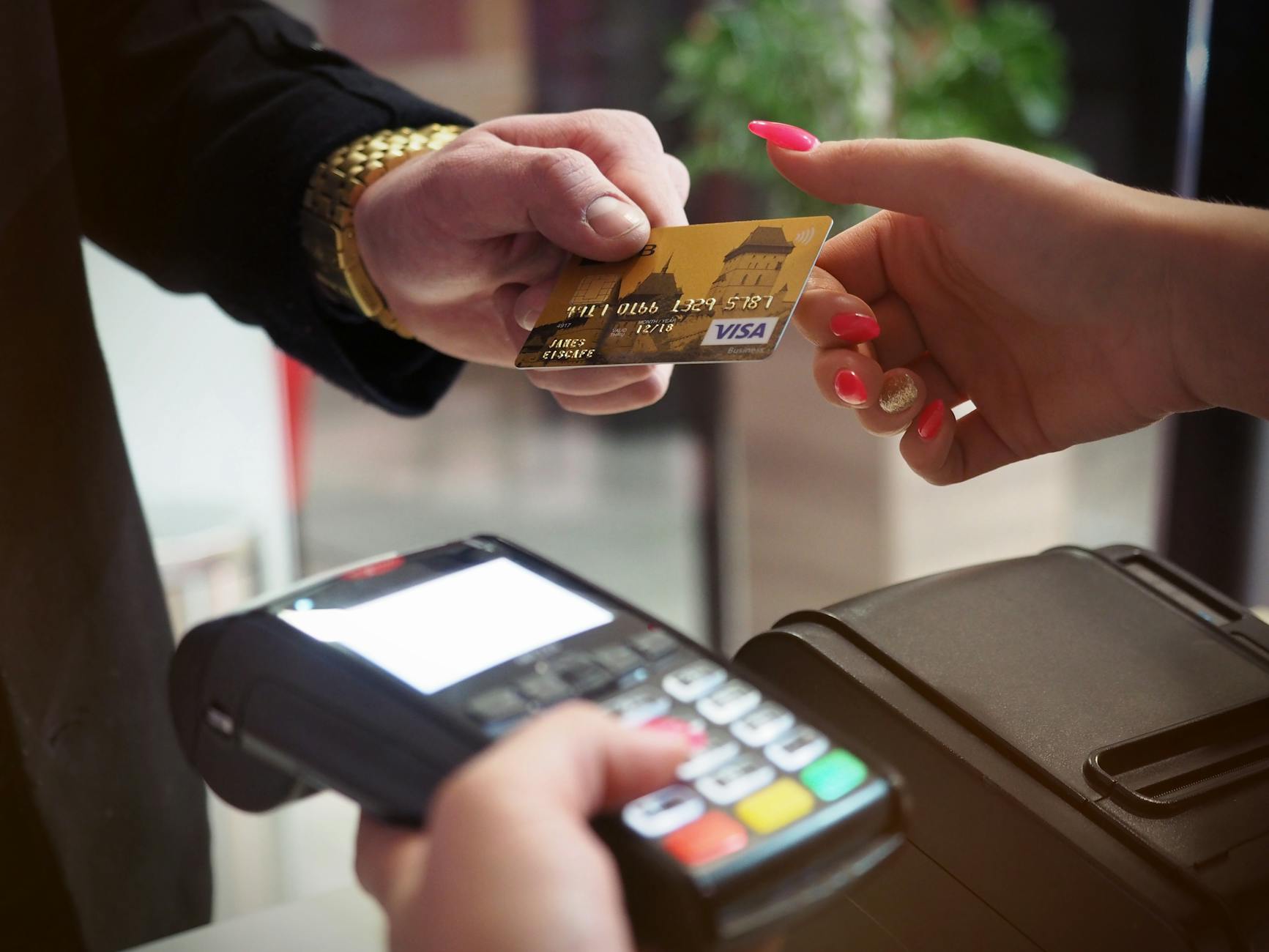
Are we prepared to survive in a cashless society?

Photo by Pixabay on Pexels.com

Recently, I’ve read about the Israeli government pushing to cancel 200-shekel bills, as part of a long-term drift toward a 100% cashless future. I was aware that large-scale transactions in cash have been limited for some time now, but until this moment, I kind of overlooked the final goal of abolishing cash altogether.

This is an alarming trend.

Going cashless will hurt the most vulnerable, like seniors and technologically challenged people. Or think about a woman in an abusive marriage, who can’t access a bank account or credit cards. Those little bits of cash she manages to stash away may be her only path toward an emergency escape.

When you have no access to physical money, you can instantly become completely destitute if the government decides to freeze your account for any reason, like protesting mandatory vaccination. Abolishing cash means stripping away a large part of our independence, freedom, and privacy.

In Israel, the official pretext for limiting cash is cracking down on criminal groups. But a capable government should have ways of fighting organized crime without cutting into the rights and freedoms of law-abiding citizens.

“Stash up cash” is common preparedness advice. If there’s a natural disaster, war, or a massive cyber attack, if the power or WiFi are out and people can’t access banks or use their credit cards, physical money may be the only way to buy food and other essentials. In a country like Israel, with so much instability, canceling cash is an extremely short-sighted move.

All of this makes me think: how can you prepare for an emergency situation or a long-term crisis, with cash being no longer available?

Precious metals like silver and gold can be a huge advantage in this situation, since they’ve kept their intrinsic value for thousands of years. Foreign currencies may likewise be useful. [As a side note, governments that want to chip away at people’s freedoms may also crack down on the possession of precious metals and other valuables.]

In a more long-term scenario, some societies can band together and establish alternative currencies. I won’t mention crypto, because again, I’m talking about situations where people are offline or off-grid.

Finally, let’s not dismiss the power of barter. Fresh produce, non-perishables, and various supplies can all be bartered, as can skills. People who are good with their hands may have many options of exchanging services for foods and other necessities.

During WWII, my grandmother survived by unraveling old wool garments people brought her and knitting or crocheting new items out of the salvaged yarn. She would accept food as payment. I hope none of us ever have to face a similar crisis, but it’s still wise to invest in skills and resources that might help us survive tough times.

***

P.S.: Tomorrow evening marks the start of a new year in the Jewish calendar. I wish all my Jewish followers Shana Tova and hope for a better, more peaceful year ahead.

Shopping smart: Save money by controlling impulse purchases

Photo by energepic.com on Pexels.com

For a very long time, I didn’t have an income or a credit card and lived in a location without any shops. Thus, while frugality was (and still is) a big part of my lifestyle, for many years I was free of the temptation of impulse purchases.

Fast forward a few years. I began earning money as a freelancer, got a credit card, and moved to an area with shops and reliable Wi-Fi. This meant I started doing a lot more shopping, and had to deal with controlling my own spending practically for the first time in my life.

It feels amazing to know that you can buy stuff after many years of everything, from socks to a new washer, being out of your reach. But staying within one’s budget is also part of adulting.

I’ll admit that, like so many others, I have occasionally succumbed to the lure of the next shiny thing. Impulse purchases are especially difficult to avoid when you shop online and can order something with the click of a button. And then, when that coveted item finally arrives, how often do you wonder what made you order it in the first place?

When I analyzed those “Don’t know what I was thinking” purchases, I saw a pattern. More often than not, I was stressed when browsing online. Or tired. Or I had had a really tough work week and felt like I “deserve” a little treat. And in most cases, by the time I got my stuff, I wasn’t sure why I wanted it and was 100% certain I didn’t need it.

There’s some great advice on curbing impulse purchases out there. Here are the top three tips that I’ve found most helpful:

One, distract yourself. Look up a fun recipe, watch a video of some beautiful places in New Zealand, listen to music, or read a book (you can find many freebie books on Amazon).

Two, reward yourself with positive things that don’t cost money, like a nature walk, a nice soak in a hot bath, or an afternoon of baking with your kids.

Three, wait. Add the item you want to a shopping list or put it in your online cart, but don’t hit “Buy” just yet. Wait a few days. If upon sober contemplation you decide you do want this thing and can afford it, go ahead. This way, there’s a much better chance you will enjoy rather than regret your purchase.

Cursed Earth: Birthday Book Release

Today is my birthday – as well as the birthday of my latest book, Cursed Earth, the first installment in my new fantasy series, Storm of Elements. Cursed Earth features an outcast with dangerous powers, tangled conspiracies, ruthless pirates, and an inexplicable phenomenon that threatens to destroy the world.

From the book: “I can never go back to Terrenia,” Maxine said in a low voice. “If someone finds out…”
“… that you have unusual abilities?”
“That I’m a freak – yes, a freak – I will be facing worse than deportation.”

I started working on Cursed Earth around the time when our world blew up in our faces on October 7th. It began as a “look, I still have it all together” novel and went on as a “everything is crumbling around me, but I can still escape to a different world by making up a story” book.

I’m thankful for having written Cursed Earth. I’m thankful for the baby steps I’m taking with the sequel, even when I feel brain dead. I’m thankful to be alive. Thankful for my family, my people, and my country. And especially thankful to have made another turn around the sun.