Spring means nesting boxes

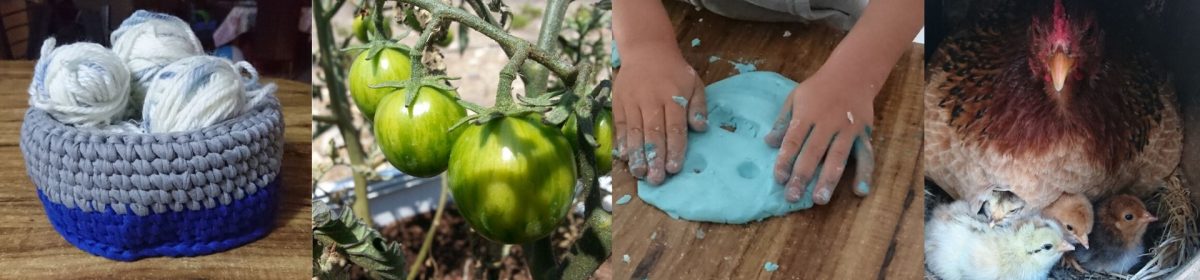
hen in box with chicks

Around here, spring is marked, among other things, by the renewal of nesting boxes, which are replaced or cleaned, and padded with fresh dry grass or leaves. My hens, excited by the end of their winter egg-laying break and the beginning of the new and fruitful season, are eagerly checking them out.

Read more about comfy nesting boxes in my latest Mother Earth News post:

“With some basic carpentry skills, you can easily build your own nesting boxes out of wood scraps, but even if you don’t know which way to hold a hammer, there are plenty of simple and cheap DIY solutions. Among them are 5-gallon buckets (resting on their side, obviously), old cat litter boxes, large plastic containers with the top cut off, and old re-purposed drawers and crates. The nesting boxes should be stable, so that they aren’t prone to falling even if the hens tend to shove each other, sheltered, and with a rim to prevent the eggs from falling.” 

The table of Abraham

Image result for hospitality oil painting
In the Jewish Grace after meals, Birkat ha-Mazon, there are lines specifically intended for the guest to say: and this table shall be as the table of Abraham; all those who hunger shall eat from it, and all those who thirst shall drink from it, and it shall never lack bounty, always and forever. I find in these lines a very beautiful image of hospitality.

Our first dinner guest was sprung up on us quite unexpectedly. The memory stands out vivid in my mind; we were a newlywed couple, married perhaps for a month or so, and it was one of the first Shabbats we spent in our home. We were just returning from the evening service when a stranger came up to us and asked if he may have a dinner with us. We exchanged startled looks, but somehow (if not very eloquently) we must have given our consent, because half an hour later this man was seated by our table. It turned out that he is our neighbour, a middle-aged bachelor with no family living nearby. For as long as we continued to be neighbours, he was often our guest. He used to bake the most wonderful pita bread, and it was initially through trying to emulate him that our passion for bread-baking grew and flourished.

I am a scrupulous kind of person when it comes to receiving guests; I have good intentions of being hospitable and welcoming, and having my doors open to others, but when the rubber hits the road I often get these fretful nervous attacks, thinking that nothing is up to scratch – that the food I prepared isn’t fancy or plentiful enough, my home is not clean or orderly enough, my children not disciplined enough to allow space for adult company to talk.

But all this passes in my mind before the dinner or lunch takes place; once we are in the thick of action, I feel very glad for having done it, as there is nothing like the exchange, fellowship, enrichment of discussion, and generally just the knitting of hearts and communities together, that takes place ’round a dinner table. Leisure time is plentiful, the children play together, and there is that ease and laughter that accompany a good meal in good company.

I am beginning to relax. Around here, an impromptu invitation usually assumes that the guests are bringing some food with them, which turns every shared meal to a spontaneous pot-luck party. I’m telling myself not to fret about the additional side dish I did not have time to make, and think instead that washing dishes after everyone is already bountiful enough. :o)

It never ceases to impress me just how much our society lost by, when people stopped regularly congregating around the dinner table. Food, family, fellowship – the magical trio. Immediate family first of all, of course, but then the circle is expanded; others are included, made to feel welcome. Jokes are shared, discussions spring up, ideas are born. Once people dispersed for time-efficient gobbling up of substandard food from plastic TV-trays, a crucial element of togetherness was abandoned. As a clinical nutritionist I feel qualified to say that at least half of all our modern obesity and other nutrition-related maladies would be solved by the return of the family table. I truly believe there is no better way to make someone feel welcome and accepted, than invite that person to share a meal.

So my advice, to myself and to others, would be – take the plunge. Invite someone over; it doesn’t have to be anything fancy. Perhaps you didn’t prepare dessert; perhaps your home has a lived-in look (a couple of kids will give that perpetual air to a house); but your hospitality will be warmly appreciated as you toss on an apron and continue smiling and chatting with your guests while you soap up the dishes in the sink.

How to juice a pomegranate

The pomegranate is a delicious fruit with many health benefits, but it can get really messy. When I want to treat my family to fresh, antioxidant-rich pomegranate juice, I seed and juice my pomegranates in the following easy, low-tech way:

1. Cut the pomegranates in half (as shown in the picture, bottom right).

2. Hold the pomegranate halves above a large bowl and seed. I do that by knocking on the outer peel with the handle of a heavy knife – a technique taught by my father-in-law. You can also just remove the seeds with your hands.

3. Once you have the bowl of pomegranate seeds (see picture, top right), mash them with something flat and heavy. I use a beer stein for this purpose – put it on top of the seeds in the bowl, bottom down, and press. The juice will flow.

4. Strain the juice by placing a strainer over a second bowl and pouring the contents of the first. Often, you will have residual juice after the first straining, so press some more.

The fresh pomegranate juice should be consumed as soon as possible so that its unique properties aren’t lost. It gives an antioxidant boost and is also an astringent, great for upset stomach and diarrhea.

The peels go on the compost pile and the remaining seed pulp to the chickens, who love it, so nothing is wasted!

Spring delights

I thought I’d post a couple of photos of the nice things we’ve been enjoying lately – plenty of sunshine, green grass for our birds to browse on, and flowers.

As you can see, our baby peafowl have grown quite a bit, but as peafowl generally don’t breed until two years of age (to the best of my knowledge), we don’t expect any egg-laying or breeding this season, though the male is becoming more colorful with each day.

The plant in the bottom right corner is actually a wild herb that sprang up in my garden quite unexpectedly. It smells wonderful, but I have no idea what it is. A guess, anyone?

In the upper right you can see a gorgeous desert view from a day trip we took. It lacks the lush greenery that can be seen in other parts of the country at this season, but I still find it majestically beautiful.

The Last Outpost: new environmental sci-fi novel

THe last outpost

If you are fans of environmental science fiction, I hope you check out my new novel, The Last Outpost, now available both on Kindle and in print. It is set in Antarctica, with its theme being the precarious balance between man and nature. Also features a mysterious indigenous tribe, an outrageous government conspiracy, and ancient monsters sleeping under the ice.

From the blurb:

“Scott “Buck” Buckley, an environmental scientist, accepts the position of general overseer at the McMurdo Antarctic research station. After signing a secrecy declaration, Scott becomes privy to the existence of Geyser Valley, an area with a unique warm microclimate, which is home to the mysterious indigenous Anai people. In an outrageous conspiracy, the world governments are keeping the existence of these people a secret, to avoid limitations on the division of land for natural resources.

Scott is fascinated by the unique culture of the Anai, visiting them and learning from them as much as he can. In the meantime, the world becomes more and more unstable as global war is about to break out. Just before darkness sets over Antarctica, warfare tears the world apart, and the research station finds itself completely isolated for the long and sunless winter.

In the loneliness of the winter, Scott remains facing difficult questions all alone: who are the Anai, and how did they come to Antarctica? How much truth is there in their legends about giant ancient reptiles frozen in ice, waiting to come back to life? How is McMurdo going to hold on until the communications and supply lines are restored? And where are the limits one is not allowed to cross, not even in the name of survival?”

I’m also looking to hand out 5 review copies (in digital format), so if you are interested, please get in touch with me through the contact form. Thank you!

The perfect pastry

DSC_0463

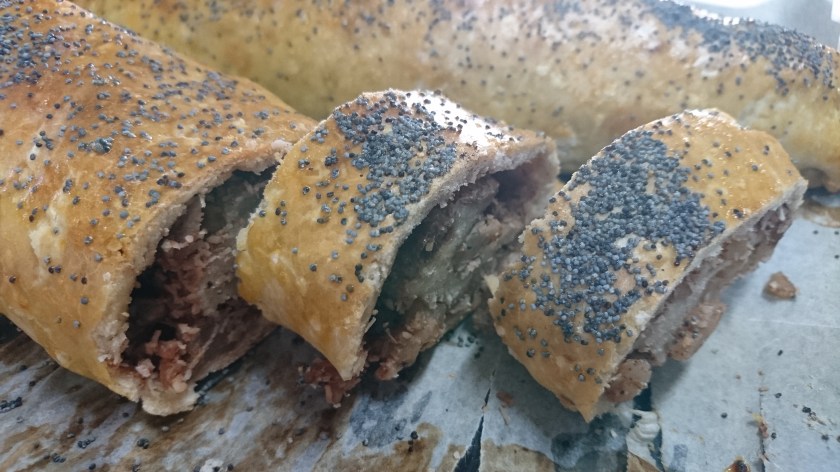
Strudel is one of my favorite kinds of pastry because it’s so versatile – basically, anything can go inside – and because, though it is made with white flour, the dough is plain and unsweetened, and the emphasis is on the filling, which can be as little sweetened as you choose. Here is my favorite recipe:

Dough:

2 cups plain white flour

An egg

A pinch of salt

2 tbsp coconut oil or butter – I’m a huge fan of coconut oil, because I usually want to make all my desserts parve rather than dairy, but butter would work just as well.

Just enough water to make the dough into a pliable, elastic ball that can be easily rolled out.

The rolling out, very thin, is the secret of a good strudel – the dough gets all the delicious flavors of the filling.

Filling: there are literally a myriad of variations, but here is my favorite. In a bowl, combine 5-6 thinly sliced apples with raisins, chopped nuts, some ground coconut, and cinnamon. Sweeten as desired. I usually put in a spoonful or two of honey. You could also spread a thin layer of jam over the dough once it’s rolled out.

Roll out the dough, spread the filling evenly, and roll in. Be careful not to tear.

Carefully, transfer the rolled-up strudel to a tray lined with baking paper and brush with beaten egg. Sprinkle poppy seeds on top (optional). Put into oven on medium heat. Bake until the top is golden, which should take around 30-40 minutes.

Serve warm and enjoy with a nice cup of tea or coffee.

Rural life and financial security

Image result for financial security homesteading

When we were about to get married, we knew just how we want to raise a family: we would live a quiet, simple, unhurried life in some beautiful rural place, and I would stay home and raise the children, as they would come.

Ten years and 3 (soon 4!) children later, our dreams haven’t changed, but our perspectives have, with experience that allows us, in hindsight, to realize many things we have missed in the past.

We had a good headstart, financially, and we were prepared to live modestly, which had enabled us to purchase our first little home outright, without getting into debt or mortgage. This was good, but it finished off all our pre-marriage savings, and there was nothing left to do some necessary repairs, which the house badly needed, and when my husband hit a period of unemployment, we eventually had to sell the house for some immediate relief. A lot of money then got frittered away on rent.

We bought another house eventually, the one where we live today, but we then hit another stretch of unemployment, or rather, underemployment, plus a few pitfalls such as unwise investments in projects, and being ill-used by unscrupulous people. This was unfortunate, but it could happen to anyone. The problem was that we failed to take something into account, namely, that in choosing to live in a relatively distant area, we are reducing our earning capabilities, and basically eliminating the possibility to find an extra job quickly and easily if needed in lean times. Spending less is great, but sometimes you just hit that bottom when you can’t cut back anymore, and must earn extra to pull through.

Since we only have one car, I don’t drive, and public transportation in our area is almost nonexistent, we couldn’t even make a temporary switch of me taking a job and my husband staying with the kids, which was, and is, incredibly frustrating, since there were opportunities of jobs five minutes away, but when you have no means of getting there, it doesn’t matter if it’s five minutes away or on Mars. I was prevented from acquiring a driver’s license by 1) all lessons being held in town, so how is one supposed to get there without any means of transportation?? and 2) the prohibitive cost, which is quite a robbery in Israel. Because, you see, around here it isn’t enough that someone who knows how to drive teaches you. Oh no! Even if you know perfectly well how to drive, you still need to take a minimum of 28 lessons (I think) with a licensed driving teacher, which costs a bundle. Sorry for the rant, but I always get my blood boiling over government-sanctioned extortion that robs people of their hard-earned money.

So, for months on end my husband and I would both be home, with the car sitting in the driveway (which, granted, saved on gas), and us going crazy with the despair of not being able to climb out of the pit.

Eventually, I came to terms with the fact that I have to make do with what I have, and find ways to generate income from home. Today, I give nutritional counseling (in which I have a degree), do editing, proofreading and translation, and write both fiction and nonfiction. It’s wonderful, but I wish I had done it sooner, because establishing yourself as a freelancer requires time and dedication, and it takes a while before you’re actually earning. It was also hard to shake off the dogma of the husband being 100% responsible for the income. I do still believe that it makes sense for the man to be the main breadwinner, and that it’s extremely difficult, unreasonable and unfair for the woman to shoulder this burden as well, in addition to pregnancy, birth, and nursing (my husband can change diapers and bathe babies very well, but he can’t breastfeed or do postpartum recovery instead of me, nor can he swap with me and borrow my heavy, tired, pregnant body). However, when one’s family is struggling financially, one of the most empowering things is to be proactive and seek ways out of the rut, rather than only look up to your other half and hope things will improve.

To sum up this long and rather rambling post: if you’re planning on a lifestyle in which you earn less and spend less, in particular if you take the plunge and move to a rural area with the goal of becoming more self-sufficient and producing at least part of your own food, that’s wonderful, and it’s still our path, though it has been rocky and winding. However, you must be prepared for financial crisis, or you’ll find yourself in deep trouble when it hits and you have no way to counter it. So what would I have done differently, if I could (some things really did not depend on me)?

1. Possibly, I would have waited with the purchase of that first home. It’s great to be a home owner, but if it leaves you with absolutely zero in the bank, it puts you in a very precarious position.

2. Once the house was bought, I would have tried harder, and would have been ready to endure more discomfort, to refrain from selling it. Selling your only home does not solve problems, though it may stave off crisis, and is unavoidable sometimes. You have to live somewhere, and loose money inevitably goes down the drain. In hindsight, we could have held on.

3. I would have fought tooth and nail to leave more in savings during that time when we did have a nice income.

4. I would have prepared earlier, and more seriously, to the possibility of having to generate income, by whatever means. Granted, even working from home isn’t always practical when babies come one after another and you struggle to hold your head above water, but I have become a lot more efficient with my time during the past three years, and my heart literally bleeds for all those hours in the past spent on passive entertainment or just muddling around.

5. I would have trusted my judgment more. Not because I’m cleverer than my husband, but because two heads are always better than one. Magnanimously saying, “I’m sure that whatever you decide will be great” may sound nice, but going into all the nitty-gritty together is far more helpful.

The silver lining: we have never been, and are not, in debt. This makes things so much easier and less stressful. Avoiding debt (and mortgage is debt as well) is the best and soundest choice, in my opinion, that a family can make.