When little ones are sick

This week we’ve been struggling with a bout of flu that got all of the children in turn. As much as it pains me to see a little one sick, I consider this also an opportunity to slow down – which is especially important if I’m not at my best either – rest, unwind and do some quiet, enjoyable things there often isn’t enough time for:

Reading – listening to an interesting new story, or re-visiting an old friend of a book, is a soothing and relaxing activity that is perfectly suited for a day spent mostly in bed or on the couch. Older children can read quietly to themselves.

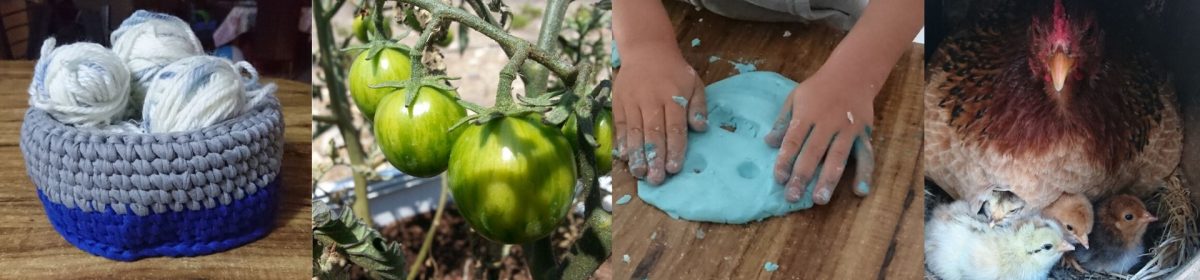
Crafts – drawing, stitching, beading and working with play-dough all stimulate the mind and creative senses without requiring too much physical exertion. Dress-up or building forts and hideouts with chairs and blankets are also fun.

Board games – pull out old favorites like Monopoly or Scrabble, or try something new. Forbidden Island is currently all the rage here.

Outdoor time – if the weather is nice, I see no reason to necessarily stay indoors. On the contrary, warm sunshine provides a cheering effect and may even help with nasal congestion. I do discourage sick children from “playing hard” – running, riding bikes, climbing trees, etc.

Outdoors we may also pick herbs to make medicinal tea and talk about their various healing properties, as well as of the importance of staying hydrated in general.

Fresh herbs from the garden make great tea for colds and flu

Movies – I like to restrict screen time, and especially so for sick children, because I find that prolonged staring into a screen is fatiguing, but a short cartoon or an educational video can be nice.

On days when the children don’t feel well, I usually dispense with school, but the girls may still choose to do some fun educational activities such as writing in their story notebooks.

The most important thing is to remember that this, too, shall pass. Slow down, allow everybody the time to rest and heal, and try not to mind the mess too much. There is always tomorrow for catching up with housework, gardening and lessons.
Homeschool science fun

20160907_113818

This neat little experiment comes from Science Bob.

You will need:

A glass or plastic bottle with a relatively narrow neck.

1 tbsp. of dry yeast

1 tbsp. of sugar

A funnel

A balloon

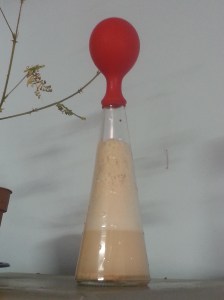
Blow up the balloon and then release the air from it to stretch a bit. Then, using the funnel, pour the dry yeast and sugar into the bottle and shake it all up with some warm water. Put the balloon over the neck of the bottle, making sure it’s firmly in place.

After a few minutes, the yeast will begin making foam and the balloon will start to blow up because of carbon dioxide emission. The foam may actually overrun the top of the bottle and escape into the balloon – that’s OK.

A couple of hours later, the yeast activity will fizz out, but the balloon will retain its size.

It’s a very easy, fun experiment which prompts interesting discussion with kids about micro-organisms, metabolic processes and properties of gas.

Jewish homesteading: an interview

A while ago I was contacted by Tachlis magazine, who were looking for information on the Jewish homesteading movement. My email interview with them is below:

Where do you live exactly?

I’m sorry, but as our privacy is important to us, I cannot state our exact location. I can only say we live somewhere in the Shomron.

What is your homestead like?

I wouldn’t call what we currently have a homestead, precisely; I look at it, figuratively, as the seed of what I would like to have. Right now we have a small flock of chickens, a small garden and a few young fruit trees. I would like to have a large, productive garden and orchard, more chickens, and ideally some sort of a dairy animal. This way, we would provide a significant part of our own food.

In the meantime, we are doing what we can with what we have, and learning relevant useful skills in gardening, improving soil and raising animals. We used to keep dairy goats so I know how to hand-milk and make cheese, and can easily go back to it again.

Is there a community where you live? Is there a minyan?

Yes and yes. We have some wonderful neighbors around here.

How did you decide to homestead?

I don’t think it was a one-time conscious decision. We did know, even when we first married, that we wanted to live on a piece of land, not in an apartment building. We are just taking baby steps in a certain direction, and anything we have accomplished so far has been largely thanks to my husband: sometimes you just need to jump in with both feet, and he can do it much better than I. He was the one who brought home a box with our first chicks, and he was the one who decided on buying goats. He has also accomplished various complicated projects around the household I couldn’t have done myself.

What do you feel your family is gaining from homesteading?

Even though I wouldn’t refer to us a homesteaders just yet, we are learning a whole lot from growing plants, raising animals and working on a plot of land. Our children know the thrill of a newly hatched chick and a newly sprouted seedling. They know how an incubator works and where is the best spot to plant tomatoes. They know all sorts of things I wish I had learned as a child.

Israel+chickens3

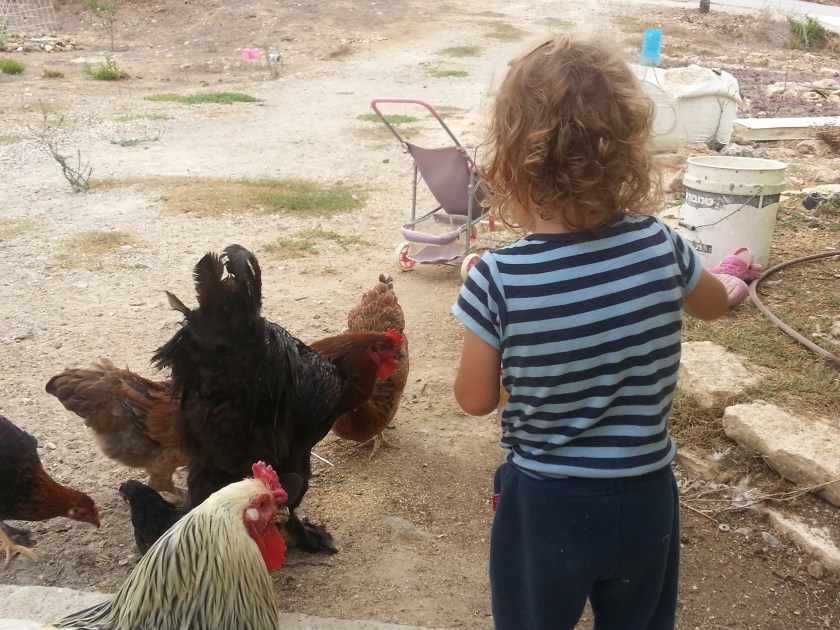
Above: Israel, 19 months old, loves to feed the chickens.

I think one of the best things in growing your own food is that the experience does something to every member of the family, regardless of age. You can all share the excitement of newborn baby goats – nobody is too young or too old for that. And when you go foraging for wild-growing goods, you are all equally satisfied when you come home with full containers.

Our lifestyle has brought us together with many wonderful like-minded people, which has been a terrific experience and an education in itself.

And, of course, those who “graduate” to growing and raising a significant part of their own food will reap the benefits of a healthier diet and reduced expenses.

Does homesteading help you connect to the Torah in a deeper or more personal way?

Yes, certainly. Jewish life and working on the land are closely intertwined. Many of the mitzvot specifically refer to agriculture: ma’asrot (tithes), Shmita (the Sabbatical year) and the holy status of the firstborn male, to name a few, and of course anything that has to do with humane treatment of animals. When you grow plants and raise animals, even on a small scale, you get to experience this first-hand, not just learn it in theory. Then there’s everything Shabbat-related, such as the restrictions of tending to the garden (you must do everything before Shabbat) and milking (you can milk so the animals don’t suffer, but not collect the milk). Also, as we’re into poultry especially, we have learned there’s some doubt about the kosher status of certain heirloom chicken breeds (in particular ones with an extra toe). We have found out so many things we would otherwise have had no clue about!

You can read more about homesteading and small-scale farming in Israel in this post.

Supermarket seeds: grow fresh food from store-bought produce

Not long ago, my husband brought home a packet of coriander (cilantro) seeds from the store. They are great in soups, stews and many other dishes. Then, by a stroke of inspiration, he said, “hey, why don’t we try to make them grow?”

I wasn’t sure the seeds were viable, but we had nothing to lose, right? I tried to plant a few and, while only about 30% germinated, it was alright by me as we had so many and bought them so cheaply. A tiny packet of planting seeds would have cost us a lot more (yes, even taking into account the low germination rate).

Below, you can see one of the new coriander plants grown from these seeds. The other plants in the photos – cherry tomatoes, peppers, melons and beans – were likewise grown from supermarket produce.

All these wonderful plants were grown from scraps most people toss into the garbage without a second thought. 

There’s no doubt it’s always better to purchase high-quality seeds from a reputable company. This way you know exactly what you’re getting and the germination rate, with proper handling, is high. Supermarket vegetables are often hybrids, so saving and planting seeds from them can have unpredictable results. But I still think supermarket-produce seeds deserve a chance. They are very cheap, readily available, and most likely you already have some on hand. There’s certainly no loss (except for a little work and some garden space) in trying, and it can be a fun experiment.

I haven’t actually collected a harvest from these supermarket-originated plants yet, but when I do, I plan to write a follow-up post and tell you whether the produce was any good and how much it resembled the mother plant.

Health and homesteading

Check out my latest Mother Earth News post: what happens when physical limitations stand in one’s way to self-reliant life.

“Even in our modernized age when almost everything is done at the click of a keyboard, being able-bodied is still an essential part of building your own house, starting a homestead, and keeping it going. But what do you do if certain health problems interfere with your homesteading goals? Should you accept that some things just aren’t meant to be – like building with your own hands, for example?

It is my belief that there is an alternative way to do pretty much anything, and even to profit from the seemingly untoward circumstances that might seem as a death certificate to your dream.”

IMG_20141127_195847

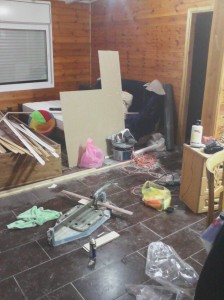
Illustration: mid-renovations mess in our living room, just before our son Israel was born.

One-minute household chores and e-book giveaway!

How many times have you looked around the house and experienced this sinking feeling that there is a million of things to be done, and no time to do them? Well, apparently the key to success is to break the million things into one-by-one, and just head in and do something, even if it is something little. The sense of accomplishment will motivate you to go on, and efficient planning will enable you to make good of those little pockets of time during the day.

Here is an excellent list of household chores that can be done in one minute.

I do have to say, however, that sometimes those little things may take longer than we estimate; for example, it really is only a minute to change your kitchen towels – if you keep them readily available. I personally don’t have much cupboard space in the kitchen, so my kitchen towels are kept in the closet in the children’s room and I have to walk there and then back to the kitchen to get the towels. I also need to drop the used towels into the laundry basket.

If you really only have a minute or two, work in the space where you already happen to be, or near it. For example, if I’m watching over a toddler playing in bath, I might use up that little slot of time to wipe down the bathroom mirror, sink and tap, and perhaps to scrub the toilet. If I’m watching over kids while they are playing in the yard, I will clean the outside of the living room window (yes, the one with fingerprints and nose prints all over it!)

Logical storage strategy is another important thing. I’ve already mentioned kitchen towels; by necessity, I keep them away from the kitchen, but I realize it would have been better to make room in one of the cupboards. The little sponge I use specifically for wiping sinks, I keep in the bathroom so it’s within easy reach. I’m forced (again by necessity of space) to keep some of our clothes in the storage shed closet, which is larger, but I make sure those are the clothes we use less often, in particular during the warm months (coats, jackets etc).

Then it’s important to assess whether a chore really takes up only a minute, or we are run away with our fanciful imagination. For example, I’ve been known to step out to fold the laundry, saying “it only takes a minute”, forgetting that with little ones in tow, it most certainly does not. In that case I must either allot more time for the chore, or delay the task until later.

And of course, this doesn’t mean every last little moment of spare time must be filled with housework! Sometimes, when you only have a couple of minutes, it’s better to take a deep breath, have a glass of cool water or a little snack, or read a page or two of a good book.

***

Giveaway announcement: starting from now and until August 31-st, you can download my natural health e-book, Nurturing Hands, from my Payhip store for free! Simply proceed to checkout and use the 100% discount coupon I have activated. Of course, you are most welcome to share this giveaway on your own blog, Facebook or Twitter and let your friends know! Coupon code: 783CZRSQDP

I have also included a 50% discount coupon for The Practical Homemaker’s Companion, which will be valid until September 7-th. Coupon code: E1KQKKJURV

In addition, following requests, The Practical Homemaker’s Companion is now also available in paperback for only 5.38$. Since it’s a short, very condensed book and my aim was to make it as affordable as possible, I chose the lowest price setting allowed.

Banner


From the back cover:

“Our job as wives and mothers is of tremendous importance and eternal impact, but it’s all too easy to get bogged down and discouraged by the mundane. The dinner got burned; the mountain of dirty clothes in the laundry basket is growing at an alarming rate; you have outstripped your grocery budget; your kids are squabbling; you lose it and yell and feel guilty. You go to bed with a nagging headache, wondering how you’ll get up and begin all over again tomorrow.

We’ve all been there. We’ve all done that – are still doing that. Opening a fresh page every day, doing our best and hoping it’s enough.

This book is a compact combination of inspirational articles, practical tips, and advice for making a small income go a long way. From encouragement to take heart in your job as a homemaker, to stockpiling, wise grocery shopping and keeping chickens, it’s based on the homemaking and simple living tips I have found most useful over the years.”

Collecting dew: another step in water conservation

There’s a lot of talk about collecting rainwater as a frugal and ecology-conscious way to reduce water waste, and that’s certainly a good thing and a project we hope to take up in the future. I do have to say, though, that in Israel we don’t get any rain to speak of approximately from May to October. What we can do in the summer months, without any special equipment, is collect dew.

Our system is simple. We have a plastic awning at the entrance to our home, and when I step out early in the morning I can see puddles of water around it. By placing buckets in strategic locations, and then combining their contents, we get roughly a bucket of clean water every day this way. We primarily use it in the garden, but if we used cleaner containers I wouldn’t hesitate to drink it. It’s easy, useful, doesn’t cost anything and could turn out very important in a survival situation. I expect we could harvest a lot more water if we set up a water catchment system all around our roof, too.

The dew we collect is used daily to water our garden. Our peppers already look very promising!

I have noticed that dew is especially abundant when a cool, quiet night follows a hot day. We have many such nights during the summer, as we live up in the hills and usually experience very pleasant temperatures once the sun sets. In Israel, and in other countries with an arid climate, dew collection can be done on a larger scale and play an important role in water conservation.