I’ve long since accepted that I belong to a family of pack rats who LOVE to accumulate stuff and find it extremely difficult to part with anything, from old T-shirts to frayed sheets or multiple dog-eared copies of the same book.
There are many days when I’m tempted to just pick up a large garbage bag and start chucking stuff into it. I fantasize about how much easier the house would be to clean and maintain in order if it contained 80% fewer things.
Unfortunately, trying something like this around here would start a full-blown war, so I’ve come up with a compromise that preserves my sanity while avoiding conflict: find one item, every day, that you can get rid of without regrets.
It can be anything: an empty perfume bottle, an ancient set of dried-out acrylic paints, a pair of shoes that pinch just a little (and that, if you’re honest with yourself, you know you’ll never wear). This strategy amounts to hundreds of unnecessary items a year, out of your house and of your life. And often, you’ll spot more than one thing you can toss.
On another note, today marks the release of my 20th fiction novel: Lethal Water, book 2 in the Storm of Elements steampunk-y fantasy series. A decade has passed since I self-published my first novel, after snatching away an hour here and there on the family’s clunky desktop while my kids were asleep. Here’s to many more exciting stories to come!
Recently, I’ve been browsing quite a lot of the AITA subreddit. You come across some interesting stories, like this take from a stay-at-home mom:
“It’s the hardest, yet most rewarding job in the world. It is work though and I feel like I should get at least some compensation for all that I sacrifice. My husband doesn’t feel that way at all, though.
I decided to draft up a list of the stuff that I do around the house. Daycare, cleaning, cooking, etc., and after the tykes were put down I presented it to him and explained that I would like to be have a separate bank account and be paid (min wage). I figured that was completely reasonable, but apparently not.”
So… should stay-at-home moms be paid? I don’t think so.
Now, I’ll be the first to admit that SAHMs are often taken for granted and not appreciated enough, even by themselves. I remember myself as a young mom with two toddlers, milk goats, a bunch of chickens, and a dog to take care of, constantly questioning whether I’m doing enough. Which, now I think about it, was crazy and kind of sad.
I also know from experience that stay-at-home parents are vulnerable and disadvantaged financially. It’s not just about the money you don’t make while you dedicate yourself to raising your children. It’s about employability. While you’re busy changing diapers and picking up toys, your professional qualifications are slipping away. Any degree you have might become less relevant with a ten-year gap on your resume. If you ever seek paid work again, you can’t pick up from the point where you left off as a college graduate or young professional. You have to start from scratch, and no one will be lining up to hire you.
Still, I don’t believe a stay-at-home mom should get money from her husband. I find this degrading. It reduces their relationship from life partners to boss-employee.
A husband and wife are one unit. Any money that one of the spouses makes belongs to both, and both should have equal access to the bank account unless there’s a good reason to do otherwise. The law agrees: in divorces, money earned by either spouse during the marriage is typically considered community property.
The stay-at-home mom from the Reddit thread above has access to the family’s money, but said she feels guilty using it for “stuff that’s just for me, like manicures or going out with my friends.”
This, I think, is the core issue here. Provided manicures and occasional outings are within this family’s budget, the mom should feel zero guilt giving herself these little pick-me-ups. She is an equal partner in the household, and shouldn’t need pin-money from her husband to validate that.
Of course, this raises questions. Has the husband ever made her feel bad about spending money on herself (as long as she doesn’t overspend)? Is he a financial control freak? Or does she simply feel uncomfortable using the money she didn’t put into the account? That’s the matter they should discuss and resolve.
The wife bailed out on their earlier agreement to put the baby in daycare when she refused to return to work once their baby was 6 months old. She realized she needed to be with her child.
So far, that’s perfectly natural. Many couples who planned their careers pre-kids underestimate the powerful way a tiny baby tugs at a mom’s heartstrings. At 6 months old, mom and baby are still practically one unit. The baby may still be exclusively breastfeeding. It’s VERY common to look at your tiny tot and realize that your priorities have changed.
The issue is with how the mom handled this situation. As the marriage partner who wanted this lifestyle change, she should have been ready for every effort to make it work. This doesn’t seem to have been the case at all:
She quit her job. She took care of baby during my work hours and wanted me to take care of cooking dinner on weekdays and cooking, cleaning and baby care on weekends because “stay at home mom deserves breaks too.”
The original poster states he had been working 80 hours a week. That’s like two full-time jobs! It’s insane and unsustainable for any length of time. I’m not sure what his field of work is, but assuming he makes more than minimum wage, the family could have probably gotten by with him working fewer hours.
This is the point where the wife should have said, “Honey, being home with Little One is the most important thing in the world to me right now. I’m ready to compromise on material things to make it happen. I’ll give up my car/ make a more frugal meal plan/ cut down on unnecessary purchases/ get baby’s things second-hand/ happily accept a staycation or camping instead of an expensive holiday.”
Or, “Let’s consider moving to a smaller house in a less expensive area.”
Or, “Let me look into flexible work from home options to contribute to our finances.”
Did she say that? If she did, the original post doesn’t mention it.
Next, it seems like the wife expected the husband to devote practically every moment at home to housework and chores “because stay-at-home moms deserve a break too.” I’m very sorry, but that’s not how this works.
Yes, everyone deserves a break, but it’s only fair that the stay-at-home parent takes on the larger share of housework, especially once the kid is past the newborn stage. If she gets a break anytime the husband is around, when does HE get a break? Especially remembering he works 80 hours a week.
Finally, once she knew the marriage is falling apart because of her attitude, she should have backpedaled. She should have realized that, if they divorced, the baby would end up in daycare anyway (as in fact did happen).
I was a SAHM for many years, and today I work from home as a freelancer. My husband never worked 80 hours a week. In fact, for extended periods, he didn’t even work 80 hours a month.
I always realized that I’m making a tradeoff: less money, more time and flexibility. I made some mistakes along the way, but overall, my priorities remain unchanged: I choose a smaller income and fewer material things in exchange for a better work-life balance. I don’t assume that the universe owes me the lifestyle I could have had if we had been a family with two full-time incomes. Fact: Today’s economy is wired for dual-income families. To make it work on one income, you need flexibility, creativity, compromises, and often sacrifices.
In short, this man didn’t divorce his wife because she wanted to be a SAHM. He divorced her because she was exploiting him and running him into the ground. It looks like the wife dismantled her own marriage with her selfishness and entitlement.
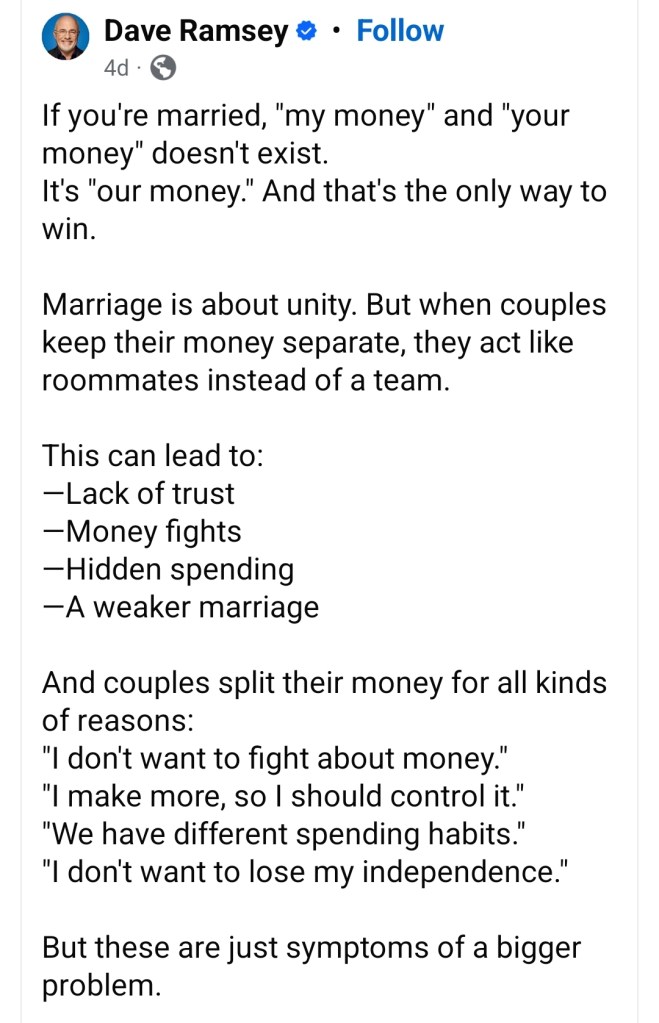
I recently came across the following Facebook post by Dave Ramsey:
Dave proceeds to suggest that spouses should address whatever underlying issue that’s preventing them from sharing finances. While true in theory, this view is incredibly simplistic and naïve.
I agree that in a perfect world, all married couples would be on the same page financially, and would have no reason to keep their money separate. However, this doesn’t always work this way.
I can think of many situations in which sharing finances could, in fact, cause a lot of trouble. Here are just a few:
One spouse’s destructive financial habits, like compulsive shopping and inability to budget
Gambling and other addictions
A spouse carrying debt from before the marriage
People in blended family situations, i.e., each spouse brings kids from a prior marriage and is responsible for covering their own kids’ expenses
And that’s even without getting into the issue of financial abuse, like one spouse (often a stay-at-home parent or the one who earns less) being blocked from freely using joint accounts and instead getting “spending money” from the main breadwinner.
Reddit is full of stories like this one, with the self-explanatory title of “Recently discovered extent of my wife’s shopping addiction.“ The poster proceeds to tell that his wife blew “$6200 on high end cloths this last month with $5200 the month before that.”
So, according to Dave Ramsey, this couple should work on budgeting and aligning their financial goals. Which is a great suggestion, actually! But what if this doesn’t work out?
Suppose the overspending wife doesn’t acknowledge the extent of her problem. Or, suppose she does and makes an effort to fix it, but relapses. Should the financially responsible husband shoot himself in the foot by sharing funds with his wife at all costs, because “marriage is about unity”?
He could divorce her, of course. Many marriages fall apart because of disagreements over money. But is breaking up the only option if spouses can’t agree on money matters?
Let’s say this Redditor wants to stay together with his wife. Maybe they have a good relationship otherwise, and money is their only major disagreement. Maybe his wife actually wants to improve her spending habits, and maybe she even will at some future point, but in the meantime, what can he do to keep up with mortgage payments and put food on the table?
Separate their finances, obviously. It’s better than drowning together with your spouse because “there’s no such thing as your money/my money anymore.” Overall, I believe everyone should do what works for them, whether it’s shared or separate accounts.
I’m writing this long overdue update at a time that is both the busiest in the year (just a little over a week until Passover) and fraught with uncertainty as we expect an attack from Iran any moment.
We’ve been doing our best to prepare for a SHTF scenario: stocking on drinking water, canned foods, hygienic products, candles, medicines, and other supplies.
I’ve been cleaning the house with all I have to make sure I complete as much as possible as early as possible, in case we spend most of next week at the bombshelter.
I’m (mostly) caught up on laundry, I have cash on hand, money in the bank, and the bills paid. We also have plenty of non-digital entertainment (books, board games, craft supplies) to relieve stress if the internet connection goes down.
We aren’t panicking, but things aren’t looking too promising right now. If you’re in Israel and reading this, stay safe and on high alert. Have your self defense weapons ready if you have them.
If I can, I’ll keep preparing for the holiday in the next few days. There’s still quite a bit of cleaning to do, switching to the Pesach dishes, bedding to change, and other odds and ends.
I’ll try to update when I can. Please keep Israel in your thoughts and prayers. 🙏🏾
A statement I encountered on social media got me so full of things to say I pulled out of my unplanned blogging hiatus. Here it goes (simplified for clarity):
“Stay-at-home moms who are looking to reenter the workforce are extremely attractive to employers because they offer so many useful and versatile skills. Therefore, if you’re a SAHM, it will be easy to find a job at any future point.”
What can I say? I do wish the job market worked this way… but it doesn’t.
As one of the more realistic people on that thread said, “Employers aren’t looking at what you COULD do… only at what you have already DONE.”
After I finished my degree, I spent a decade having babies, mucking out chickens, and handling mountains of laundry. Any credentials I had became obsolete, and I had nothing to put on my resume when I eventually started applying for jobs. I was lost, because when I opted out, I never thought there might come a day when I’d be desperately looking for work.
Trust me, employers weren’t lining up saying, “Wow! This woman can change a diaper on a toddler who’s standing on his head, and she’s a real pro at matching socks. That’s a hire!”
Eventually I managed to land my first long-term editing gig, which paid like a Scrooge but allowed me to gain experience I used as a springboard into better things. It was hard; I recall the days of balancing my laptop on the corner of the nursing pillow as my baby snoozed. It got easier at some point, but I’m still a freelancer. I don’t enjoy the security or pay that my peers managed to gain by staying in the workforce.
Do I regret this? No. I made choices; being with my children was and is priceless; I love the flexibility of working remotely. But what I wish I had done, and what I hope everyone does, is walk into this situation with eyes open.
Everything is a tradeoff. If you take a decade off to focus on parenting, reentering the job market may be a grueling uphill struggle. If you choose to work part-time and/or from home, you might miss out on opportunities. You may need to settle for lower pay and no security. You may lie awake at night panicking about what’s going to happen.
I don’t want to discourage anyone, but let’s just stay real. Yes, you can find paid work after many years of full time parenting. Just don’t expect this to be easy, fast, or instantly super lucrative.
Some time ago, I wrote about the potential pitfalls of investing a lot of time and resources into unpaid, unacknowledged work, even and especially if you’re working in a family business and/or for your spouse.
Honestly, I didn’t expect the post to get any traction. I mostly treated it as a mini-rant on my private web corner. But surprisingly (or perhaps not), I keep getting feedback on what I wrote back then.
Here are a couple of the public comments:
“My husband left me for a younger girl and abandoned me. For 25 years, I worked with him in his company and never had a role, never been put on the books at all. I have no social security at all. What do I do?”
“We bought a business 7 years into a common law marriage. It was in my wife’s name only. I have worked there for free for 19 years. Never thought much about it until now. We have been together 25 years now and she just left me and moved out for a guy she just met. I’m left running her business that was ours by myself now. I’m 66, disabled because of the hard work at the business. I can’t get medicare or SS because she never paid for me… now I’m told that it’s her business and I benefited from it by having a place to live and food for 19 years! I’m tired, disabled and left without anything.”
You guys, these people did what appears the most natural thing in the world. They trusted their partners and put in the work for a family business without keeping score. Because that’s what you do when you’re married, right? But it can lead to some absolutely heartbreaking, glaringly unfair situations. I believe the commenters may have some legal recourse, but it would probably take a skilled lawyer who’d agree to work on a contingency basis.
When I was younger, I didn’t believe in planning for financial crises. I saw it as pessimism, or lack of faith, or whatever. I was all about looking at the future with a bright and trusting outlook, and I got my comeuppance. You guys know the story: I moved into the middle of nowhere, cut myself from all transportation and resources, and was left with no means to provide for myself and the kids when we hit a long stretch of unemployment, underemployment, and disastrous financial decisions. I remember there was one job opportunity that was SUCH a great fit for me and so close to home… only 10 minutes’ ride – but as I had no car, it might as well have been on the moon! I remember thinking, “I did this to myself. My own lack of forethought put me in this position.”
I’m in a different and better place now. And I know I talk a lot about finances and financial security. I do this because I feel a duty to warn people: don’t entrust your whole future (and your children’s future) to one person, even if this person is the love of your life. People can fail you. I bet the people who commented on my original post never thought their partners would abandon them. But even if everyone is 100% faithful and well-intentioned, people still fall sick, lose jobs, and run into unexpected financial pitfalls.
Protect yourselves, folks. If you stay home with your kids, have something to fall back on. If you pour your soul into working in a family business, make sure you get official recognition for your role, if not a salary. If you’re married to someone who isn’t very good with money, consider setting up a separate bank account for your own and your children’s sake.
That’s all for now. Here’s to a joyous month of Nissan and a happy, non-stressful Passover.







 Domestic Felicity