Of kitchen sinks and gratitude

Image result for kitchen mess comic

Illustration photo: Huffington Post

Last Friday I awoke to the sounds of gushing water from the kitchen. It actually sounded like a small, gurgling stream. Bleary-eyed, I rolled off the bed and went to see what’s the deal; I discovered a small lake spreading out from under the kitchen sink.

Of course, I did what any rational woman would do in such a situation – I ran to shake my husband awake, panting, “Quick! Quick! There’s an emergency! We’re all drowning!”. My husband opened one eye, stepped into the kitchen, took a look at the whole thing and closed off the pipeline leading to the sink. While I was mopping up this miniature Lake Windermere, he remarked, “Well, at least the kitchen floor will be clean.”

He explained to me that there’s something wrong with the kitchen pipeline (you don’t say?!). Did it rust through? Got nibbled on by mice? Punctured by evil aliens? I didn’t care; I just wanted the use of my kitchen sink back. It didn’t help that Friday is the busiest day in Orthodox Jewish households, growing progressively crazier as the clock ticks toward afternoon and the lighting of Shabbat candles.

In case you are wondering, washing dishes in the bathroom sink is not very convenient.

I’m sure my husband, who is a real handyman, will put this right eventually, but this kitchen sink incident got me thinking of all the other things we normally take for granted – our comforts and conveniences, the abundance of food and clothes, our spacious, well-heated homes, our civil rights and freedoms, our families, health, and very life. So let us stop for a moment to appreciate it all. Celebrate the kitchen sink!

This week we marked our son Israel’s second birthday. I am so happy and grateful to be the mother of this little boy. With my older girls, I was very young and newly married and it was Mommy Boot Camp all the way for the most part. But once Tehilla, our second daughter, was out of her toddler years and I realized I might never have another baby again, I shed many tears. When Israel was born all felt like a gift; it still does. For the past two years, I am grateful to say I have been able to appreciate so many things about his infancy and toddlerhood – just relax, enjoy and let go. We all sit on the floor a lot, playing with Lego, blocks or toy trains, and I no longer have that itch telling me I have to get going and move on to do something more important.

I guess this post is just a record of thanksgiving. For children, families, life, and comfortable homes with modern conveniences. I thank God for what I have, really I do.

Just please, fix that kitchen sink.
Hold On to Your Kids: book review


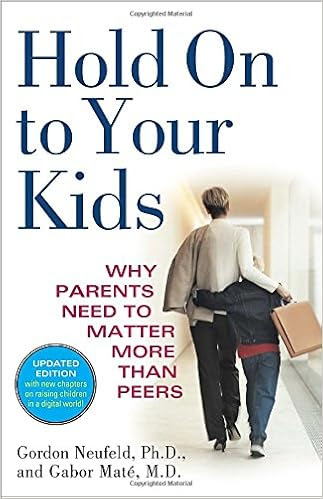
Hold On To Your Kids: Why Parents Need To Matter More Than Peers is a book with an important message (the headline itself, I think, speaks volumes!).

By Briana LeClaire:

“The overarching theme of the book is ATTACHMENT. To whom are your children more attached? Are they attached to you, their parents, and other adults? Or are they attached to their peers? To whom do they look for guidance? Whose star have they hitched their little wagons to?”

“My son is so independent,” a neighbor proudly told me once, “he has so many friends! As soon as he gets back home, after lunch, his friends come to visit him or he visits them, and he plays together with them until it’s time for supper. He hardly needs me at all!” Want to guess how old the boy was? Only 4. And the situation described above was seen by his mother as something most natural and desirable.

There is a perspective of my own I would like to add: while the authors of the book admit that attachment between parents and children, especially young children, is vitally important, and that early enrollment in daycare and preschool is more likely to make children peer-oriented (that is, dependent upon their friends in the development of social connections, goals, values, morals, language and habits), they also say that the most obvious (and, they confess, most desirable) solution – that of young children staying at home, usually with their mothers, is in most cases an impractical, outdated measure.

Their suggested solution is creating an attachment between the child and the “parent substitute” – babysitter, daycare worker, teacher, etc. While, of course, an invested and caring daycare worker is better than a detached, unaware one, I do not think a parent-child-like connection between the child and the care provider is possible or even healthy. There are too many children per caretaker and, above all, nobody can love your child like you do. Also, there is absolutely no guarantee the caretaker/teacher passes on values and messages you approve.

I vividly remember a 3-year-old niece who kept talking to us about her preschool teacher, whose name was Ruthie. That child was evidently engrossed by Ruthie and talked about her a lot more often than she mentioned her parents. Perhaps it is better that the child was so connected to her teacher, rather than her peers, but the fact remains that Ruthie (however capable of creating the attachment) did not care about the child in the same way. It was not her child, after all. At the end of the year, the child and her teacher would part, never to meet again. Is it really good for a child to give her heart to a teacher in such a way, when we know it is to be only a temporary relationship?

Even grandparents, aunts and uncles (the relationship with whom is permanent) are not supposed to be more than auxiliary figures in child-rearing. They can provide help, plenty of help, but the biggest chunk of the job of child-rearing (in time as well as authority) should belong to the parents.

Rather than say it’s impractical for young children to remain under the care of their mothers, it is better to stress the importance of such a measure, and to encourage families to stick to it as much as possible. You know how it works: when you are convinced something is truly important, and that there is really no equally good substitute, you will move mountains to make it happen. Of course, for some parents it will not be possible to keep their child at home, and then damage-minimizing tactics, as described in this book, are in order.

While I do not think mothers at home should be directly funded by the government, I do believe that  significant tax reduction for fathers in single-income families would be a fair measure. Let people keep a larger share of their own fairly earned money and provide for their family. It would ultimately save the government a lot of money on all sorts of programs that fight violence, bullying in schools, teen pregnancy and drug abuse, and other ailments of our society.

Terrific Twos: why I love toddlers

israelpuppies2

Israel’s second birthday is now drawing near – it has been almost two years since this wonderful little boy has joined our family, and we feel so happy and blessed to have him. Raising him is a privilege and a joy I feel keenly every day, and it just gets better and better.

Not that I can’t relate to the “Terrible Twos” discussions – after all, toddlers are indeed a handful. It’s easy to feel wiped out at the end of a long day with a little person who suddenly decides hot water and soap are his worst enemies. But I do love two-year-olds – they are full of energy, fun, enthusiasm and initiative, curious about anything and everything, always ready to explore and discover, and easy to amuse. And two is an age of amazing physical, verbal and cognitive development which is a marvel to just stand back and watch.

Furthermore, though they can definitely throw tantrums and sometimes make you want to hide yourself in a very small hole somewhere, at least toddlers won’t try to sass and outsmart you the way older children can. A six-year-old can make you feel really stupid on occasion. With a two-year-old, you can still be pretty sure of your superior intelligence.

Some of the challenges of having a toddler in the house come from clashes with older children who like to have their own space for quiet creativity and don’t like their projects to be stepped on, torn, chewed or drooled over. Some maneuvering might be necessary there, for example scheduling art projects for a toddler’s naptime or providing a place for the older child where a toddler cannot reach. My eldest (aged almost 8) likes to take her reading, drawing and cross-stitching to the top of the bunk bed she shares with her sister.

Around here, every day is an adventure and there is never a dull moment. And I wouldn’t want it any other way.

When everyone is sick

About a week and a half ago, I woke in the middle of the night because Israel vomited all over me (what a way to wake up, huh?). At first I thought (hoped) it was only a fluke, but when he continued being sick in the morning, and my two other children picked up after him, I realized we’re in trouble. Then, as my husband and I I began feeling sick ourselves, I had this sinking uh-oh feeling, because few things are more exhausting than caring for a bunch of sick children when you are not on your best form yourself. I vividly remember the night when I had to get up every hour to take care of another vomiting kid, and then found it difficult to fall asleep again because I felt so queasy. On the up side, it was an opportunity to finish reading a book I’ve been hacking at for ages.

Luckily, it didn’t last long – a couple of days at most – but these were a very intense couple of days which left us totally drained and with a mountain-high pile of stinky clothes and bedding to wash. Oh, and should I mention that exactly at that time, the water pump leading to our area broke down? The stinky pile had to wait, while it got stinkier and stinkier and, eventually, some sheets developed horrible mold and had to be thrown out.

What a time. I also wrote a post about this on Mother Earth News:

“If you also have to deal with a houseful of sick little ones, this can be particularly challenging, especially if your kids, like ours, are used to running in and out of doors at all times and find it frustrating to sit or lie down still and quiet. It helps to provide some quiet amusement in the form of books, coloring books, sketching pads, and other quiet, non-messy crafts. Let your children curl up with you in bed for some reading together, or allow them to spread a board game or puzzle on the floor while you are relaxing on the couch. Movies can have their place, too, of course, but in general I find that prolonged staring into a screen contributes to fatigue and doesn’t promote the overall sense of well-being.”

The Diaper Debate

stardiapers_secondarypackshot_355x215

A long time ago, when I was pregnant for the first time and we had many lofty ideas about our own capabilities, my husband and I talked about cloth diapers. We pretty much decided we are going to use them, for the sake of frugality, sustainability and baby’s skin health. It just seemed the right choice all around, until one day, when I was getting pretty big, we had the following conversation.

DH: “But where would we wash the diapers?”

Me: “What do you mean, where? We put them in the washing machine.”

DH: (wrinkling his nose): “What, you’ll put poopy diapers in the same machine that we use to wash our clothes?”

Me: “Not in the same cycle. We’ll wash them separately, you know.” 

DH: “I still think that’s gross. Think of all the bacteria that will be left over.”

Me: “Well, what do you suggest?”

DH: “My Mom always washed our diapers by hand.”

Do I have to tell you? We’ve been using disposables ever since. And at times I’ve been feeling guilty about it, too, especially when I haul out a big garbage bag full of almost nothing but diapers and think about it adding to some tremendous landfill.

It wasn’t just the gross factor that put us off; we’ve had plenty of poop in our washing machine anyway over the years, what with newborn blow-outs and all. There were periods when changing a poopy diaper equaled changing a whole baby outfit, every time. We’re still all alive and well.

It was also that conveniently made cloth diapers are a pretty hefty initial investment, one we hesitated to make, and I’m not up to sewing my own. And, of course, there’s the convenience; at times, I’ve been so overwhelmed by laundry (especially not having a drier, on long rainy weeks in winter) that voluntarily adding more seemed an effort of will beyond my capability.

As a compromise, I have tried doing early potty-training, with babies running around bare-bottomed around the house on many a summer day. The little tushies got a pleasant breeze, we saved some money on diapers, and I felt better about the ecological aspect of it all.

In the place where we live now, we have frequent electricity and water shortages, up to the point that everybody living in the neighborhood often gets requests to save on electricity and water as much as possible by trying to minimize the usage of air conditioners, ovens and, of course, washing machines. An extra load of diapers every day or two just doesn’t seem feasible in such conditions.  I actually believe that in Israel, where water is a precious commodity, bio-degradable diapers may be more eco-friendly than cloth.

There had to be, however, a compromise: green and convenient; eco-friendly but disposable. So lately I’ve started looking into the option of switching to bio-degradable disposable diapers, such as these. I’d love to hear from any of you who care to share your experience. Cloth? Bio-degradable? Plain ol’ Pampers?

Jewish homesteading: an interview

A while ago I was contacted by Tachlis magazine, who were looking for information on the Jewish homesteading movement. My email interview with them is below:

Where do you live exactly?

I’m sorry, but as our privacy is important to us, I cannot state our exact location. I can only say we live somewhere in the Shomron.

What is your homestead like?

I wouldn’t call what we currently have a homestead, precisely; I look at it, figuratively, as the seed of what I would like to have. Right now we have a small flock of chickens, a small garden and a few young fruit trees. I would like to have a large, productive garden and orchard, more chickens, and ideally some sort of a dairy animal. This way, we would provide a significant part of our own food.

In the meantime, we are doing what we can with what we have, and learning relevant useful skills in gardening, improving soil and raising animals. We used to keep dairy goats so I know how to hand-milk and make cheese, and can easily go back to it again.

Is there a community where you live? Is there a minyan?

Yes and yes. We have some wonderful neighbors around here.

How did you decide to homestead?

I don’t think it was a one-time conscious decision. We did know, even when we first married, that we wanted to live on a piece of land, not in an apartment building. We are just taking baby steps in a certain direction, and anything we have accomplished so far has been largely thanks to my husband: sometimes you just need to jump in with both feet, and he can do it much better than I. He was the one who brought home a box with our first chicks, and he was the one who decided on buying goats. He has also accomplished various complicated projects around the household I couldn’t have done myself.

What do you feel your family is gaining from homesteading?

Even though I wouldn’t refer to us a homesteaders just yet, we are learning a whole lot from growing plants, raising animals and working on a plot of land. Our children know the thrill of a newly hatched chick and a newly sprouted seedling. They know how an incubator works and where is the best spot to plant tomatoes. They know all sorts of things I wish I had learned as a child.

Israel+chickens3

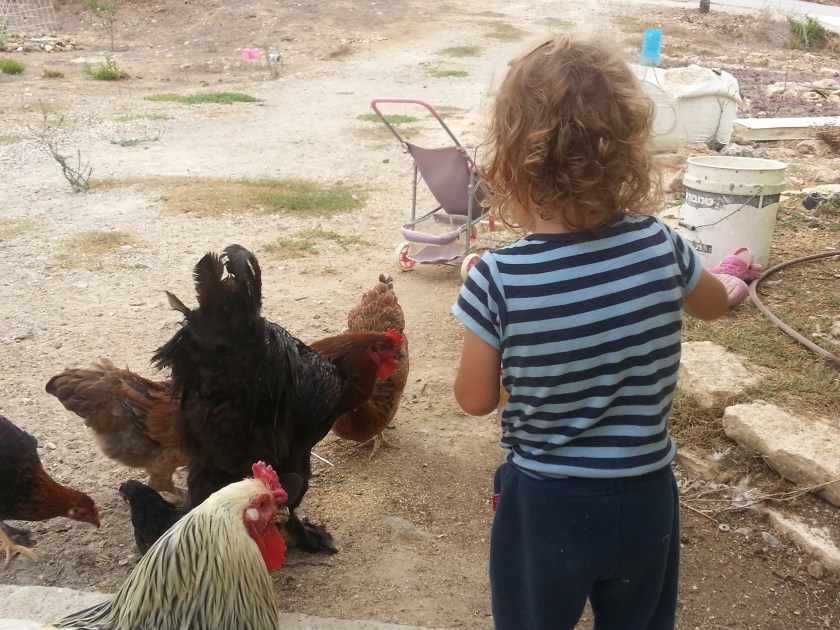
Above: Israel, 19 months old, loves to feed the chickens.

I think one of the best things in growing your own food is that the experience does something to every member of the family, regardless of age. You can all share the excitement of newborn baby goats – nobody is too young or too old for that. And when you go foraging for wild-growing goods, you are all equally satisfied when you come home with full containers.

Our lifestyle has brought us together with many wonderful like-minded people, which has been a terrific experience and an education in itself.

And, of course, those who “graduate” to growing and raising a significant part of their own food will reap the benefits of a healthier diet and reduced expenses.

Does homesteading help you connect to the Torah in a deeper or more personal way?

Yes, certainly. Jewish life and working on the land are closely intertwined. Many of the mitzvot specifically refer to agriculture: ma’asrot (tithes), Shmita (the Sabbatical year) and the holy status of the firstborn male, to name a few, and of course anything that has to do with humane treatment of animals. When you grow plants and raise animals, even on a small scale, you get to experience this first-hand, not just learn it in theory. Then there’s everything Shabbat-related, such as the restrictions of tending to the garden (you must do everything before Shabbat) and milking (you can milk so the animals don’t suffer, but not collect the milk). Also, as we’re into poultry especially, we have learned there’s some doubt about the kosher status of certain heirloom chicken breeds (in particular ones with an extra toe). We have found out so many things we would otherwise have had no clue about!

You can read more about homesteading and small-scale farming in Israel in this post.

When Children Fight: book review

When Children Fight, by Miriam Levi, was a very timely read for me this week. Sibling fights have been the perennial challenge in our house for a couple of years now; we have two girls, currently 7.5 and soon to be 6 who, as a friend of mine very aptly puts it, “will fight over dead air space”.

children-fight

“Do you imagine that nobody else’s kids fight the way yours do? “Hearing shrieks and screams, I stormed into the playroom ready to screech, ‘What’s going on here?!’ But stopped myself, remembering the lessons from Miriam’s workshop. Lo and behold – the next thing I heard was – silence!”

Don’t get me wrong, most days I really appreciate having two girls close together in age. It really simplifies things when doing school, crafts, or any special activities – most of the time they can do anything together (of course with expected age-appropriate differences). They also always have a playmate, which is especially important because in the area we currently live, there really aren’t very many girls close to their age, and as you know, not all children of the same age hit it off together.

The problem is, sometimes my two daughters don’t hit it off together either. There are few things more frustrating than a sudden episode of loud whining, screeching, name-calling, hitting, taunting, etc, especially when a baby or toddler is having a nap, or you are trying to get dinner done – and especially when, after digging in, you realize this fight is about some scrap of a chewed-on pencil, or because someone looked at someone not quite the right way.

First I’m ashamed of my children acting this way. Then I’m ashamed of myself for yelling.

Since we homeschool, sibling antagonism is exacerbated. Yes, pretty much all families with more than one child deal with sibling rivalry, not just the homeschooling ones, but because we are together so much more, problems can’t be brushed aside or misted over by lengthy breaks from each other. They must be dealt with, promptly and effectively.

So yes, you can imagine the title of Miriam’s book spoke right to me when I grabbed it from the library. I whizzed through it in two days – it’s a compact, practical, straightforward, easy-to-read Judaism-based guide to dealing with those draining and exhausting sibling fights. Miriam doesn’t dig deep into complicated psychological theories: she gives slice-of-life examples of unhealthy sibling dynamics and their solutions.

I think the most important thing I gleaned from When Children Fight is that I don’t need to interfere in every single fight, every single time. I can’t prevent all fighting; it will always be there at some level, and not every dispute will be settled in a 100% fair, harmonious way. That’s life. Try to let your children solve the problem themselves, Miriam says. I tried that, drawing a red line at hitting and offensive name-calling. I withdrew from trying to personally solve every dispute of “but I had it first” and “she will never let me use it”, and let me tell you, I was pleasantly surprised by how creative my daughters can be at resolving their conflicts when they know they are on their own.

One thing I do have to say, though, is that this book is like a home first-aid medical kit: it contains some band-aids and iodine, but not things needed to treat more serious injuries. That is to say, it deals with a generally normal, well-functioning Jewish family where sibling dynamics are a little jarring. It doesn’t go into more complicated real-life issues such as severe, persistent disobedience, behavioral problems, ADD, or issues that spring when a family deals with trauma due to divorce, illness, or loss of a loved one.

Nevertheless, I enjoyed When Children Fight and no doubt will return to it for reference in the future.

* Illustration image: oliviamainville.com