Just taking a few minutes in the midst of this delightfully busy time of the year to wish all my friends a happy Hanukkah, a joyful holiday season, and a terrific 2023.
My goals for 2023:
Spend more fun and memorable times with my kids
Keep up my productive routine of an early workday that ends by noon
Get more creative writing done
Carve out more opportunities to get out into nature
Finally do that big closet sort-out
Catch up with housework
Whatever your 2023 ambitions are, I hope you have a happy, healthy, safe, and productive new year, surrounded by family and friends and enjoying all this messy crazy world has to offer.
I love a bit of shopping as much as the next person – especially if it’s thrif shopping. In fact, it’s thrilling to know you’ve scored and got a quality item for a fraction of the price. I have a pair of knee-high genuine leather boots, which I got for about $20 in a second-hand store and wear almost every day, every winter.
But here’s the problem with shopping, even and especially when you get a great deal: we all have limited space on our shelves and in our closets, and no one wants their house to look like something that belongs in an episode of Hoarders.
Cue a simple but effective rule I’ve been implementing lately for purchases that aren’t absolutely necessary: one goes in, one comes out.
Here’s how I do this: if I consider buying a pair of shoes for myself or my kids, I challenge myself to go over all our shoes and part with at least one pair. It can be something that doesn’t fit anymore or just something that hasn’t been worn in a while.
This actually works great, because:
a) I put stuff in order as I go through it
b) I keep the house from being overrun by surplus items (does stuff breed when I’m not looking, or what?)
c) As I go over our things, I usually find more than one item we can do without, so it usually ends up being “one goes in, two or more go out”
These days, I apply this rule to pretty much anything: clothing, toys, books. With items that get used up, like art supplies and yarn, I adjust the rule to “finish one, then buy another”.
So that’s my current strategy. Rather than do one big seasonal declutter, just keep clutter from accumulating as much as you can.
I thought this hat would take me a few days at most to put together. Worsted weight yarn with a super simple pattern – what could possibly take too long? But, given my recent disproportionate workload and a couple of kids with temporary health issues, I spent a couple of weeks working on this little piece. I pulled it out to crochet a couple of rows on any errand that stalled and on any occasional bus ride.
Here’s a view of the hat before I attached the pom my daughter selected.
Crochet hook: 3.5 mm for the brim, 4 mm for the body.
Pattern: None to speak of. Done from the bottom up, like my other hats, starting with a stretchy ribbing brim (single crochet in back loop only). Body: three front post double crochets and one back post double crochet all the way. Freehand decrease.
I used exactly one hank of Malabrigo Worsted, another dreamlike yarn by Malabrigo, for this project. Let me just say a few words about this amazing yarn.
First, working with Worsted is probably the closest you can get to crocheting off a real live sheep. This yarn is 100% lush merino, not superwash (if you want a superwash variety, try Malabrigo Washted or another type of superwash merino), from sustainably and humanely raised, pastured Uruguayan sheep. It delights the crafter with a beautiful halo and delicious softness. It has a gorgeous stitch definition and is perfect for showing off stitchwork, cables, and textures.
Now for the downside. With all my weakness for super soft single-ply yarns, I’ll be the first to admit Worsted probably won’t stand up to hard wear, which is why I’d use it for something that may expect gentle use, like a hat or cowl, but definitely not a sweater.
Second, the uniformity of thickness was really off. Sometimes it would come closer to super bulky, while at others it resembled more of a sport weight yarn.
Malabrigo Worsted comes in a range of stunning colors. I used Damask Rose, a would-be solid muted pink that offers delightful, subtle variation.
Do I plan to buy more of this yarn? Yes, definitely yes!
I’ve always considered myself a fairly eco-conscious person. I line dried, hand washed, repurposed, and tried to minimize the use of disposables. With one exception: plastic tablecloths for the Shabbat table.
I sort of felt I gamed the system when I spread out that transparent rustling sheet of plastic over my table. I didn’t need to worry about spills. Cleanup was a breeze. And I could still see my pretty cloth tablecloth through the plastic.
No, I didn’t feel too good about myself when it was time to shove that giant wad of plastic into the trash can. But I told myself, “You do enough laundry. You have tiny kids. You’re just surviving.” It was that word, “surviving”, which I used to justify a lot of lack of effort in many areas.
I could, of course, put on reusable waxed tablecloths, but there are limitations to cleaning on the Shabbat. For example, you can’t clean with a cloth and then wring it.
Then, one day, we switched to buying a long plastic roll rather than individual pre-cut pieces to save money. The problem is, you need to cut your plastic cover before the Shabbat, and if you forget to do that, too bad.
One such time, I nearly threw a fit when I realized that I’ll need to use cloth tablecloths and wash them. We lived in an area where we’d regularly get stuck without electricity or running water for days. But I still couldn’t help noticing how much nicer it was to eat without touching plastic with our hands and elbows.
I still wasn’t ready to give up on plastic table covers because of the aforementioned patchy utilities. There were many times when I delayed washing the dishes and was stuck with a full sink for three days. But when we moved, I no longer had to obsess about getting every load of laundry or stack of dishes done as soon as possible.
Then I started ghostwriting for one eco blog, which really got me more aware of how harmful plastic actually is and how important it is to minimize its use. I decided to lay my Shabbat cloth with no cover.
All in all, I needed three cloths for the three Shabbat meals. They took about half a load in the washer. And there was not a single stain, despite multiple spills of oil, wine, and tomato sauce.
For over a year now, I haven’t looked back. I just took my three favorite tablecloths off the line. They are perfectly clean and smell delicious – and they are ready to go on the table tomorrow night.
In the past few weeks, I’ve been so busy I was practically brain dead at the end of the day. I hope everyone is doing well and keeping sane.
These days, walking into a supermarket or receiving a utility bill is somewhat of a shock for me. I just find it hard to adjust to how steeply the prices are climbing.
Forbes advises us to combat inflation by increasing our income. For many people, that’s not an option. They’re locked into minimum wage, dead end jobs with not many prospects. They can’t negotiate a raise because they’ll get the boot before they get one extra dollar from their employer.
As a freelancer, I have slightly more flexibility. I negotiated a little rate uptick. I took on a little more work. I made a full time wage working part time for several months now (except for the holidays), which was absolutely thrilling. But financial insecurity is real, and there’s only so much you can hustle.
For most people, living through this inflation involves spending less. Yeah, not a major catalyst for economic growth; our leaders want us to spend to keep the wheels moving. But what we need to do is keep out of debt.
I know how to scrimp. I know all about mending clothes, stretching leftovers, repurposing school supplies, and accepting hand-me-downs. I know that it won’t kill you to occasionally go without a shower in winter if the day was cloudy and the solar water heater didn’t provide enough hot water for the whole family.
But I also know you can’t line dry and coupon-clip your way out of a full blown financial crisis. It sometimes takes more than that. For some people, it will be moving in with family, giving up their car, or telling their children they’ll need to fund their own higher education.
And, again, I remind myself it’s not just about cash. Surviving hard times is easier with chickens in the backyard, vegetables in the garden, wild growing trees full of bounty, a supportive community, and barterable skills.
As usual, I don’t have answers. But I know this: we’re some tough nuts. This inflation isn’t going to crack us. We will keep getting more educated, more resourceful, more resilient, and more generous towards those in need. And I believe we’re going to win.
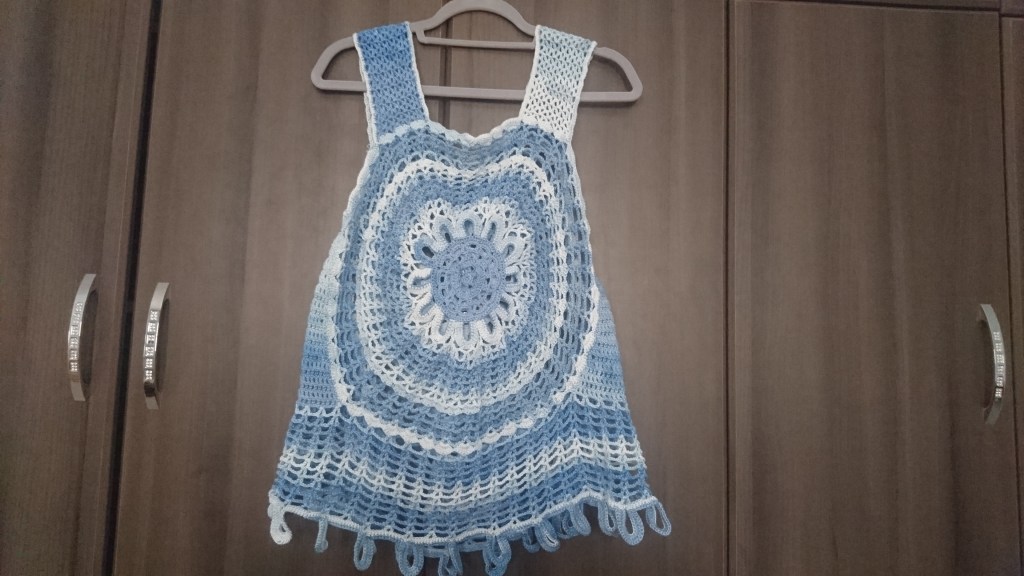
If you are an improvising crocheter like me, you may easily figure out how to construct this simple crochet top, based on two circles in the front and back and attached with triangular panels on the sides. I had something a little different in mind when I started making it, but overall I’m pleased with the result – perfect to wear over a tight-fitting black or white tee.
This is the second top I’ve made with Camilla Cotton Magic by Ice Yarns, and it won’t be the last. I just love this yarn – 100% mercerized cotton with the tiniest bit of shine. It doesn’t tend to split, glides so nicely on the hook but still gives a good grip, and comes in a range of gorgeous variegated colorways. I used the colorway Blue Shades.
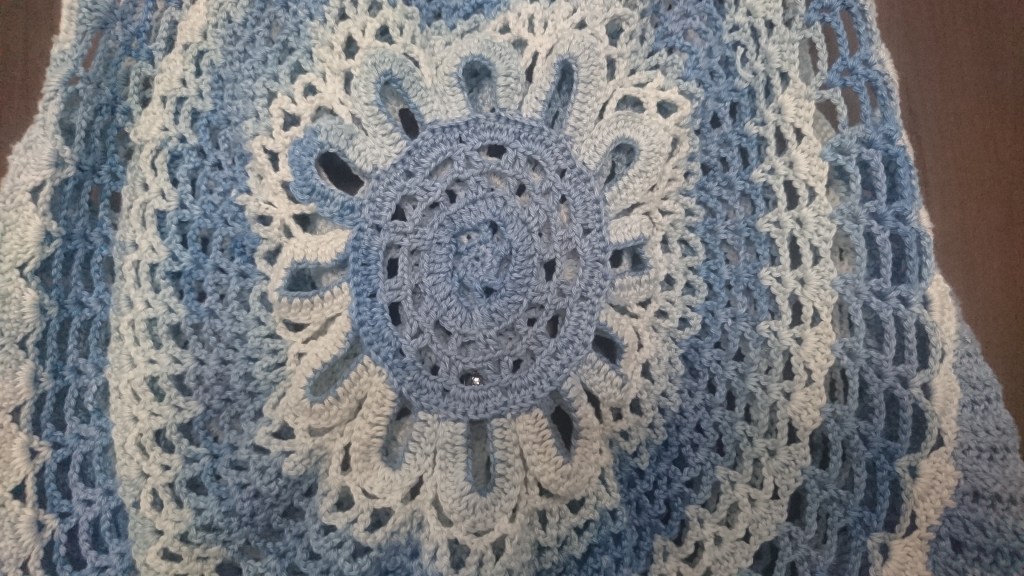
A close-up of the central motif
This is fingering weight yarn, my favorite – delicate enough for a lacy top but not too thin to work with comfortably.
At the end of the Sabbatical year, my plants are looking rather sad and forlorn. During the Sabbatical, a Biblical concept unique to Israel, Orthodox Jews must observe a range of rules, but in a nutshell it comes to this: not planting and doing just the bare minimum to keep existing plants alive.
It’s a bummer for hobbyists gardeners and backyard homesteaders, but much beyond that for people who rely on growing crops to make a living. Some resort to ritual “selling” of the field to a non-Jewish person; others abandon their crops altogether and spend a year doing something different from agriculture, or go into hydroponics.
Similarly, when buying vegetables, one has to check that they come either from a “sold” area or from regions that don’t count as part of Biblical Israel – which includes some regions of the modern State of Israel, like Eilat and parts of the Arava.
I wish I could say I can’t wait to get to planting again after Rosh HaShana, but the truth is, I’ve gotten a bit of used to neglecting my plants. There’s just too much to do – and sometimes I wish I could enjoy lush greenery and succulent tomatoes without doing any of the work 😉 I guess I’ll get back into the swing eventually.
Either way, I’m wishing everyone a most happy Jewish new year and look forward to seeing what it brings.





 Domestic Felicity