Should stay-at-home moms get paid?

Photo by cottonbro studio on Pexels.com

Recently, I’ve been browsing quite a lot of the AITA subreddit. You come across some interesting stories, like this take from a stay-at-home mom:

“It’s the hardest, yet most rewarding job in the world. It is work though and I feel like I should get at least some compensation for all that I sacrifice. My husband doesn’t feel that way at all, though.

I decided to draft up a list of the stuff that I do around the house. Daycare, cleaning, cooking, etc., and after the tykes were put down I presented it to him and explained that I would like to be have a separate bank account and be paid (min wage). I figured that was completely reasonable, but apparently not.”

So… should stay-at-home moms be paid? I don’t think so.

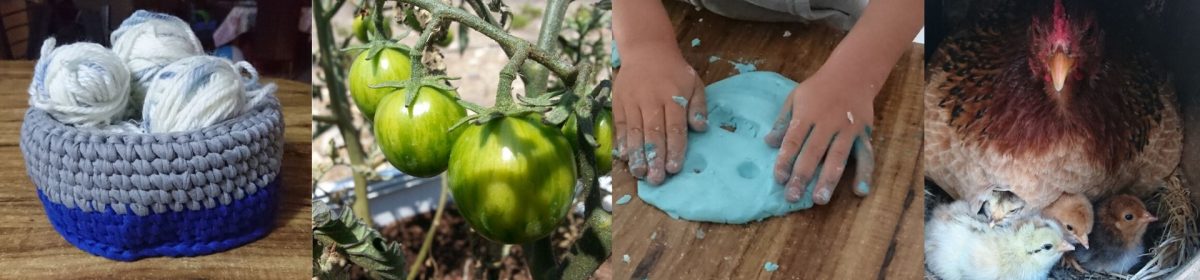
Now, I’ll be the first to admit that SAHMs are often taken for granted and not appreciated enough, even by themselves. I remember myself as a young mom with two toddlers, milk goats, a bunch of chickens, and a dog to take care of, constantly questioning whether I’m doing enough. Which, now I think about it, was crazy and kind of sad.

I also know from experience that stay-at-home parents are vulnerable and disadvantaged financially. It’s not just about the money you don’t make while you dedicate yourself to raising your children. It’s about employability. While you’re busy changing diapers and picking up toys, your professional qualifications are slipping away. Any degree you have might become less relevant with a ten-year gap on your resume. If you ever seek paid work again, you can’t pick up from the point where you left off as a college graduate or young professional. You have to start from scratch, and no one will be lining up to hire you.

Still, I don’t believe a stay-at-home mom should get money from her husband. I find this degrading. It reduces their relationship from life partners to boss-employee.

A husband and wife are one unit. Any money that one of the spouses makes belongs to both, and both should have equal access to the bank account unless there’s a good reason to do otherwise. The law agrees: in divorces, money earned by either spouse during the marriage is typically considered community property.

The stay-at-home mom from the Reddit thread above has access to the family’s money, but said she feels guilty using it for “stuff that’s just for me, like manicures or going out with my friends.”

This, I think, is the core issue here. Provided manicures and occasional outings are within this family’s budget, the mom should feel zero guilt giving herself these little pick-me-ups. She is an equal partner in the household, and shouldn’t need pin-money from her husband to validate that.

Of course, this raises questions. Has the husband ever made her feel bad about spending money on herself (as long as she doesn’t overspend)? Is he a financial control freak? Or does she simply feel uncomfortable using the money she didn’t put into the account? That’s the matter they should discuss and resolve.

AITA take: Husband divorces wife who decided to become a SAHM

Photo by MYKOLA OSMACHKO on Pexels.com

I bumped into a Reddit thread making rounds on social media: husband asks “AITA?” after divorcing his wife following her decision to become a SAHM.

The wife bailed out on their earlier agreement to put the baby in daycare when she refused to return to work once their baby was 6 months old. She realized she needed to be with her child.

So far, that’s perfectly natural. Many couples who planned their careers pre-kids underestimate the powerful way a tiny baby tugs at a mom’s heartstrings. At 6 months old, mom and baby are still practically one unit. The baby may still be exclusively breastfeeding. It’s VERY common to look at your tiny tot and realize that your priorities have changed.

The issue is with how the mom handled this situation. As the marriage partner who wanted this lifestyle change, she should have been ready for every effort to make it work. This doesn’t seem to have been the case at all:

She quit her job. She took care of baby during my work hours and wanted me to take care of cooking dinner on weekdays and cooking, cleaning and baby care on weekends because “stay at home mom deserves breaks too.”

The original poster states he had been working 80 hours a week. That’s like two full-time jobs! It’s insane and unsustainable for any length of time. I’m not sure what his field of work is, but assuming he makes more than minimum wage, the family could have probably gotten by with him working fewer hours.

This is the point where the wife should have said, “Honey, being home with Little One is the most important thing in the world to me right now. I’m ready to compromise on material things to make it happen. I’ll give up my car/ make a more frugal meal plan/ cut down on unnecessary purchases/ get baby’s things second-hand/ happily accept a staycation or camping instead of an expensive holiday.”

Or, “Let’s consider moving to a smaller house in a less expensive area.”

Or, “Let me look into flexible work from home options to contribute to our finances.”

Did she say that? If she did, the original post doesn’t mention it.

Next, it seems like the wife expected the husband to devote practically every moment at home to housework and chores “because stay-at-home moms deserve a break too.” I’m very sorry, but that’s not how this works.

Yes, everyone deserves a break, but it’s only fair that the stay-at-home parent takes on the larger share of housework, especially once the kid is past the newborn stage. If she gets a break anytime the husband is around, when does HE get a break? Especially remembering he works 80 hours a week.

Finally, once she knew the marriage is falling apart because of her attitude, she should have backpedaled. She should have realized that, if they divorced, the baby would end up in daycare anyway (as in fact did happen).

I was a SAHM for many years, and today I work from home as a freelancer. My husband never worked 80 hours a week. In fact, for extended periods, he didn’t even work 80 hours a month.

I always realized that I’m making a tradeoff: less money, more time and flexibility. I made some mistakes along the way, but overall, my priorities remain unchanged: I choose a smaller income and fewer material things in exchange for a better work-life balance. I don’t assume that the universe owes me the lifestyle I could have had if we had been a family with two full-time incomes. Fact: Today’s economy is wired for dual-income families. To make it work on one income, you need flexibility, creativity, compromises, and often sacrifices.

In short, this man didn’t divorce his wife because she wanted to be a SAHM. He divorced her because she was exploiting him and running him into the ground. It looks like the wife dismantled her own marriage with her selfishness and entitlement.

How to protect yourself from SHTF financially

Photo by Miguel u00c1. Padriu00f1u00e1n on Pexels.com

When I got married, I was under the illusion that I’d have very little to do with money from then on. I’d just cheer on the sidelines and be frugal, and everything would work out fine… right?

Several unemployment periods, a bunch of financial crises, and one massive fraud (on the victim end, of course) later, I realized that sometimes, things don’t work as you mean them to.

I think my top financial tip for anyone planning to get married would be: Don’t pool everything together. Yes, we always think in terms of joint accounts and finances, but if your spouse owes money or makes a big financial mistake, it can wipe everything out clean. Having my own account has become a source of such major comfort and security I would never give it up today.

If you already have a joint account, I’d set up a separate one, or, ideally, three accounts: one belonging to each spouse and a third for joint expenses. As long as there’s good communication and no childlike offenses (“don’t you trust me?!”) it can work great.

Second, keep stashing something away. Even if it’s very, very little. Just keep adding a tiny bit to that savings pile, and you’ll have yourself a nice little emergency fund for SHTF times.

Third, know the difference between a situation in which you just need to tighten your belt a bit, and a massive wake-up call. I had wrote once about how I found myself scrounging the freezer for a couple last cups of flour. It was an awful feeling. If you’re in a situation when you have no food security, reach out for help.

And one last tip: Never work for free. Your time is precious; yes, unpaid internships are a thing in many industries, but if someone is clearly profiting off your time and not paying you anything, don’t fall for that.

Why you should stay in control of your finances and future

Some time ago, I wrote about the potential pitfalls of investing a lot of time and resources into unpaid, unacknowledged work, even and especially if you’re working in a family business and/or for your spouse.

Honestly, I didn’t expect the post to get any traction. I mostly treated it as a mini-rant on my private web corner. But surprisingly (or perhaps not), I keep getting feedback on what I wrote back then.

Here are a couple of the public comments:

“My husband left me for a younger girl and abandoned me. For 25 years, I worked with him in his company and never had a role, never been put on the books at all. I have no social security at all. What do I do?”

“We bought a business 7 years into a common law marriage. It was in my wife’s name only. I have worked there for free for 19 years. Never thought much about it until now. We have been together 25 years now and she just left me and moved out for a guy she just met. I’m left running her business that was ours by myself now. I’m 66, disabled because of the hard work at the business. I can’t get medicare or SS because she never paid for me… now I’m told that it’s her business and I benefited from it by having a place to live and food for 19 years! I’m tired, disabled and left without anything.”

You guys, these people did what appears the most natural thing in the world. They trusted their partners and put in the work for a family business without keeping score. Because that’s what you do when you’re married, right? But it can lead to some absolutely heartbreaking, glaringly unfair situations. I believe the commenters may have some legal recourse, but it would probably take a skilled lawyer who’d agree to work on a contingency basis.

When I was younger, I didn’t believe in planning for financial crises. I saw it as pessimism, or lack of faith, or whatever. I was all about looking at the future with a bright and trusting outlook, and I got my comeuppance. You guys know the story: I moved into the middle of nowhere, cut myself from all transportation and resources, and was left with no means to provide for myself and the kids when we hit a long stretch of unemployment, underemployment, and disastrous financial decisions. I remember there was one job opportunity that was SUCH a great fit for me and so close to home… only 10 minutes’ ride – but as I had no car, it might as well have been on the moon! I remember thinking, “I did this to myself. My own lack of forethought put me in this position.”

I’m in a different and better place now. And I know I talk a lot about finances and financial security. I do this because I feel a duty to warn people: don’t entrust your whole future (and your children’s future) to one person, even if this person is the love of your life. People can fail you. I bet the people who commented on my original post never thought their partners would abandon them. But even if everyone is 100% faithful and well-intentioned, people still fall sick, lose jobs, and run into unexpected financial pitfalls.

Protect yourselves, folks. If you stay home with your kids, have something to fall back on. If you pour your soul into working in a family business, make sure you get official recognition for your role, if not a salary. If you’re married to someone who isn’t very good with money, consider setting up a separate bank account for your own and your children’s sake.

That’s all for now. Here’s to a joyous month of Nissan and a happy, non-stressful Passover.

One valuable lesson I hope my children learn

Flower growing in a rock crevice: blooming in hard circumstances

I started my married life with a mortgage-free home, a husband who had a nice, stable job, and a great deal of optimism bordering on self-assurance. I mean… things were looking so great, so why would anything ever go wrong, right?

Then, for almost a full decade, I had done my best to ride out one financial crisis until another, facing the loss of the income and the house that had seemed so secure. Having chosen a remote lifestyle, I had very limited employment opportunities, a bunch of kids, no reliable transportation, and no steady internet connection. So my only available strategy was, tighten that belt… and tighten it more… until it nearly suffocated me.

I believe my great epiphany came at the moment when I was scouring the corners of my freezer for the last bit of flour to make one last loaf of bread. I was feeling utterly helpless, vulnerable, and desperate.

And I realized I don’t ever want to feel this way again. Never. Never.

Today, I am lucky enough to live in improved circumstances and enjoy wider opportunities. I’m in a safe, settled place and am successfully employed in writing and editing. But often, it still feels as though I first shot myself in the foot and then spent years trying to repair the damage.

In a few years, my older children will be starting on the road to adulthood. It’s a sobering thought; they’ll get to make their own choices – and their own mistakes. And if there’s one message I hope to convey to my kids while they are growing, it’s this:

“Don’t be afraid to envision a bright future in which all your dreams come true, but also make a Plan B in case the you-know-what hits the fan. Believe me, you don’t want to burn all your boats and then discover you’re stuck on an island.”

Though nobody like to think of unpleasant things, it’s wise to think of how you’d handle sickness, prolonged unemployment, or the breakup of your marriage. This does happen, and it’s important to have an emergency fund and employment opportunities on the back burner.

I love attachment parenting and will never regret the years when I was “just” Mom, not a freelancer juggling an intense work-from-home situation. But I’ll never forget the panicky feeling of “I need to make an income and I freakin’ don’t know how, and I’m afraid this ship is going to sink if something doesn’t change soon.”

A few years ago, a building contractor in our community, a young and healthy man, fell down from a ladder to his sudden and tragic death, leaving behind a widow and six children. The widow was devastated, but at least her established high-tech job enabled her to keep providing for her kids. Things were horrible for that family, but they could have been so, so much worse if the mom had had no education or employment opportunities.

Be safe. Protect yourself. “Hope for the best, but prepare for the worst” had never gone wrong yet.

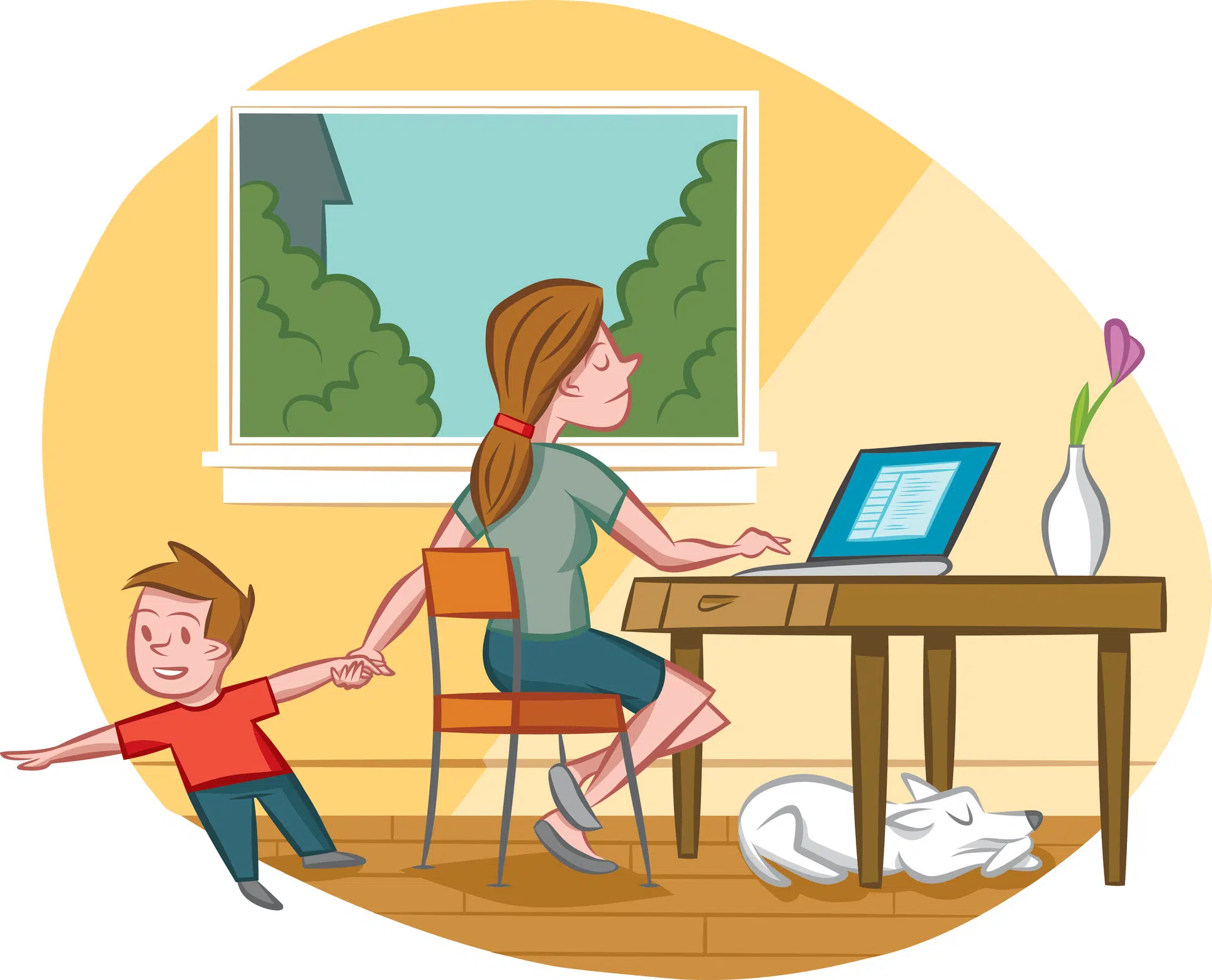
My transition to a work-from-home mom

If You Dream of Being a Work-at-Home Mom, Here's Everything You ...

I had my first baby over 11 years ago (crazy to think of! Time flies!) and ever since, my life has revolved in a large measure around my children.

Until my fourth child was born, I was mostly “just” a stay-at-home mom. Don’t get me wrong – it’s more than a full-time job! Oh, I did get some bits and pieces from my books and articles, but overall, I was more focused on saving money than making it.

My mindset shifted with a prolonged period of financial distress, during which I realized how vulnerable I really was. I knew I needed to have a source of income, but I also knew I wanted to be with my children. Thus I resolved to work from home. But how to achieve this, when I already felt like every spare moment was taken?

Well, I certainly made some lifestyle changes that enabled me to fit part-time work into my mom schedule. Here’s how.

1. I became a lot more careful with my time. Not that I was ever that frivolous, but I did watch the occasional movie with the kids during the day, and I could spontaneously set aside a couple of hours for a whimsical project like picking acorns for crafts.

Now I’m extremely jealous of every spare minute during the day. I am either with my children or working, and any extras (like outings) are strictly pre-planned. I don’t remember when I last watched a movie and I rarely answer the phone, opting to return calls at my convenience instead.

Does this sound too restrictive? It might be, but this schedule has enabled me to generate an income from home while also going on with writing and publishing my books. I think it’s a worthy tradeoff.

2. I sought the niche that works for me. I tried translation, transcription, and a couple of other things, and eventually got into freelance editing and, more recently, writing. If there’s one advice I’d give anyone, it’s this: don’t force yourself to do something you don’t like, even if it pays well. You’ll get burned out very quickly and won’t last.

3. I diversify and work towards creating a scalable income. I don’t concentrate all my work on one platform, but do some on several for a constant cash flow. I also work directly with authors, helping them edit their books.

Finally, even though it’s not easy, I set aside some time for my own books. In the past couple of years, I have been rewarded with a steady trickle of income from this venue, and I hope it will keep growing (book 5 in my Frozen World sci-fi saga coming soon!).

4. I don’t take low-paying gigs anymore. When you just start out, you may have to accept some less-than-lucrative jobs to get some experience under your belt, but take it from me, you don’t want this to last too long. Keep looking about you and angling up to raise your pay rate.

I currently work about 2-3 hours a day, splitting this time between early in the morning before my kids wake up, and a spell of quiet time I usually get around mid-day. I used to work after the kids have gone to bed, but realized I’m not really productive at that time of the day and it’s better to relax and spend some time getting the house in order before I go to sleep so I’ll have a good start the next day.

I don’t make full-time income yet, but that is my goal. Eventually, I want to be able to provide for my family single-handedly, if needed – like in case my husband loses his job again. It gives tremendous peace of mind knowing you have feasible, flexible options to do that – especially during a full-blown worldwide crisis.

Is stability still possible?

financial sustainability

These days, my heart is just breaking. It’s breaking for all the people who have been separated from their families as the skies closed. For all the people who lost their businesses. For the older folks who were active and hardy and kept in good shape, mentally and physically, by going to exercise classes, swimming, and traveling, and are now stuck in their homes, deteriorating by the day and unbearably alone if they have no nuclear family living with them.

It’s heartbreaking that children will have to start school next year burdened with restrictions that are far too heavy for their age, and other children who will be left out without adequate resources for at-home learning.

It seems we are saying a reluctant goodbye to job security, financial security, pension security, any-kind-of-security as stocks are plummeting and pension funds losing value as we speak. I am heartbroken for all the people who lived wisely and made all the right choices, and still find themselves financially (among other ways) vulnerable today.

This was also the core of my latest Mother Earth News post.

“What does this mean? I won’t say anything radical like “money is worthless now” or “ditch the money economy.” I’m a firm believer in personal finances, putting money aside, and planning for the future. 

But I also believe that the coronavirus crisis has shown us that stability, security, and wellbeing depend on much more than money. “

Now is the time to ask ourselves: how self-reliant are we? How prepared are we for another event of extended lockdown and empty store shelves? Do we have barterable skills we can use in lieu of money if the latter loses some of its value? Do we belong to a supportive community of people who can be counted on to help each other out when the you-know-what hits the fan and starts flying in all directions?

Read the rest here.